


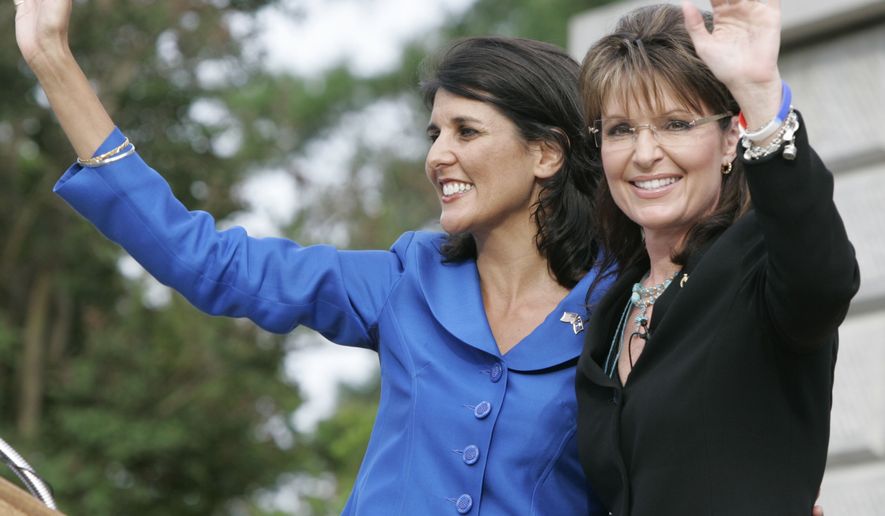

Meet Reshma, Surya, Manan, Raj, Ami, Ravi, Nimrata and Kamala — a new wave of Indian-American politicians.
At least eight children of Indian immigrants are running for Congress or statewide office, the most ever. The star of this trend is Nikki Haley, born Nimrata Nikki Randhawa, who is favored to win the election for governor of South Carolina.
Indian heritage is where Haley’s similarity with the other candidates seems to end. She is the only Republican, the only one who has been widely mistaken for a white woman, the only one who has been accused of abandoning her heritage for converting from the Sikh faith to Christianity.
Yet when Haley’s motives are questioned and some suggest Indians must become less “foreign” to get elected, many of these new candidates are quick to ask: Who are we to judge the mashup of American ambition with an ancient culture?
Manan Trivedi, a doctor and Iraq war veteran who recently won a Democratic primary for Congress in eastern Pennsylvania, said he did not view his ethnicity as a handicap: “The American electorate is smarter than that.”
He called criticism of Haley’s name and religion unfounded. “Nikki Haley and (Republican Louisiana Gov.) Bobby Jindal are on the wrong side, but they worked their butts off, they had the bonafides to get the votes, and I think it had so much more to do with their work ethic than the fact that they may have changed their names and adopted a different religion.”
Jindal was elected the nation’s first Indian governor in 2007, at age 36. Named Piyush at birth, he told his Hindu parents when he was 4 that he wanted to be called Bobby, like the “Brady Bunch” boy. He converted to Catholicism as a teenager.
As Jindal’s star rose, the meaning of his assimilation drew much scrutiny. Many people outside South Carolina only learned Haley is Indian after a fellow South Carolina lawmaker used a racial epithet to describe her. Now her choice of names, marriage to a white man and Methodist conversion is raising similar questions.
Christianity is a more critical issue for white Republicans than other groups — could a Hindu who worships multiple gods, or a turbaned Sikh who doesn’t cut his hair, survive a statewide Republican primary in the Bible Belt?
Vidya Pradhan, editor of India Currents magazine, thinks not.
Haley and Jindal “were really ambitious about their politics, and they could not do it being Hindu or their old religion,” Pradhan said. “I do think it was a political move. They felt that not being a Christian would hurt them.”
Haley and Jindal declined to be interviewed for this story. But J. Ashwin Madia, a Minnesota Democrat who lost a congressional election in 2008 and is a follower of the Jain religion, says their faith is irrelevant.
“They can choose to be called what they want to be called, they can worship what they want to worship,” said Madia, a board member of the Indian American Leadership Initiative, which supports Democratic candidates. “I don’t think being Indian-American is this thing they need to strive for or meet some sort of purity test. They are finding the right balance for themselves.”
Madia stopped using his first name, Jigar, when he joined the Marines about age 22. “I’m not running from something or ashamed of it. I’m proud of my name and where I come from. But I was constantly explaining it or hearing it mangled.”
Barack Hussein Obama, known as Barry in his younger days, proved that an unusual name was not an insurmountable political barrier. Some Indian politicians seem to be following his blueprint as they embrace their Indian names while describing their faith in voters’ lack of bias.
“This campaign is all about vision and values and policies,” said Raj Goyle, who is battling for the Democratic congressional nomination in his hometown of Wichita, Kan. “I don’t spend time thinking about differences, I think about ways that Kansans can come together.”
Goyle worships at an Indian temple. His first name is Rajeev, but he has gone by Raj since childhood. In 2006, he became the first Indian-American elected to the Kansas Legislature and the first Democrat to hold his statehouse district.
He said he doesn’t worry about appearing more American or more Indian. “I am who I am, I’m proud of my background and what I’ve accomplished and my family. Kansas voters absolutely will choose the best candidate based on the merits.”
Indians began immigrating to the United States in large numbers about 50 years ago, but just two have been elected to Congress: Dalip Singh Saund in 1956 and Jindal, who entered Congress in 2004 and became governor midway through his second term.
In 2008, Madia says he was the only major Indian-American candidate for Congress. Today there are six, including Goyle and Trivedi. Ami Bera in California, Ravi Sangisetty in Louisiana and Reshma Saujani in New York face upcoming primaries, and Surya Yalamanchili won a primary in Ohio.
In California, Kamala Harris, the child of an Indian mother and black father, won the Democratic nomination for state attorney general and is favored to win the election this fall. Harris was raised in a black neighborhood, attended black churches and graduated from historically black Howard University. She also worshipped in her mother’s Hindu temple and has made many visits to her family in India.
“Running for office, you have to simplify or condense or put into pre-existing boxes who you are,” Harris said, “so people will have a sense of you based on what they easily and quickly identify.”
“I grew up in a family where I had a strong sense of my culture and who I am, and I never felt insecure about that at all,” she said. “Slowly, perhaps, with each of us taking on more prominent positions, people will start to understand the diversity of the people.”
___
Jesse Washington covers race and ethnicity for The Associated Press. He is reachable at jwashington(at)ap.org.

Please read our comment policy before commenting.