


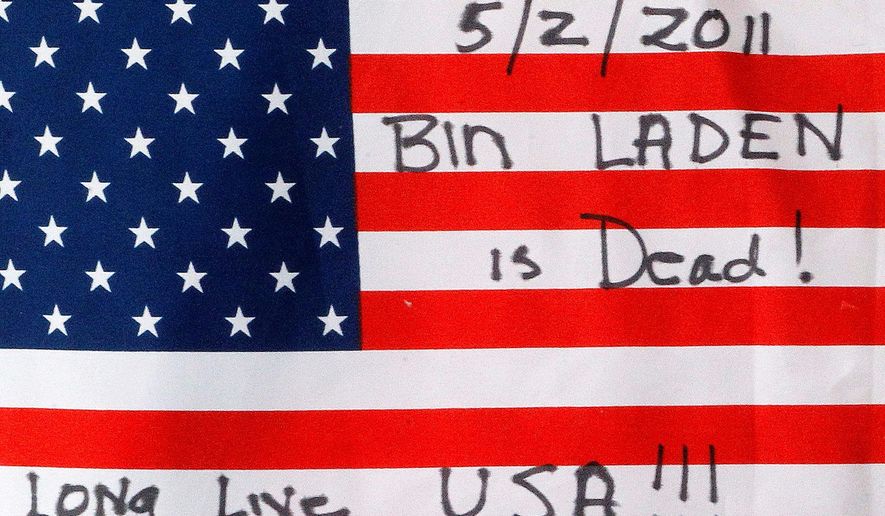

The national security state that has expanded in response to the Sept. 11 attacks will not shrink in the near future, even though al Qaeda’s top leadership has been decimated and the U.S. government faces extreme budget pressures.
When asked last month if the U.S. government could relinquish some of the extraordinary powers or shrink some of the budgets and bureaucracies created to protect Americans since 9/11, Homeland Security Secretary Janet Napolitano gave a one-word response: “No.”
Speaking at a homeland security seminar sponsored by the National Governors Association, Ms. Napolitano elicited nervous laughter with her response. She went on to say that her department defends against multiple threats beyond the ideology of al Qaeda.
“Realistically, we have to say environments change over time, and 9/11 was the signal of a change in the environment that we have to deal with, I think, throughout the foreseeable future,” Ms. Napolitano said.
“What is that change? That change is the threat against the United States motivated by various ideologies, terrorists, other ideologies as well, aimed at trying to commit a crime motivated by that ideology that will have an undue impact on our society, either economically and/or by the number of individuals affected.
“We at the department, we run this assuming that is the environment,” she said. “Then the question is, what are the best things we can do, consistent with American values and privacy.”
Since 9/11, the federal government has created a counterterrorism state unto itself:
• The FBI and the Justice Department have been given broad new authority to subpoena financial records from private companies without a search warrant.
• The National Security Agency (NSA) can wiretap electronic communications between U.S. citizens and foreign nationals without a warrant.
• The military has waged wars in Afghanistan and Iraq under the broader banner of the war on terror. But the U.S. has fought secretive wars all over the world in the past 10 years via drones, special operations forces and close cooperation with foreign intelligence services.
• The annual budget for the U.S. intelligence community has nearly tripled since 2001. Some analysts estimate that the federal, state and local governments have spent nearly $1 trillion on homeland security since the 2001 attacks.
• Major cities have installed full-motion video cameras at traffic lights, and many departments of motor vehicles require facial and iris scans to get a driver’s license. Indeed, the face, iris and fingerprint scan has become the industry standard for government and corporate ID cards.
Though the Obama administration has said much of al Qaeda’s leadership has been killed or captured, no administration official has said when the war on terrorism might end.
Ms. Napolitano is not alone in thinking the national security state will not soon recede.
“I would be hopeful, it would be aspirational where we could get to an environment where that could occur, but I think it’s unlikely,” Tom Ridge, the first homeland security secretary, said in an interview.
“I think there’s this whole notion that there is a belief system, a flawed belief system, an ideology of hate and intolerance that we’ve seen rear itself over the past 20 years, most horrifically on 9/11. So I think it’s unlikely that we are going to see any changes,” he said.
Mr. Ridge helped build and consolidate the bureaucracy that today oversees everything from border security to immigration to coordination of local law enforcement responses to terrorism.
“I can recall the first year there were 180,000 people” in Homeland Security, he said. “I am told today there are 220,000.”
Billions and billions
In his memoir, Richard A. Clarke, the top U.S. bureaucrat in charge of counterterrorism before 9/11, described the budget justifications for homeland security and counterterrorism as a “self-licking ice cream cone.”
The analogy meant that regardless of whether the government’s measures are effective, there is an almost perpetual justification for spending more money for programs designed to fight terrorism.
A scholarly paper released last month noted that nearly $690 billion has been spent on homeland security between 2001 and 2011 by the federal, state and local governments and the private sector.
The paper’s authors - John Mueller, a political scientist at Ohio State University, and Mark G. Stewart, a professor of civil engineering at the University of Newcastle in Australia - estimate another $417 billion has been lost in opportunity costs because of homeland security precautions such as increases in terrorism risk premiums for insurance and delays in air travel.
Mr. Mueller said the chance of a U.S. citizen being killed in a terrorist attack is 1 in 3.5 million. Yet the U.S. government spends more to protect its citizens from those kinds of attacks than more likely risks, such as traffic accidents, he said.
“The threat they are trying to deal with, it’s so limited and the huge expenditures are not cost-effective,” he said in an interview.
In his calculations, Mr. Mueller did not account for foreign wars or the increases in foreign intelligence collection since 9/11.
Steve Aftergood, who is in charge of the U.S. government project on secrecy for the Federation of American Scientists, said the overall annual budgets for the U.S. intelligence community before 9/11 was about $30 billion.
The first broad intelligence community budget number was disclosed in 1998 for the fiscal 1997 budget after Mr. Aftergood’s organization won a Freedom of Information Act lawsuit against the federal government.
For 1997, the overall U.S. intelligence community budget was $26.7 billion. This year, Director of National Intelligence James R. Clapper Jr. disclosed the overall budget to be more than $80 billion.
Extraordinary powers
Many of the programs supported by the increase in intelligence funding remain secret.
But since the 9/11 attacks, the federal government has accumulated a host of new or extraordinary powers in the name of counterterrorism.
One example is the use of what the FBI calls “national security letters,” which are administrative subpoenas for records that do not require probable cause or a warrant signed by a judge.
These letters have been used to obtain phone records from telecommunications companies, websites visited by individuals from Internet service providers and financial records from businesses.
According to the Justice Department’s inspector general, the FBI issued 193,099 such letters from 2003 to 2006.
Restrictions on when the National Security Agency can wiretap or sort through telephone and Internet traffic have also been eased.
In 2005, the New York Times exposed a top-secret program authorized by President Bush aimed at monitoring electronic communications between terrorists abroad and people in the United States.
Though the story and the program elicited strong criticism from many Democrats and others including then-Sen. Barack Obama voted to enshrine those powers into law in 2008 in amendments to the Foreign Intelligence Surveillance Act.
Another example of expanded law enforcement authority is the USA Patriot Act, which was signed into law just six weeks after the 9/11 attacks.
The most significant portions of the law allow the FBI to renew surveillance of individuals even if they switch phones, creating a “roving wiretap” and eliminating an old requirement to ask a court to issue new warrants for new phone numbers.
The legislation also removed a legal wall that separated domestic law enforcement investigations from intelligence-related investigations.
In May, a Wired magazine interview with Sen. Ron Wyden, Oregon Democrat, first disclosed that the federal government has a “secret interpretation” of the Patriot Act.
“I draw a sharp line between the secret interpretation of the law, which I believe is a growing problem, and protecting operations and methods in the intelligence area, which have to be protected,” Mr. Wyden said.
Jameel Jaffer, a senior attorney at the American Civil Liberties Union who litigated the first successful court challenge on the Patriot Act, said he suspects the secret interpretation of the law lets the FBI track the locations of suspects through their cellphones.
“My educated guess is that the FBI is using the Patriot Act to engage in suspicionless location tracking, not just of suspected terrorists, but of innocent people as well,” he said.
In some cases, the courts have shrunk the counterterrorism state. The Supreme Court ordered Congress to write new rules for the military commissions first developed under Mr. Bush.
In 2008, a federal appeals court ordered the FBI to seek court approval for the issuance of national security letters and barred the FBI from ordering the recipients of such letters to uphold a gag order on the request for information.
What’s more, Mr. Obama signed an executive order that closed CIA-run prisons in Europe, but he allowed temporary facilities to remain for the rendition of suspected terrorists to foreign jails and U.S. locations.
Mr. Obama also signed an order to make all U.S.-led interrogations cohere with the U.S. Army Field Manual.
The war on terrorism
In addition to new law enforcement powers at home, the U.S. military and CIA have expanded their missions overseas since 9/11 under legislation known as the Authorization for Use of Military Force enacted just three days after the attacks.
The authorization has been cited as a catchall by attorneys for both the Bush and Obama administrations as the authority for capturing terror suspects overseas, holding them without trial and killing them with remotely piloted aircraft in Somalia, Pakistan, Yemen and other places.
“It has been commonplace in American history that following a national trauma we have restricted rights and given too many powers to the executive,” said Ben Wizner, an attorney with the American Civil Liberties Union.
Mr. Wizner noted that Franklin D. Roosevelt detained Japanese-Americans during World War II and Abraham Lincoln suspended the writ of habeas corpus in some cases during the Civil War.
“With the war on terror, there is a danger that the cyclical pattern of rights restriction and restoration has been broken, and we are moving in one direction only, toward the permanent enshrinement of emergency powers as a new normal,” Mr. Wizner said.
Though Mr. Obama has continued a drawdown of troops in Iraq and announced the end of the troop surge in Afghanistan, his administration has given no signal about amending the Authorization for Use of Military Force.
Meanwhile, Rep. Howard P. “Buck” McKeon, California Republican and chairman of the House Armed Services Committee, is seeking to amend the 2012 defense authorization bill to expand the target of the war on terror to include the Taliban and affiliated groups. The move reflects the broader definition of the war resolution upheld by federal courts under the Bush and Obama administrations.
Former New Jersey Gov. Tom Kean, co-chairman of the National Commission on Terrorist Attacks Upon the United States, said the national security state could recede when Americans feel more secure.
“I think we start to relinquish those powers when we are less afraid, when the threat becomes less than it may still be,” Mr. Kean said in an interview last month. “It’s a very difficult question because people want to be safe.”
But he added that all of the measures taken by the federal government would not be as valuable in preventing attacks as a vigilant citizenry.
“My feeling is that it’s not the federal government that is going to prevent the next attack,” he said. “It’s the citizen. Because if the citizens are still alert and they see something unusual and report it, that’s when we can take action.”

Please read our comment policy before commenting.