
You are currently viewing the printable version of this article, to return to the normal page, please click here.
The Washington Times

Protesters reach palace; Morsi flees

Tensions raise risk of civil war

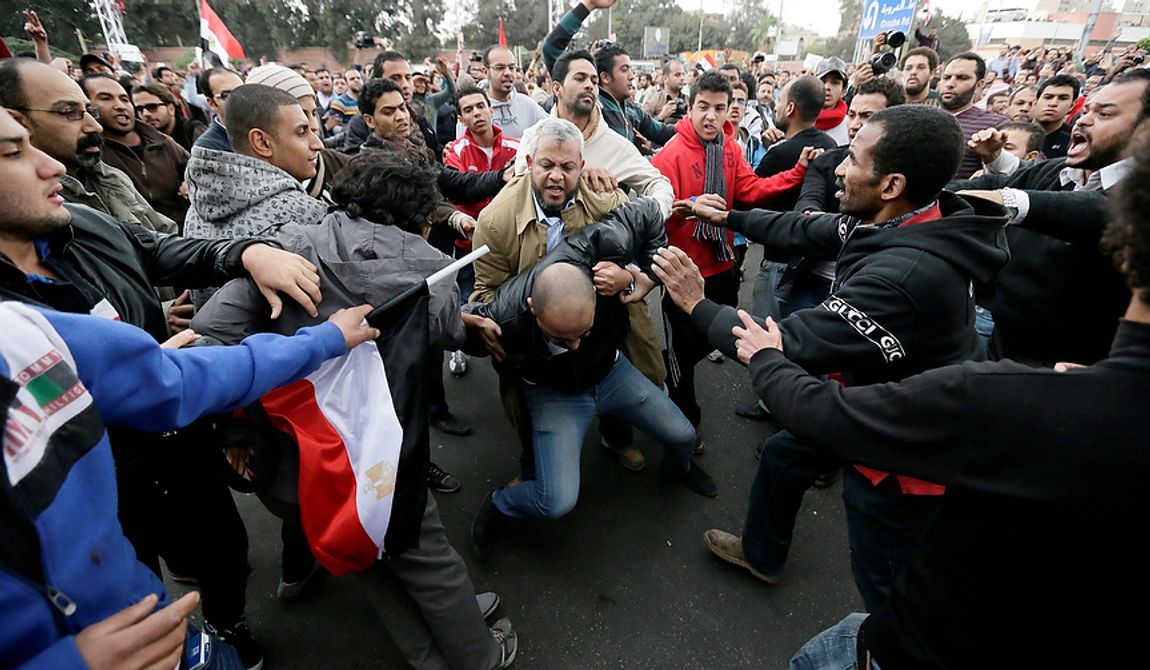
  • Egyptian President Mohammed Morsi's supporters beat an opponent, center, during clashes outside the presidential palace, in Cairo, Egypt, Wednesday, Dec. 5, 2012. Wednesday's clashes began when thousands of Islamist supporters of Morsi descended on the area around the palace where some 300 of his opponents were staging a sit-in. (AP Photo/Hassan Ammar)Egyptian President Mohammed Morsi's supporters beat an opponent, center, during clashes outside the presidential palace, in Cairo, Egypt, Wednesday, Dec. 5, 2012. Wednesday's clashes began when thousands of Islamist supporters of Morsi descended on the area around the palace where some 300 of his opponents were staging a sit-in. (AP Photo/Hassan Ammar)
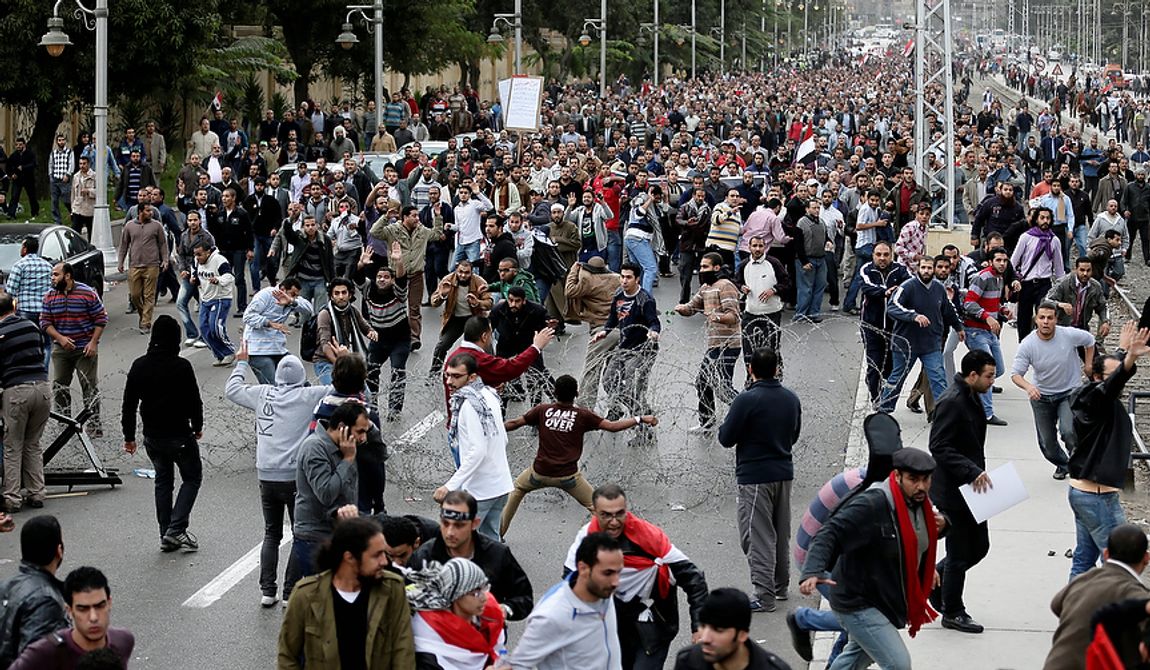
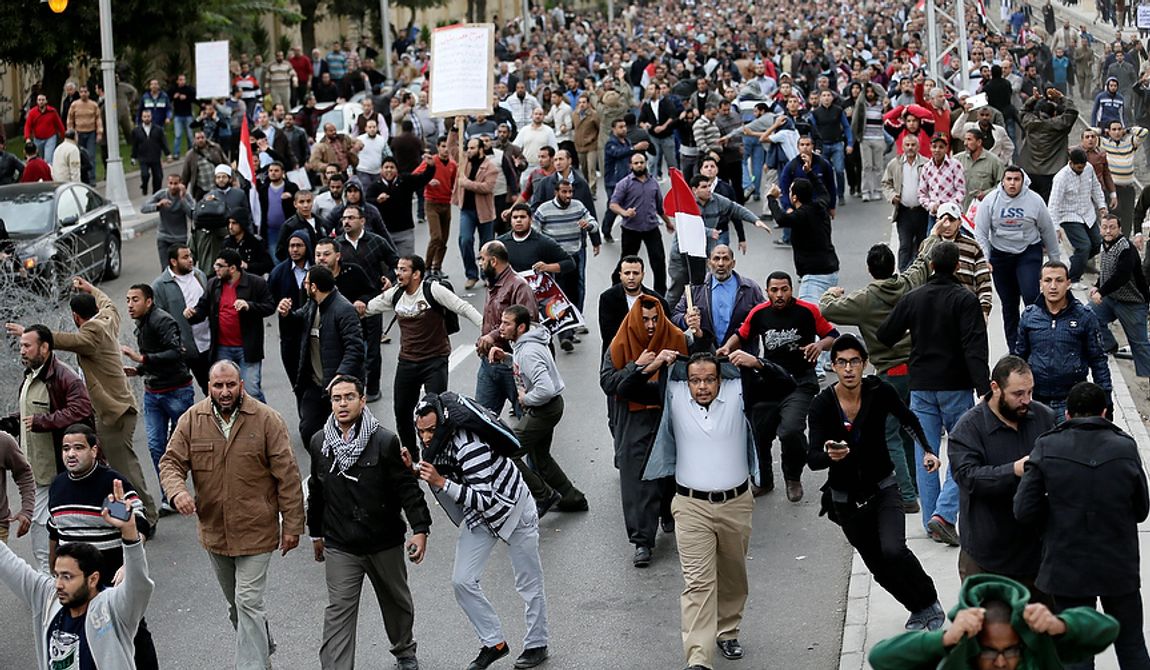
  • Egyptian President Mohammed Morsi's supporters, background, clash with opponents, foreground, outside the presidential palace, in Cairo, Egypt, Wednesday, Dec. 5, 2012. Wednesday's clashes began when thousands of Islamist supporters of Morsi descended on the area around the palace where some 300 of his opponents were staging a sit-in. (AP Photo/Hassan Ammar)Egyptian President Mohammed Morsi's supporters, background, clash with opponents, foreground, outside the presidential palace, in Cairo, Egypt, Wednesday, Dec. 5, 2012. Wednesday's clashes began when thousands of Islamist supporters of Morsi descended on the area around the palace where some 300 of his opponents were staging a sit-in. (AP Photo/Hassan Ammar)
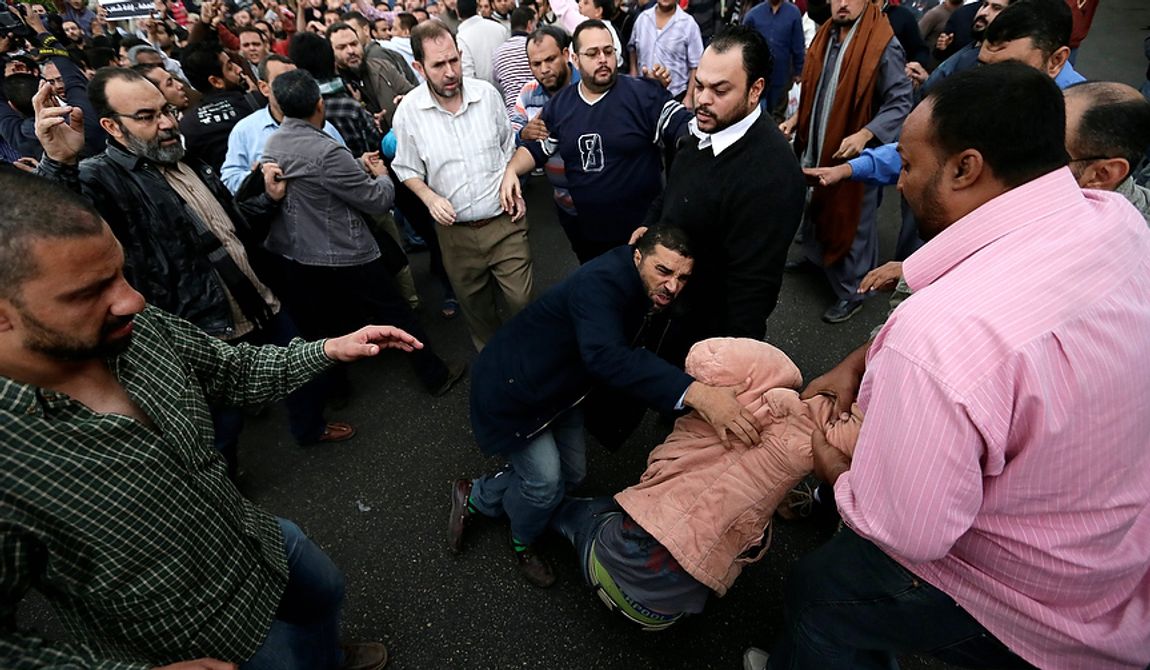
  • Egyptian President Mohammed Morsi's supporters try to detain an opposition protester during clashes outside the presidential palace, in Cairo, Egypt, Wednesday, Dec. 5, 2012. Wednesday's clashes began when thousands of Islamist supporters of Morsi descended on the area around the palace where some 300 of his opponents were staging a sit-in. (AP Photo/Hassan Ammar)Egyptian President Mohammed Morsi's supporters try to detain an opposition protester during clashes outside the presidential palace, in Cairo, Egypt, Wednesday, Dec. 5, 2012. Wednesday's clashes began when thousands of Islamist supporters of Morsi descended on the area around the palace where some 300 of his opponents were staging a sit-in. (AP Photo/Hassan Ammar)
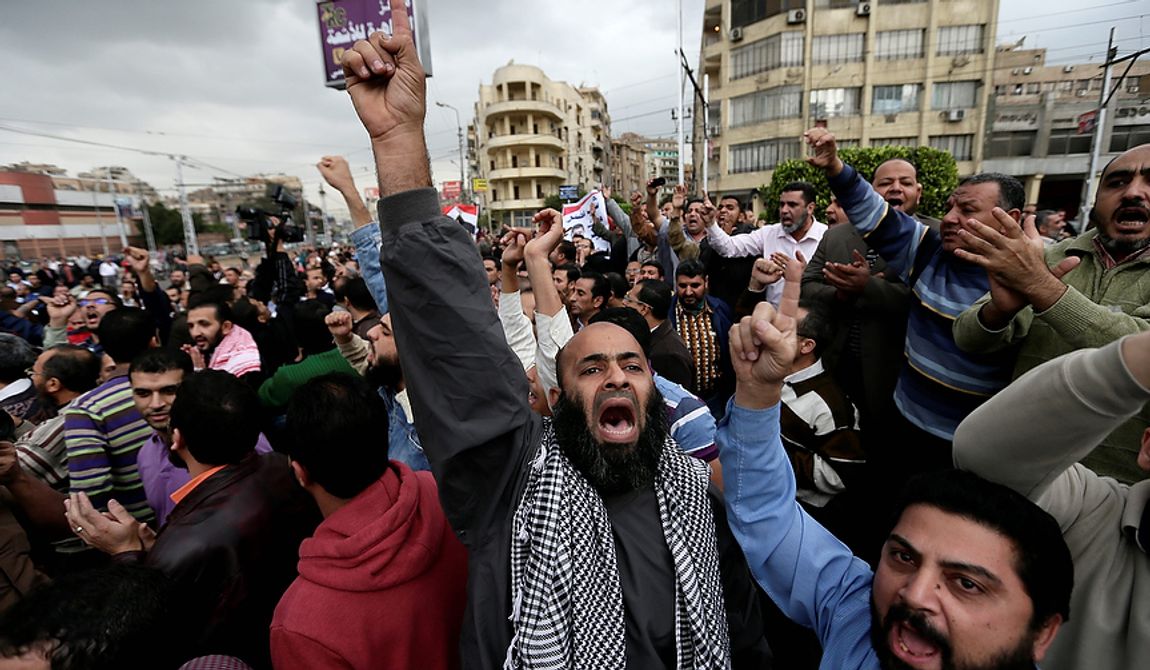
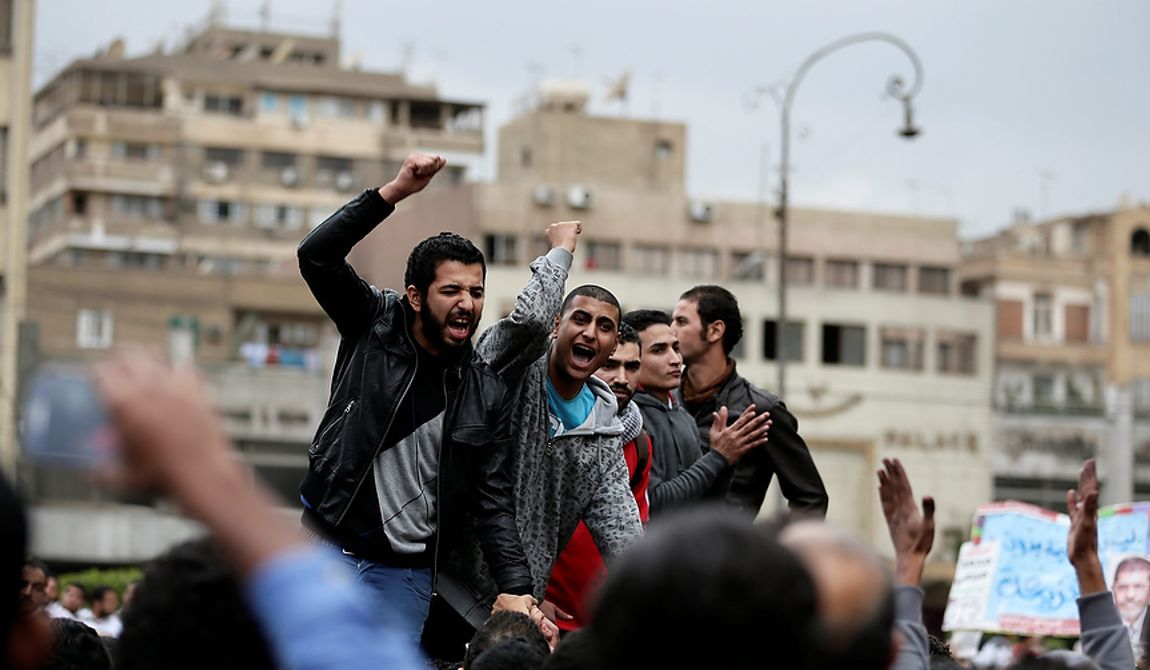
  • A supporter of Egyptian President Mohammed Morsi chants slogans during clashes with opponents, not pictured, outside the presidential palace, in Cairo, Egypt, Wednesday, Dec. 5, 2012.  (AP Photo/Hassan Ammar)A supporter of Egyptian President Mohammed Morsi chants slogans during clashes with opponents, not pictured, outside the presidential palace, in Cairo, Egypt, Wednesday, Dec. 5, 2012. (AP Photo/Hassan Ammar)
  • Egyptian President Mohammed Morsi's supporters clash with opponents, not pictured, outside the presidential palace, in Cairo, Egypt, Wednesday, Dec. 5, 2012.  (AP Photo/Hassan Ammar)Egyptian President Mohammed Morsi's supporters clash with opponents, not pictured, outside the presidential palace, in Cairo, Egypt, Wednesday, Dec. 5, 2012. (AP Photo/Hassan Ammar)
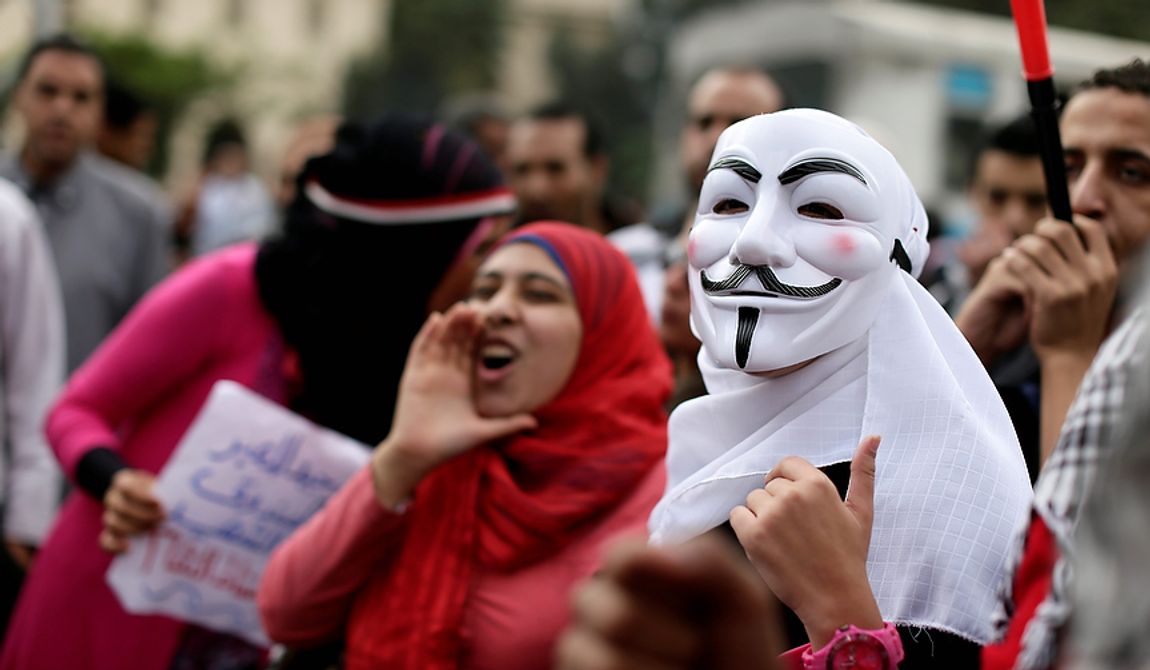
  • Egyptian protesters chant anti Muslim Brotherhood slogans outside the presidential palace, in Cairo, Egypt, Wednesday, Dec. 5, 2012. Supporters of President Mohammed Morsi and opponents clashed outside the presidential palace.  (AP Photo/Hassan Ammar)Egyptian protesters chant anti Muslim Brotherhood slogans outside the presidential palace, in Cairo, Egypt, Wednesday, Dec. 5, 2012. Supporters of President Mohammed Morsi and opponents clashed outside the presidential palace. (AP Photo/Hassan Ammar)
  • Egyptian protesters chant anti Muslim Brotherhood slogans during a demonstration outside the presidential palace, in Cairo, Egypt, Wednesday, Dec. 5, 2012. Egyptian  (AP Photo/Hassan Ammar)Egyptian protesters chant anti Muslim Brotherhood slogans during a demonstration outside the presidential palace, in Cairo, Egypt, Wednesday, Dec. 5, 2012. Egyptian (AP Photo/Hassan Ammar)
  • Egyptian protesters chant slogans against the Muslim Brotherhood during a rally Dec. 4, 2012, in front of the presidential palace in Cairo. (Associated Press)Egyptian protesters chant slogans against the Muslim Brotherhood during a rally Dec. 4, 2012, in front of the presidential palace in Cairo. (Associated Press)
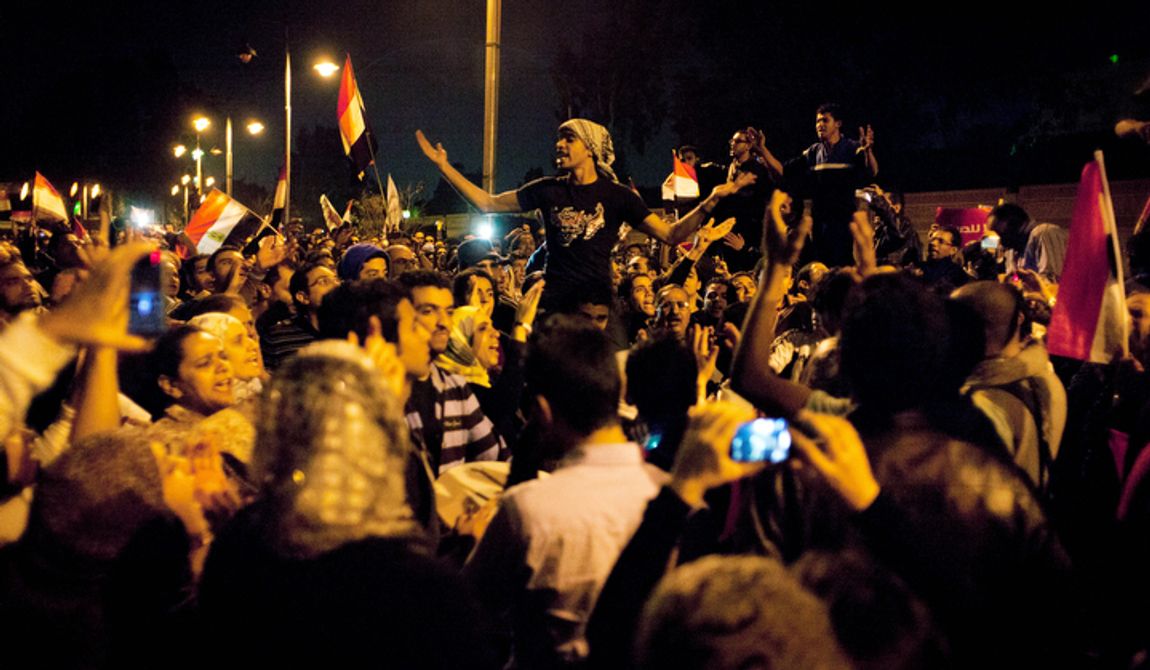
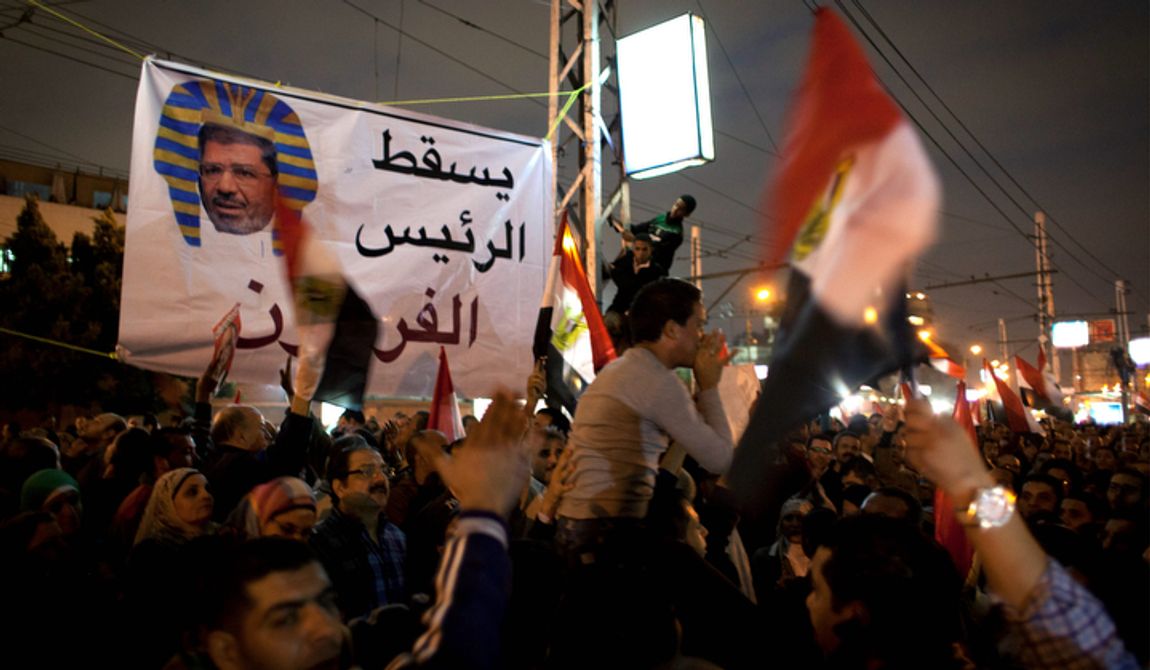
  • Egyptian protesters carry national flags and chant slogans against the Muslim Brotherhood during a rally Dec. 4, 2012, in front of the presidential palace in Cairo. Tensions grew over Islamist President Mohammed Morsi's seizure of nearly unrestricted powers and a draft constitution hurriedly adopted by his allies. Arabic on the banner reads, "down with the pharaoh president." (Associated Press)Egyptian protesters carry national flags and chant slogans against the Muslim Brotherhood during a rally Dec. 4, 2012, in front of the presidential palace in Cairo. Tensions grew over Islamist President Mohammed Morsi's seizure of nearly unrestricted powers and a draft constitution hurriedly adopted by his allies. Arabic on the banner reads, "down with the pharaoh president." (Associated Press)
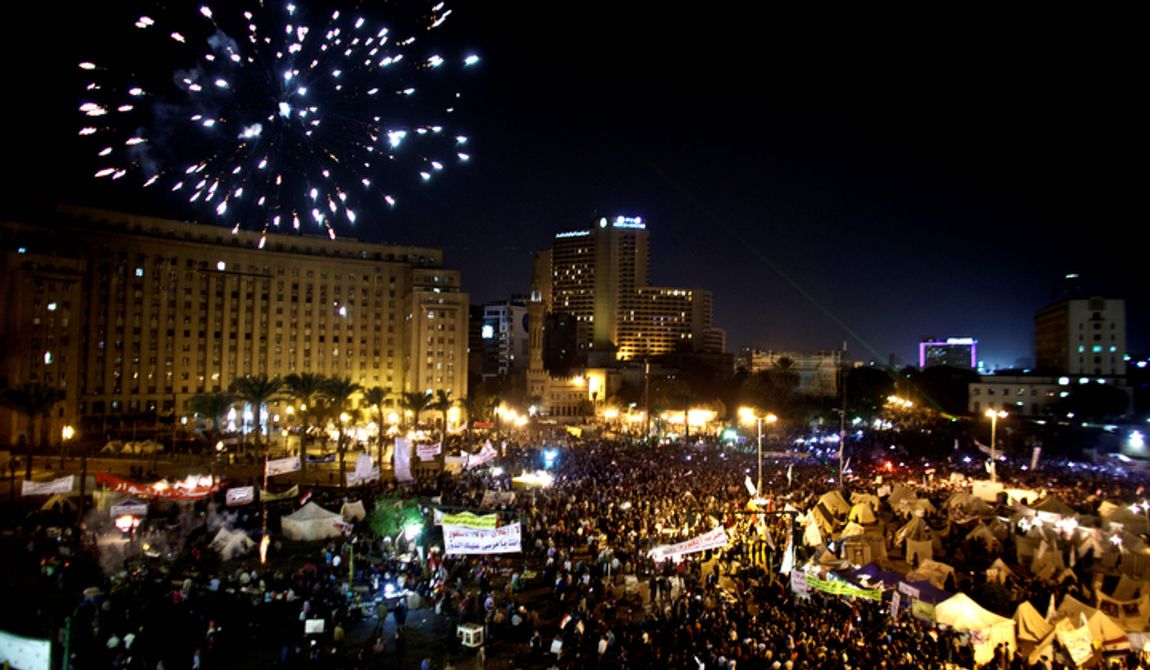
  • Fireworks burst over Tahrir Square as protesters gather in Cairo on Dec. 4, 2012. Demonstrations by tens of thousands of Egyptians outside the presidential palace turned violent as tensions grew over Islamist President Mohammed Morsi's seizure of nearly unrestricted powers. Thousands of protesters also gathered in Cairo's downtown Tahrir Square, miles away from the palace, to join several hundred who have been camping out there for nearly two weeks. (Associated Press)Fireworks burst over Tahrir Square as protesters gather in Cairo on Dec. 4, 2012. Demonstrations by tens of thousands of Egyptians outside the presidential palace turned violent as tensions grew over Islamist President Mohammed Morsi's seizure of nearly unrestricted powers. Thousands of protesters also gathered in Cairo's downtown Tahrir Square, miles away from the palace, to join several hundred who have been camping out there for nearly two weeks. (Associated Press)
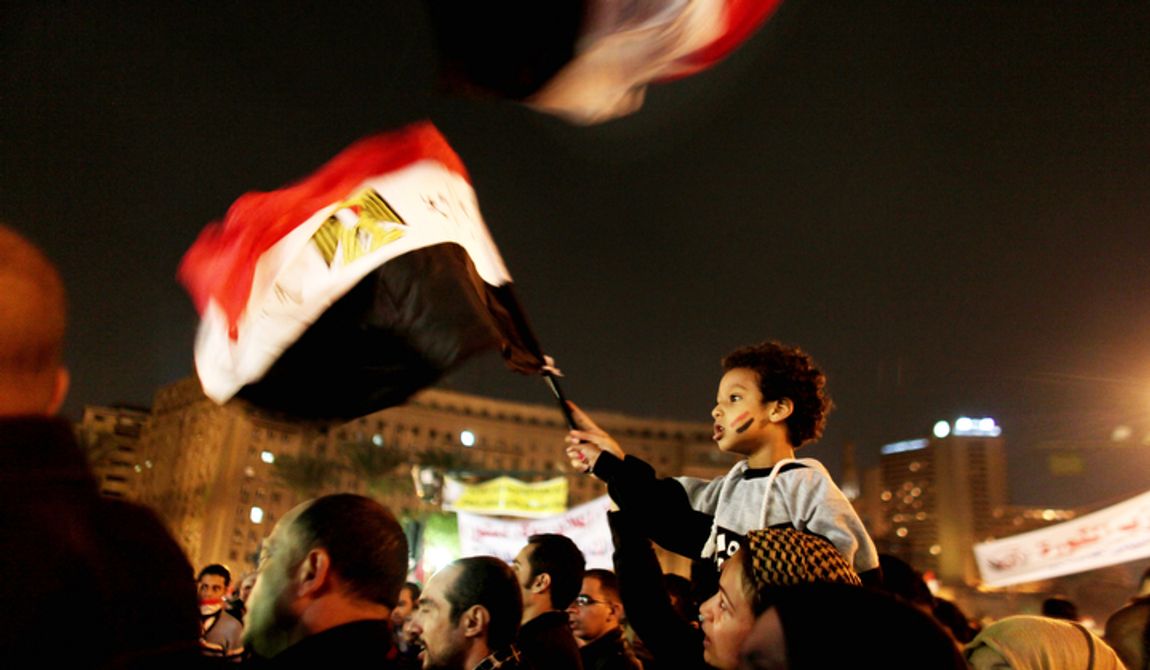
  • An Egyptian boy atop his mother’s shoulders waves a national flag in Tahrir Square in Cairo, where several hundred demonstrators have been camping for two weeks. (Associated Press)
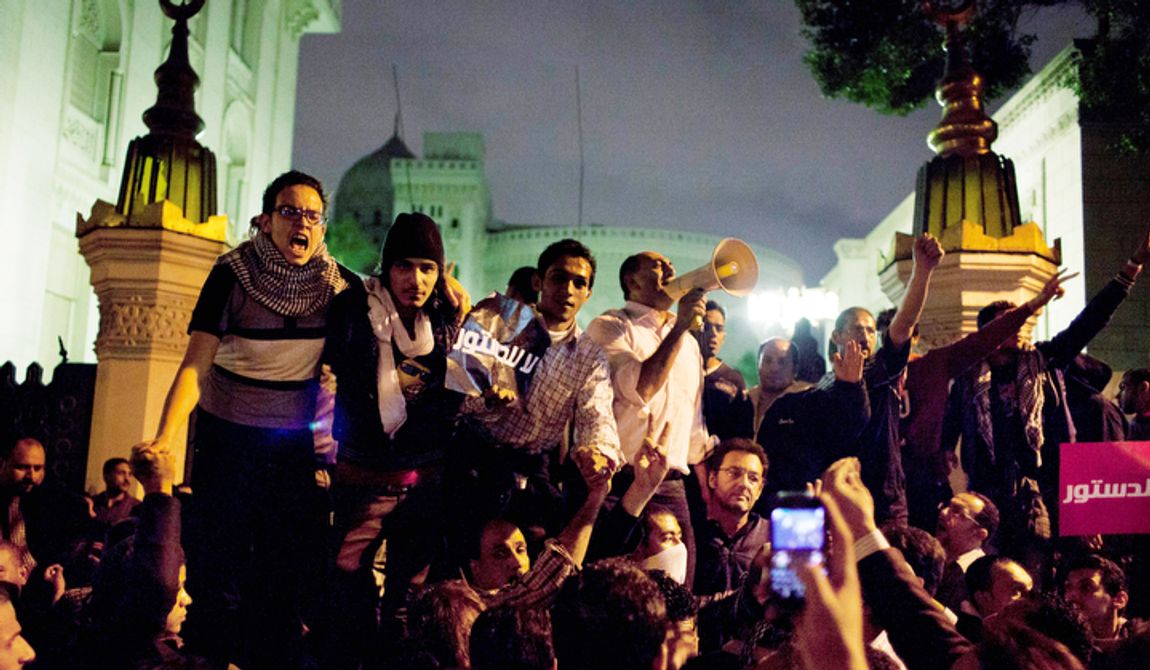
  • Egyptian protesters chant slogans against the Muslim Brotherhood during a rally Dec. 4, 2012, in front of the main gate of the presidential palace in Cairo. (Associated Press)Egyptian protesters chant slogans against the Muslim Brotherhood during a rally Dec. 4, 2012, in front of the main gate of the presidential palace in Cairo. (Associated Press)

CAIRO — Egypt's Islamist president fled his palace by the back door Tuesday as riot police used clubs and tear gas to battle thousands of demonstrators protesting his seizure of broad powers that enabled him to push through a draft constitution.

Protesters proclaimed the march on the presidential residence in Cairo a "last warning" to President Mohammed Morsi. They shouted, "We want the downfall of the regime" and "leave, leave," echoing chants used against authoritarian President Hosni Mubarak, who was ousted in February 2011.

Observers feared for the stability of Egypt after more than 10 days of demonstrations by opponents and supporters of Mr. Morsi's Muslim Brotherhood government.

"What we are seeing now is an escalation by both camps, who are both going for broke," said Fawaz A. Gerges, director of the Middle East Center at the London School of Economics.

"This is very dangerous because Egypt is descending into a potential civil war."

Protesters cut through a barbed-wire barrier several hundred yards from the palace before police fired tear gas at the demonstrators. The police then retreated, allowing the protesters to reach the palace walls. It was the first time since Mr. Morsi took office in June that his government has used violence against civilians.

Demonstrators demanded the withdrawal of a draft constitution passed hurriedly Friday and slated for a national referendum Dec. 15, as well as the cancellation of the Nov. 22 presidential decrees giving Mr. Morsi nearly limitless power.

The decrees also shield his office, the committee that drafted the proposed constitution and the upper house of parliament from the courts.

On Friday, the Muslim Brotherhood-dominated Constituent Assembly rushed through a draft constitution without participation of the secular opposition or Coptic Christians, who began boycotting the assembly last month. They accused the Islamists of forcing through a charter that fails to protect free speech and the rights of women and minorities and gives too much power to religious clerics to interpret law.

"Morsi's policies represent dictatorship," said Ali Ziad, 21. The student said he voted for Mr. Morsi because he "represented the revolution" that overthrew Mr. Mubarak.

Now he opposes the president.

"The people will not agree to it because there is no respect for the law," Mr. Ziad said of Mr. Morsi's power grab.

Others say Mr. Morsi was forced to take action to move the country forward in its political transition.

"I hope people would give him time. It's been only five months," said Huda Mohammad, 30, calling the anti-Morsi protesters "thugs."

"We need to give him the chance to be able to live in stability."

On Sunday, Mr. Morsi's supporters from the Muslim Brotherhood protested at the Supreme Constitutional Court, where the high court judges were to rule on the legality of the Constituent Assembly and the draft constitution.

Judges said the protests prevented them from entering the courthouse.

The Supreme Constitutional Court judges suspended their work and joined other members of the judiciary who went on strike last week. On Tuesday, a few high court judges said they would oversee the referendum, as the courts are required to do under Egyptian law.

Mr. Morsi continued to discuss preparations for the referendum with his Cabinet while as many as 12 newspapers, most independent, went on strike to protest the draft constitution's limitations on freedom. Some private broadcasters announced that they would shut off their programming Wednesday to support the protests against Mr. Morsi.

Analysts predicted the opposition, more united than before, will boycott the Dec. 15 referendum, which would further undermine the charter's legitimacy and create more divisions within society.

"It's difficult to see how the opposition can participate in the referendum given that it is so opposed to the draft constitution," said David Hartwell, a Middle East analyst at IHS Jane's security analysts in London.

"There is a very real prospect of a boycott, which will lead to greater division. We'll see how it pans out over the next week or two, but I don't see it being resolved quickly."

Mr. Gerges blamed the instability on Mr. Morsi.

"President Morsi was responsible for triggering the current crisis by [trying to make himself] supreme leader and to have absolute power. He didn't even consult with his closest advisers prior to carrying out the decree," he said. "He has chosen to escalate the confrontation."

Some Cairo residents say they just want things to calm down.

"Nobody cares about this country. Everybody is looking after their own interests," said Nada Seliem, 23, a medical student in Cairo.

"We live in such a state of confusion — and I'm confused. I'm thinking to boycott the referendum because I'm not sure if I should vote yes or no."

Jabeen Bhatti reported from Berlin. Naomi Westland in London and Louise Osborne in Berlin contributed to this article, which is based in part on wire service reports.

Comments
blog comments powered by Disqus

      Independent voices from the TWT Communities

      Sharp Pearson Thoughts

      Politics and pop culture from the perspective of an independent hip-hop conservative

      Red Pill, Blue Pill

      Al Maurer provides a common sense, conservatarian, Constitutional conservative perspective from the battleground state of Colorado