


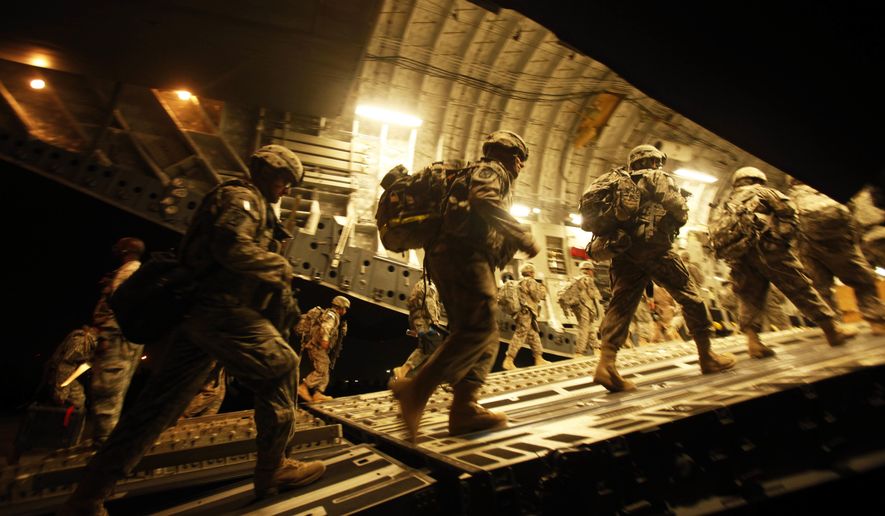

BAGHDAD (AP) — Iraq’s prime minister said Saturday that U.S. troops are leaving Iraq after nearly nine years of war because Baghdad rejected American demands that any U.S. military forces to stay would have to be shielded from prosecution or lawsuits.
The comments by Nouri al-Maliki, a Shiite, made clear that it was Iraq who refused to let the U.S. military remain under the Americans’ terms.
A day earlier, President Barack Obama had hailed the troops’ withdrawal as the result of his commitment — promised shortly after taking office in 2009 — to end the war that he once described as “dumb.”
“When the Americans asked for immunity, the Iraqi side answered that it was not possible,” al-Maliki told reporters in Baghdad. “The discussions over the number of trainers and the place of training stopped. Now that the issue of immunity was decided and that no immunity to be given, the withdrawal has started.”
Nearly 40,000 U.S. troops remain in Iraq, all of whom will withdraw by Dec. 31 — a deadline set in a 2008 security agreement between Baghdad and Washington.
But continued violence across Iraq, coupled with growing influence by the Shiite power Iran over the government in Baghdad, prompted the Obama administration earlier this year to push to keep thousands of U.S. troops here for years to come. The two nations negotiated for months over whether U.S. forces should stay — a politically delicate issue for Obama and al-Maliki, both of whom faced widespread opposition from their respective publics to continue a war that was never popular in either nation.
U.S. officials, from Obama to Defense Secretary Leon Panetta and Secretary of State Hillary Rodham Clinton, stressed that Washington will continue to have a strong diplomatic relationship with Baghdad despite the absence of military forces to help guide Iraq to stability.
Washington has long worried that Iranian meddling in Iraq could inflame Sunni tensions with Iraq’s Shiite-led government and set off a chain reaction of violence and disputes across the Mideast.
In an interview released Saturday, Iranian President Mahmoud Ahmadinejad said that Tehran has “a very good relationship” with Iraq’s government, and that this relationship will continue to grow.
“We have deepened our ties day by day,” Ahmadinejad said in an interview broadcast Saturday with CNN’s Fareed Zakaria.
Al-Maliki told reporters he still wants American help in training Iraqi forces to use billions of dollars worth of military equipment that Baghdad is buying from the United States. He did not say if the prospective U.S. trainers would be active-duty troops, and said any immunity deals for them would have to be worked out in the future.
About 160 U.S. troops will remain at the U.S. Embassy in Baghdad to help oversee training plans — a duty that is common at most American diplomatic posts worldwide.
Michael O’Hanlon, an expert at the Brookings Institution in Washington said continued violence in Iraq was always a threat, whether or not U.S. troops remain.
“But it’s true that their frequency may increase absent U.S. help in areas of intelligence and special operations,” said O’Hanlon, who was among a group of Bush administration officials and academics who called on Obama to keep a robust U.S. force in Iraq. “In addition, I do fear the residual risk of civil war goes up with this decision, as the north in particular will become more fraught.”
___
Associated Press Writers Bushra Juhi and Sameer N. Yacoub contributed to this report.


Please read our comment policy before commenting.