


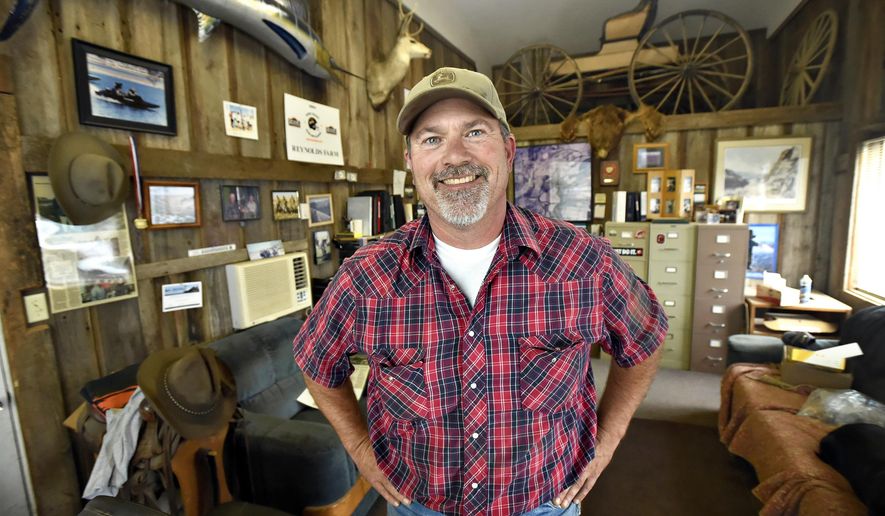

CORVALLIS, Ore. (AP) - For Kenny Reynolds, history is never far away.
In his office at Reynolds Farms, the walls are paneled in recycled barn wood. A buckboard from his great-grandfather’s livery stable looks down from the loft, and a pair of great-grandpa’s chaps hang from a peg in the corner, alongside his dad’s Filson chore coat and battered Stetson.
Growing up on the farm, which runs along either side of Highway 20 a few miles northeast of the Corvallis city limits, Reynolds was raised on a steady diet of family history served up by his grandmother Minerva Kiger Reynolds. The tale has a lot of twists and turns, and hearing it today can make a listener marvel that the family still has any land left to farm.
It’s a story that goes back to the mid-1800s, when Reynolds’ great-great-grandfather Daniel Morgan came west over the Oregon Trail to build a new life with his young family in the Willamette Valley. Morgan arrived in what is now Benton County in 1848, but he paid a terrible price for the journey: His wife, Rebecca, died on the way, along with the couple’s youngest child.
“He showed up in the valley with three kids and a widower,” Reynolds said. “What he did is he married the daughter of one of the other people on the wagon train.”
Along with his new wife, Mary, Daniel Morgan homesteaded a donation land claim in 1849 and began the backbreaking work of carving a farm out of the wilderness. But by 1850 - a little over a year after crossing the continent in a covered wagon - Daniel, too, was dead.
“There’s two stories in the family about that,” Reynolds said. “One is that he was killed by some of the original settlers of the area, what we’d call Native Americans today. The other is that he keeled over digging a well.”
Researching the family’s background on the Internet, Reynolds came across a third explanation: According to one website, his ancestor died of “consumption,” an old-fashioned term for tuberculosis.
With a family to feed and faced with the prospect of losing the homestead, Mary Morgan found a new husband.
“Mary married John Sylvester, and they proved up on the claim,” Reynolds said. “I’ve got the document - or a copy of the document - signed by Ulysses S. Grant.”
Their daughter, Dollie Morgan Sylvester, married an enterprising young man named Reuben Kiger, who owned a local livery stable.
In the 1870s Kiger sold his livery business and moved with his wife to southeastern Oregon, where they homesteaded a canyon on the slopes of Steens Mountain that became known as Kiger Gorge. The couple prospered in the new location until the Bannock Indian War of 1878. The conflict briefly forced them to flee their homestead, and although the U.S. Cavalry quickly restored order, it had been a little too close for comfort.
As Reynolds tells the tale, “Dollie sees one of the Indian women wearing one of her dresses and says, ’That’s it - we’re done.’”
The couple sold their Kiger Gorge holdings to cattle baron Pete French and returned to Benton County to buy more land, including a spread south of Corvallis on what’s now known as Kiger Island.
When Reuben Kiger died around the turn of the century, he and Dollie still owned the original 1,100-acre donation land claim north of Corvallis plus several hundred acres on Kiger Island. In his will, he divided the property among his two sons, Dick and John, and his widow, who was still raising their daughter, Minerva.
According to Reynolds, his great-uncles Dick and John may have played a little fast and loose with their inheritance.
“They both were pretty good at singing, at fishing and, apparently, pretty good at drinking,” he said.
John Kiger’s ultimate downfall may have been gambling, which is reputed to have cost him the Kiger Island farm in the early 1900s.
“John lost the place,” Reynolds said, “and the rumor is he lost it in a poker game.”
That left the old homestead along Highway 20, which at that point was split between Dick and Dollie. But Dick’s financial situation was precarious, according to Reynolds, and he was in danger of losing his share of the old home place when he died; it only stayed in the family after his widow got remarried to a man of means.
Eventually the two properties were united again under the ownership of Reynolds’ grandfather, Jay Reynolds, who had met Minerva Kiger at Oregon Agricultural College (the forerunner of Oregon State University). He graduated in 1910, she in 1912.
Like so many other farm families, they struggled through the Great Depression, selling off portions of their land to survive. But they hung on, and the family’s fortunes eventually improved. The couple’s son, Ed, studied agriculture at Oregon State College after serving in the Navy during World War II. The farm prospered under his management, and he used his veteran’s loans to buy back some of the land the family had lost.
Before Ed died in 2008, the family farm passed to Kenny. Today Reynolds and his wife, Heidi, raise grass seed and grain, vegetables and meadowfoam on about 800 acres in the same stretch of Willamette River bottomland that Daniel and Mary Morgan homesteaded more than a century and a half ago. They’ve also raised three kids there. Cole, 22, is a junior at OSU. Luke, 18, is a freshman at Santa Barbara City College in California. And Megan, 15, is a sophomore at Crescent Valley High School.
All three of Reynolds’ children have grown up hearing the old family stories he heard from his grandmother, and he hopes he’s been able to impart some sense of the local history that is their legacy. He also hopes at least one of them will be ready to take over Reynolds Farms when it’s time for him to retire.
“We go back to 1849, which is pretty good. It’s a huge sense of pride,” Reynolds said.
“I’m proud of the fact that my granddad held onto the farm through the Depression and two world wars.
“My dad came in and the farm was nothing, and he built it up. I’m proud of the fact that I was able to stand on his shoulders.
“Now I’m waiting to see what the kids are going to do - waiting to see if there’s going to be another generation.”
___
Information from: Gazette-Times, https://www.gtconnect.com

Please read our comment policy before commenting.