



ANALYSIS:
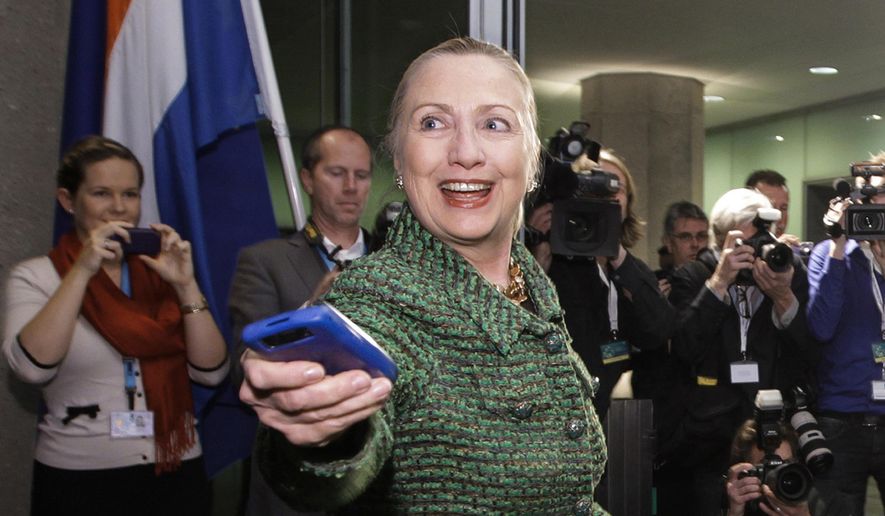
Hillary Clinton’s chief defense of her email behavior is that she tried to forward her messages so they were captured by the State Department — but a Washington Times analysis found she clearly did that only a quarter of the time when she was corresponding with someone outside the department.
More often than not, when Mrs. Clinton was exchanging thoughts or policy memos with outsiders, their correspondence ended up in the digital black hole of her secret email system and were never forwarded to anyone else in the State Department.
Although dozens of her top aides knew about her private email, they kept it secret from the State Department office charged with handling open records requests, meaning those staffers didn’t know how to find her messages — effectively shielding them from public view for nearly six years.
Mrs. Clinton, who is now the top candidate for the Democratic presidential nomination, has said it was a mistake to use the secret system, but she and her defenders say she made a point of trying to email other people on official state.gov addresses, figuring the messages would at least be stored by the government, which would fulfill her legal obligations as secretary of state.
“More than 90 percent of her work-related emails ought to have been preserved in the State Department from the beginning because she either copied, or corresponded with, a staff person using a state.gov account,” Brian Fallon, Mrs. Clinton’s spokesman, told The Times.
SEE ALSO: Hillary Clinton to attack Donald Trump on foreign policy
The Times’ analysis also confirmed that to be the case for her messages overall: A random sample from the more than 8,000 messages Mrs. Clinton sent showed that 89 percent of them involved a state.gov account.
But when it came to Mrs. Clinton’s communications with those outside the department, she stumbled — badly.
An analysis of 200 messages Mrs. Clinton sent to outsiders found only 51 that were clearly forwarded to a state.gov account, another 131 that were not forwarded, and the rest were unclear, based on the addresses involved.
Mr. Fallon questioned The Times’ sample and said the findings were “inaccurate.”
Messages Mrs. Clinton exchanged with outsiders, and which never got captured in the State Department system, included correspondence with U.S. senators, top White House officials and special advisers.
One message that she sent to a private email account with the subject line “SYRIA TODAY (SUNDAY 7/22)” was later labeled by the State Department as classified because it contained foreign relations or foreign activities of the United States, including confidential sources.
SEE ALSO: Hillary Clinton’s Wall Street speech transcripts an issue for majority of voters: poll
In another exchange that wasn’t forwarded to the State Department, Mrs. Clinton and Sen. Barbara A. Mikulski chatted about progress toward expanding the visa waiver system, an issue that the senator described as “so important to Poland and other allies.”
“If anyone can finally get visa waiver done for our Polish friends — who now live a few doors from me! — it’s you, my friend,” Mrs. Clinton told the Maryland Democrat with strong ties to the Polish community in Baltimore.
The State Department’s inspector general, in a report sent to Congress last week, concluded that Mrs. Clinton’s email practices violated several department rules. She did not take steps to ensure her messages were being stored, she never got approval for her use of a secret server, and she failed to report to the department when hackers attempted to access her server.
Mrs. Clinton and her aides refused to cooperate with the inspector general’s probe, but several of the aides are being forced to testify under oath in a lawsuit seeking to get to the bottom of how the department bungled its handling of her email.
In deposition testimony released Tuesday, Cheryl Mills, Mrs. Clinton’s chief of staff at the department, insisted she never bothered to check up on things because she was convinced Mrs. Clinton was always sending messages to others within the State Department.
“It was my impression that when she emailed, because it was her practice to email people on their State accounts when she was doing State business, that any of those communications would be captured and maintained by the State Department system,” Ms. Mills testified.
That turned out to be wrong. The State Department system did not capture all messages sent to a state.gov account, further undercutting efforts to meet open records obligations.
Ms. Mills said she never “reflected on” whether there were outsiders Mrs. Clinton was also sending messages to that should have been stored as official records.
“I wish I had thought about that subset,” she said. “I wish I had thought about the fact that someone could be nongovernment, non-State, and those records might be not being captured. I didn’t think about that.”
Among those outsiders Mrs. Clinton messaged were unofficial adviser Sidney Blumenthal, White House Deputy National Security Adviser Thomas E. Donilon, Special Adviser on Middle East Policy Dennis B. Ross and then-Sen. John F. Kerry, who was chairman of the Senate Foreign Relations Committee and later succeeded Mrs. Clinton as secretary of state.
Mrs. Clinton often forwarded information sent to her by Mr. Blumenthal, a longtime Clinton confidant, to an aide to be printed. But Mrs. Clinton’s own replies back to Mr. Blumenthal were generally not forwarded, meaning they would not have been captured by the state.gov system.
When Mr. Blumenthal sent recommendations for handling the photographs of the deceased Osama bin Laden, Mrs. Clinton forwarded it to the State Department account of top aide Jacob Sullivan.
However, her reply to Mr. Blumenthal was not forwarded, and the State Department later redacted her reply as part of the administration’s “deliberative process,” which is a clear indication that the State Department needed to retain the message.
Mrs. Clinton also regularly emailed her State Department underlings at their own personal accounts. In the case of Ms. Mills, Mrs. Clinton also would usually email her at both her personal and state.gov accounts.
But on a number of occasions Mrs. Clinton forwarded messages from outsiders to underlings at their own personal email addresses, asking them to print the original correspondence.
In a deposition last month, Lewis A. Lukens, who was deputy executive secretary at the State Department during part of Mrs. Clinton’s time in office, said when traveling overseas, it was difficult to print from official state.gov accounts, and “you couldn’t print” at all from a BlackBerry — the tool Mrs. Clinton used to access her email.
Mr. Lukens said employees usually would forward messages to a personal account to be printed.
Mrs. Clinton’s unique email setup, operated via a private server in her home in Chappaqua, New York, shielded her from Freedom of Information Act requests for nearly six years. Only after pressure from the congressional committee investigating the deadly 2012 terrorist attack in Benghazi, Libya, did Mrs. Clinton turn over the 30,000 messages to the department in December 2014, nearly two years after she had left office.
The emails between outside accounts included two to Chicago Mayor Rahm Emanuel, who previously had served as President Obama’s chief of staff.
The content of the emails are not always heavy on policy.
The exchange with Mr. Emanuel involved him asking, and her declining, to participate in the panel discussion for Ideas Week in Chicago.
“Sorry, but I’m scheduled to be in the Balkans so would love a rain check for next time. All the best, Mayor,” Mrs. Clinton wrote.
Contact the author


Please read our comment policy before commenting.