
The Washington Times

Jazz composer, pianist Dave Brubeck dies

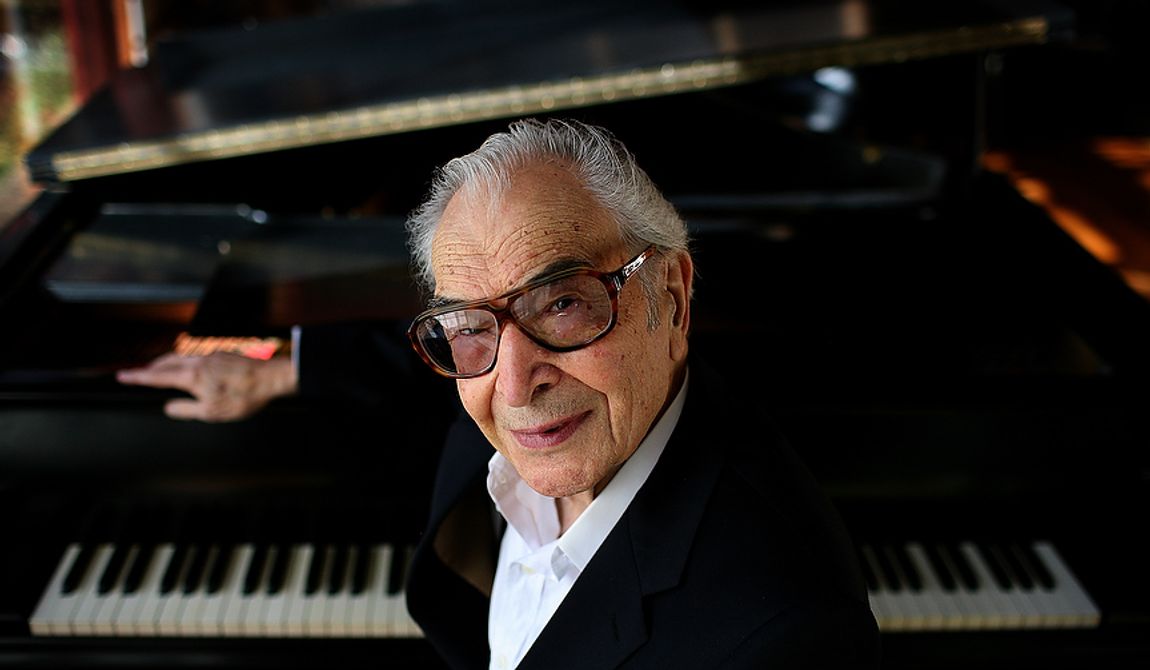
  • Dave Brubeck is photographed in his home in Wilton, Conn., on Nov. 17, 2009. (The Washington Times)


Dave Brubeck is photographed in his home in Wilton, Conn., on Nov. 17, 2009. (The Washington Times)
  • The 2009 Kennedy Center Honorees Robert De Niro, left; Grace Bumbry, bottom left, Dave Brubeck, bottom right; Bruce Springsteen, second from right; and Mel Brooks, right, pose with Secretary of State Hillary Rodham Clinton for a photo at the State Department following the Kennedy Center Honors Gala Dinner on Saturday, Dec. 5, 2009 in Washington. (AP Photo/Kevin Wolf)The 2009 Kennedy Center Honorees Robert De Niro, left; Grace Bumbry, bottom left, Dave Brubeck, bottom right; Bruce Springsteen, second from right; and Mel Brooks, right, pose with Secretary of State Hillary Rodham Clinton for a photo at the State Department following the Kennedy Center Honors Gala Dinner on Saturday, Dec. 5, 2009 in Washington. (AP Photo/Kevin Wolf)
  • Jazz pianist and composer Dave Brubeck is photographed in the backyard of his home in Wilton, Conn., on November 17, 2009. (Katie Falkenberg / The Washington Times) 


Jazz pianist and composer Dave Brubeck is photographed in the backyard of his home in Wilton, Conn., on November 17, 2009. (Katie Falkenberg / The Washington Times)
  • An all-star opening night concert and award ceremony kicks off the Jazz In Our Time festival at the Kennedy Center in NW Washington DC, Saturday, March 3, 2007. The eight-day-long jazz festival highlights performances by vocalist Nancy Wilson, drummer T.S. Monk, pianist Dave Brubeck, Wynton Marsalis on the trumpet, and Dr. Billy Taylor on the piano. (Astrid Riecken/The Washington Times)
An all-star opening night concert and award ceremony kicks off the Jazz In Our Time festival at the Kennedy Center in NW Washington DC, Saturday, March 3, 2007. The eight-day-long jazz festival highlights performances by vocalist Nancy Wilson, drummer T.S. Monk, pianist Dave Brubeck, Wynton Marsalis on the trumpet, and Dr. Billy Taylor on the piano. (Astrid Riecken/The Washington Times)
  • In this Aug. 8, 2010 file photo, Dave Brubeck plays at the CareFusion Newport Jazz Festival in Newport, R.I.  Brubeck is among the featured artists scheduled to return to the festival on Sunday, Aug. 7, 2011. (AP Photo/Joe Giblin, File)In this Aug. 8, 2010 file photo, Dave Brubeck plays at the CareFusion Newport Jazz Festival in Newport, R.I. Brubeck is among the featured artists scheduled to return to the festival on Sunday, Aug. 7, 2011. (AP Photo/Joe Giblin, File)
  • In this undated photo provided by Hank O'Neal, pianist Dave Brubeck, right, sits beside actor and producer Clint Eastwood. Brubeck, who turns 90 on Monday, Dec. 6, 2010, will celebrate the day by gathering in the family home in the Connecticut woods to watch Turner Classic Movies broadcast "Dave Brubeck: In His Own Sweet Way," a new documentary directed by Bruce Ricker, produced by Clint Eastwood and narrated by Alec Baldwin. (AP Photo/Hank O'Neal) NO SALESIn this undated photo provided by Hank O'Neal, pianist Dave Brubeck, right, sits beside actor and producer Clint Eastwood. Brubeck, who turns 90 on Monday, Dec. 6, 2010, will celebrate the day by gathering in the family home in the Connecticut woods to watch Turner Classic Movies broadcast "Dave Brubeck: In His Own Sweet Way," a new documentary directed by Bruce Ricker, produced by Clint Eastwood and narrated by Alec Baldwin. (AP Photo/Hank O'Neal) NO SALES
  • Dave Brubeck performs with his band, The Dave Brubeck Quartet, at the JVC Jazz Festival in Newport, R.I., Sunday, Aug. 10, 2003. (AP Photo/Stew Milne)Dave Brubeck performs with his band, The Dave Brubeck Quartet, at the JVC Jazz Festival in Newport, R.I., Sunday, Aug. 10, 2003. (AP Photo/Stew Milne)
  • Wynton Marsalis, right, greets Dave Brubeck as he joins him on stage during Marsalis's set  at the CareFusion Newport Jazz Festival on Sunday, Aug. 8, 2010 in Newport, R.I.  (AP Photo/Joe Giblin)Wynton Marsalis, right, greets Dave Brubeck as he joins him on stage during Marsalis's set at the CareFusion Newport Jazz Festival on Sunday, Aug. 8, 2010 in Newport, R.I. (AP Photo/Joe Giblin)
  • President Bill Clinton, right, shakes hands with jazz musician and composer Dave Brubeck during the 1994 National Medals of Arts ceremony at the White House, Friday, Oct. 14, 1994, Washington DC. The President presented Brubeck and others with at the 1994 National Medals of Arts. First lady Hillary Rodham Clinton looks on at center. Woman on far left is unidentified. (AP Photo/Joe Marquette)President Bill Clinton, right, shakes hands with jazz musician and composer Dave Brubeck during the 1994 National Medals of Arts ceremony at the White House, Friday, Oct. 14, 1994, Washington DC. The President presented Brubeck and others with at the 1994 National Medals of Arts. First lady Hillary Rodham Clinton looks on at center. Woman on far left is unidentified. (AP Photo/Joe Marquette)
  • Jazz Pianist Dave Brubeck shown playing at the Newport Jazz Festival August 23, 1981, Newport, RI. (AP Photo/Paul Mello)Jazz Pianist Dave Brubeck shown playing at the Newport Jazz Festival August 23, 1981, Newport, RI. (AP Photo/Paul Mello)
  • American jazz pianist Dave Brubeck, right, shown at a press conference prior to his appearance before a Soviet audience, Thursday, March 26, 1987, Moscow, Russia. (AP Photo/Boris Yurchenko)American jazz pianist Dave Brubeck, right, shown at a press conference prior to his appearance before a Soviet audience, Thursday, March 26, 1987, Moscow, Russia. (AP Photo/Boris Yurchenko)
  • American Jazz pianist Dave Brubeck visits Red square under a full Moon, Thursday, May 31, 1988, Moscow, Russia. In the background is the Kremlin. President Reagan invited Brubeck and his quintet to perform at a dinner in honor of Soviet Leader Mikhail Gorbachev. (AP Photo/Chris Brubeck)American Jazz pianist Dave Brubeck visits Red square under a full Moon, Thursday, May 31, 1988, Moscow, Russia. In the background is the Kremlin. President Reagan invited Brubeck and his quintet to perform at a dinner in honor of Soviet Leader Mikhail Gorbachev. (AP Photo/Chris Brubeck)
  • This 1956 file photo shows Dave Brubeck, American composer, pianist and jazz musician. Brubeck, who turns 90 on Monday, Dec. 6, 2010, will celebrate the day by gathering in the family home in the Connecticut woods to watch Turner Classic Movies broadcast "Dave Brubeck: In His Own Sweet Way," a new documentary directed by Bruce Ricker, produced by Clint Eastwood and narrated by Alec Baldwin. (AP Photo/File)This 1956 file photo shows Dave Brubeck, American composer, pianist and jazz musician. Brubeck, who turns 90 on Monday, Dec. 6, 2010, will celebrate the day by gathering in the family home in the Connecticut woods to watch Turner Classic Movies broadcast "Dave Brubeck: In His Own Sweet Way," a new documentary directed by Bruce Ricker, produced by Clint Eastwood and narrated by Alec Baldwin. (AP Photo/File)
  • Jazz musicians, Dave Brubeck, center, and Paul Desmond, left, listen intently to Indian musicians performing on the Sitar following their performance, April, 1958, Bombay, India. (AP Photo)Jazz musicians, Dave Brubeck, center, and Paul Desmond, left, listen intently to Indian musicians performing on the Sitar following their performance, April, 1958, Bombay, India. (AP Photo)
  • Profile view of Jazz Pianist Dave Brubeck in 1974. (AP Photo)Profile view of Jazz Pianist Dave Brubeck in 1974. (AP Photo)
  • A cheerful Dave Brubeck sits as his sons Chris, left, Danny and Darius, right, surround him during an intermission at Lincoln Center's Avery Fisher Hall, Saturday, June 23, 1985, New York. Joining Dave in his performance of "The musical life of Dave Brubeck", are his sons Chris on bass, Danny on the drums and Darius on the keyboards. (AP Photo/Richard Drew)A cheerful Dave Brubeck sits as his sons Chris, left, Danny and Darius, right, surround him during an intermission at Lincoln Center's Avery Fisher Hall, Saturday, June 23, 1985, New York. Joining Dave in his performance of "The musical life of Dave Brubeck", are his sons Chris on bass, Danny on the drums and Darius on the keyboards. (AP Photo/Richard Drew)
  • Dave Brubeck and his quartet perform at the JVC Jazz Festival in Newport, R.I., Sunday, Aug. 13, 2006. Fans enjoyed jazz acts on three stages set around the Fort Adams waterfront during the third day of the three day festival. (AP Photo/Stew Milne)Dave Brubeck and his quartet perform at the JVC Jazz Festival in Newport, R.I., Sunday, Aug. 13, 2006. Fans enjoyed jazz acts on three stages set around the Fort Adams waterfront during the third day of the three day festival. (AP Photo/Stew Milne)
  • Dave Brubeck arrives at the Kennedy Center for the Kennedy Center Honors in Washington, DC, on December 6, 2009. (Katie Falkenberg / The Washington Times) 


Dave Brubeck arrives at the Kennedy Center for the Kennedy Center Honors in Washington, DC, on December 6, 2009. (Katie Falkenberg / The Washington Times)
  • In this photo provided by the State Department, Legendary jazz pianist Dave Brubeck, 87, stands after performing his improvisational piece "Dziekuje" ("Thank you," in Polish) for an audience at the State Department Tuesday, April 8, 2008. Brubeck was honored by Secretary of State Condoleezza Rice for a half-century of service as a public diplomacy envoy, 50 years after making his first trip to then-communist eastern Europe to promote American ideals through jazz. "Jazz was the voice of freedom and it still is," Brubeck said after the ceremony. Rice said she had grown up on Brubeck's music "because my dad was your biggest fan. I want to thank you for your patriotism and your leadership in representing America by introducing the language, the sounds and the spirit of jazz to new generations around the world." (AP Photo/State Department, Michael Gross)In this photo provided by the State Department, Legendary jazz pianist Dave Brubeck, 87, stands after performing his improvisational piece "Dziekuje" ("Thank you," in Polish) for an audience at the State Department Tuesday, April 8, 2008. Brubeck was honored by Secretary of State Condoleezza Rice for a half-century of service as a public diplomacy envoy, 50 years after making his first trip to then-communist eastern Europe to promote American ideals through jazz. "Jazz was the voice of freedom and it still is," Brubeck said after the ceremony. Rice said she had grown up on Brubeck's music "because my dad was your biggest fan. I want to thank you for your patriotism and your leadership in representing America by introducing the language, the sounds and the spirit of jazz to new generations around the world." (AP Photo/State Department, Michael Gross)
  • ** File ** Tony Bennett performs with Dave Brubeck at George Wein's Carefusion Newport Jazz 55 in Newport, R.I. on Sunday, Aug. 9, 2009. (Associated Press)** File ** Tony Bennett performs with Dave Brubeck at George Wein's Carefusion Newport Jazz 55 in Newport, R.I. on Sunday, Aug. 9, 2009. (Associated Press)
  • Actor-singer Harry Belafonte left, jazz musician and composer Dave Brubeck, center, and singer Celia Cruz, at the White House Friday, Oct. 14, 1994, Washington, DC. They received 1994 National Medals of Arts. (AP Photo/Joe Marquette)Actor-singer Harry Belafonte left, jazz musician and composer Dave Brubeck, center, and singer Celia Cruz, at the White House Friday, Oct. 14, 1994, Washington, DC. They received 1994 National Medals of Arts. (AP Photo/Joe Marquette)
  • In this Dec. 6, 2009 file photo, Kennedy Center honoree Dave Brubeck stands for the National Anthem at the Kennedy Center Honors gala in Washington.  Brubeck, a pioneering jazz composer and pianist died Wednesday, Dec. 5, 2012 of heart failure, after being stricken while on his way to a cardiology appointment with his son. He would have turned 92 on Thursday.   (AP Photo/Alex Brandon, File)In this Dec. 6, 2009 file photo, Kennedy Center honoree Dave Brubeck stands for the National Anthem at the Kennedy Center Honors gala in Washington. Brubeck, a pioneering jazz composer and pianist died Wednesday, Dec. 5, 2012 of heart failure, after being stricken while on his way to a cardiology appointment with his son. He would have turned 92 on Thursday. (AP Photo/Alex Brandon, File)

You don’t have to be a jazz aficionado to recognize “Take Five,” the smoky instrumental by the Dave Brubeck Quartet that instantly evokes swinging bachelor pads, hi-fi systems and cool nightclubs of the 1950s and ‘60s.

“Take Five” was a musical milestone — a deceptively complex jazz composition that managed to crack the Billboard singles chart and introduce a new, adventurous sound to millions of listeners.

In a career that spanned almost all of American jazz since World War II, Brubeck’s celebrated quartet combined exotic, challenging tempos with classical influences to create lasting standards such as “Take Five” and “Blue Rondo a la Turk.”

Brubeck, the pianist and composer behind the quartet, died Wednesday of heart failure a day shy of his 92nd birthday. He believed that jazz presented the best face of America to the world.

“Jazz is about freedom within discipline,” Brubeck said in a 2005 interview with AP. “Usually a dictatorship like in Russia and Germany will prevent jazz from being played because it just seemed to represent freedom, democracy and the United States.

“Many people don’t understand how disciplined you have to be to play jazz. … And that is really the idea of democracy — freedom within the Constitution or discipline. You don’t just get out there and do anything you want.”

The common thread that ran through Brubeck’s work was breaking down the barriers between musical genres — particularly jazz and classical music. He was inspired by his mother, Elizabeth Ivey Brubeck, a classical pianist, and later by his composition teacher, the French composer Darius Mihaud, who encouraged his interest in jazz and advised him to “keep your ears open” as he traveled the world.

“When you hear Bach or Mozart, you hear perfection,” Brubeck said in 2005. “Remember that Bach, Mozart and Beethoven were great improvisers. I can hear that in their music.”

Brubeck was always fascinated by the rhythms of everyday life. In a discussion with biographer Doug Ramsey, he recalled the rhythms he heard while working as a boy on cattle drives at the northern California ranch managed by his father.

The first time he heard polyrhythms — the use of two rhythms at the same time — was on horseback.

“The gait was usually a fast walk, maybe a trot,” he said. “And I would sing against that constant gait of the horse. … There was nothing to do but think, and I’d improvise melodies and rhythms.”

Brubeck combined classical influences and his own innovations on the seminal album “Time Out,” released by his classic quartet with alto saxophonist Paul Desmond, drummer Joe Morello and bassist Eugene Wright in 1959.

It was the first jazz album to deliberately explore time signatures outside of the standard 4/4 beat or 3/4 waltz time. It was also the first million-selling jazz LP and is still among the best-selling jazz albums of all time.

Columbia executives blocked its release for nearly a year — until label President Goddard Lieberson intervened.

“They said, ‘We never put out music that people can’t dance to, and they can’t dance to these rhythms that you’re playing,’” Brubeck recalled in 2010. He also wanted a painting by Joan Miro on the cover, something else the record company had never done.

“I insisted that we go with something new,” he said. “And to their surprise, it became the biggest jazz recording they ever made.”

The album opens with “Blue Rondo a la Turk” in 9/8 time — nine beats to the measure instead of the customary two, three or four beats — blending these folk rhythms with jazz and a Mozart piece. The piece was inspired by Turkish street musicians Brubeck heard on a 1958 State Department tour that also took his quartet to Poland, Iraq, Afghanistan and Iran, among other countries.

The album also features “Take Five,” the cool and catchy odd-metered tune that became the Brubeck quartet’s signature and even made the Billboard singles chart. The tune was derived from a pattern that the quartet’s drummer Joe Morello liked to play backstage. Brubeck asked alto saxophonist Paul Desmond to write a two-part melody over the rhythm, and Brubeck patched the pieces together.

“It was a song that people could relate to, and it influenced the future of the music,” said George Wein, a jazz pianist and founder of the Newport Jazz Festival.

Brubeck always felt that his successful jazz career led fans to overlook the second career he launched as a jazz-inspired classical orchestral and choral composer in 1967 after disbanding his classic quartet.

Brubeck’s experience in World War II led him to look beyond jazz to compose oratorios, cantatas and other extended works touching on themes involving the church, civil rights and peace.

“I knew I wanted to write on religious themes when I was a GI in World War II,” said Brubeck in 2005, recalling how he was trapped behind German lines in the Battle of the Bulge and nearly killed. “I saw and experienced so much violence that I thought I could express my outrage best with music.”

Brubeck interest in classical music was inspired by his mother, Elizabeth Ivey Brubeck, a classical pianist, who was initially disappointed by her youngest son’s interest in jazz. She later came to appreciate his music.

Born in Concord, Calif., on Dec. 6. 1920, Brubeck began piano lessons with his mother at age four, but those ended when he was 12 and his father moved the family to a cattle ranch in the foothills of the Sierras. As a teenager, he played in local dance bands on the weekends.

When he enrolled at the College of the Pacific in 1938, Brubeck had intended to major in veterinary medicine and return to ranching. But while working his way through college by playing piano in local nightclubs, he became smitten with jazz and changed his major to music. In 1942, he married Iola Whitlock, a fellow student who became his lifelong partner, librettist, and sometime manager.

Brubeck joined the Army as an infantry man, but ended up leading the semi-official Wolf Pack band attached to Gen. George S. Patton’s army. They played popular standards as well as some of his first original jazz tunes, including “We Crossed the Rhine,” based on the rhythm of trucks hitting the metal pontoon bridges as the entered Germany. His band, which was one of the first integrated units in the then-segregated Army, reopened the Opera House in Nuremberg, the site of mass rallies organized by the Nazis, who had also banned jazz.

After his discharge, he enrolled at Mills College in Oakland, Calif. That’s where he formed an octet, including Desmond on alto sax, Dave van Kreidt on tenor sax, Cal Tjader on drums and Bill Smith on clarinet. The group played Brubeck originals and standards by other composers. Their ground breaking album “Dave Brubeck Octet” was recorded in 1946.

In 1949, Brubeck with Tjader and bassist Ron Crotty, both fellow octet members, formed a more commercially viable trio and cut their first records, which gained a national audience. After surviving a near-fatal diving accident in 1951, Brubeck formed a quartet by adding Desmond.

“No one else played like Dave Brubeck,” said Wein, who had known Brubeck since he first worked in Wein’s club in Boston in 1952. “No one had the approach to the music that he did. That approach communicated.”

Associated Press writer Michelle R. Smith in Providence and the late AP writer Mary Campbell contributed to this report.

Copyright 2013 The Associated Press. All rights reserved. This material may not be published, broadcast, rewritten or redistributed.

Comments
blog comments powered by Disqus

      Independent voices from the TWT Communities

      Sharp Pearson Thoughts

      Politics and pop culture from the perspective of an independent hip-hop conservative

      Red Pill, Blue Pill

      Al Maurer provides a common sense, conservatarian, Constitutional conservative perspective from the battleground state of Colorado