



Second of three parts
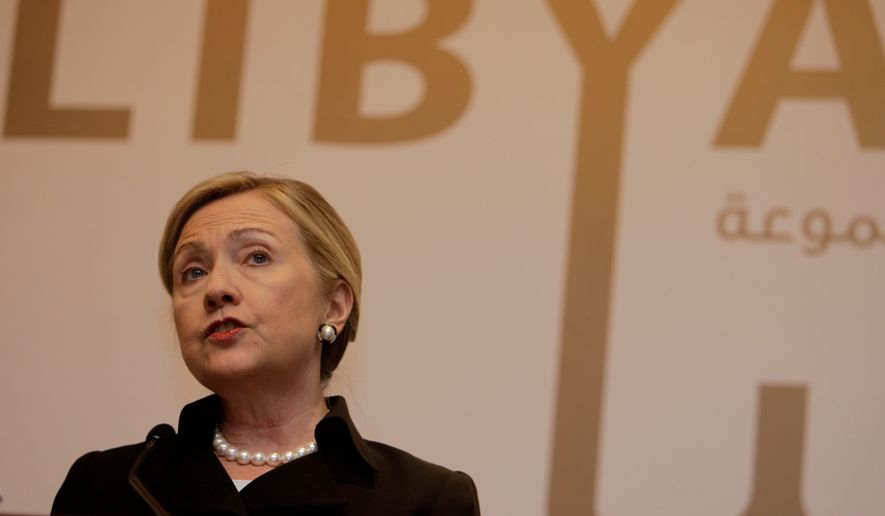
The intelligence community gathered no specific evidence of an impending genocide in Libya in spring 2011, undercutting Secretary of State Hillary Rodham Clinton’s primary argument for using the U.S. military to remove Col. Moammar Gadhafi from power, an event that has left his country in chaos, according to officials with direct knowledge of the dispute.
Defense officials, speaking in detail for the first time about their assessments of the Libyan civil war four years ago, told The Washington Times that Mrs. Clinton’s strong advocacy for intervention against the Libyan regime rested more on speculative arguments of what might happen to civilians than on facts reported from the ground.
The Defense Intelligence Agency ran the Libya intelligence operation.
“It was an intelligence-light decision,” said one senior U.S. intelligence official directly familiar with the Libyan matter, who spoke to The Washington Times only on the condition of anonymity because he was not authorized to speak to reporters.
The official’s sentiments were echoed by nearly a dozen other key players inside the intelligence and military communities who described to The Times a frustrating period during which the concerns of senior military leaders, including Defense Secretary Robert M. Gates and Chairman of the Joint Chiefs of Staff Adm. Mike Mullen, were repeatedly cast aside.
SEE ALSO: Hillary Clinton undercut on Libya war by Pentagon and Congress, secret tapes reveal
Speculative arguments often trumped reporting from the ground, the officials added.
The intelligence community wasn’t the only one concerned that Mrs. Clinton was selling the war on exaggerated pretenses.
In secretly tape-recorded conversations, an emissary sent by the Pentagon and Democratic Rep. Dennis J. Kucinich openly discussed with Gadhafi regime officials in 2011 concerns that there was a false narrative being used to sell the war, The Washington Times reported Thursday.
In one pointed conversation, the officials suggested Mrs. Clinton was engaging in the same misleading tactics as the George W. Bush administration when it went to war with Iraq in 2003 claiming the country had large stocks weapons of mass destruction, a claim that proved to be inaccurate.
“It was like the WMDs in Iraq. It was based on a false report,” Seif Gadhafi, the son of the Libyan leader, said in a May 2011 phone call with Mr. Kucinich. “Libyan airplanes bombing demonstrators, Libyan airplanes bombing districts in Tripoli, Libyan army killed thousands, etc., etc., and now the whole world found there is no single evidence that such things happened in Libya.”
The gap between Mrs. Clinton’s rhetoric warning of a Rwanda-like slaughter of civilians in Libya and the facts gathered by career intelligence staff is taking on significance as the former secretary of state prepares another bid for the White House and her national security credentials are re-examined.
Predictions of genocide
When the Arab Spring fervor touched off a civil war in Libya in early 2011, U.S. officials were caught off guard. The CIA had little information about the rebels leading the fight, the Libyans who set up an interim government or Gadhafi’s own intentions in repressing the rebellion, officials said.
In fact, intelligence agencies didn’t even have a good estimate of how many civilians were living in Benghazi, which was expected to be the conflict’s flashpoint, officials told The Times.
The DIA was put into the lead role for assessing the situation, and a separate working group within the Pentagon’s joint chiefs quickly gathered valuable insights from an American asset who was in direct contact with the Gadhafi regime, including the leader’s son Seif and Mohammad Ismael, Seif Gadhafi’s chief of staff.
Soon, however, the information being gathered by the intelligence community was at loggerheads with claims of the main supporters for war with Libya, which included French President Nicolas Sarkozy; Sen. John McCain, Arizona Republican; Senate Foreign Relations Committee Chairman John F. Kerry, Massachusetts Democrat; and three powerful women close to President Obama: Mrs. Clinton; Susan E. Rice, the U.S. ambassador to the United Nations; and adviser Samantha Powers.
Mrs. Clinton ultimately became the most powerful advocate for using U.S. military force to dethrone Gadhafi, both in her closed-door meetings with Mr. Obama, who ultimately made the decision, and in public with allies and the news media
Her argument was best summed up in comments she made in March 2011, when she warned that Gadhafi was on the cusp of a genocide against civilians in Benghazi on par with those in Rwanda and Bosnia in the 1990s when her husband, Bill, was president.
“Imagine we were sitting here and Benghazi had been overrun, a city of 700,000 people, and tens of thousands of people had been slaughtered, hundreds of thousands had fled either with nowhere to go, or overwhelming Egypt while it’s in its own difficult transition,” Mrs. Clinton told ABC News on March 27 after the U.S. signed off on a U.N. resolution granting military intervention.
If “we were sitting here, the cries would be, ’Why did the United States not do anything?’” she predicted.
Few objective indicators
The intelligence community had few facts to back up Mrs. Clinton’s audacious predictions, officials told The Times.
In fact, the Pentagon’s judgment was that Gadhafi was unlikely to risk world outrage by inflicting large civilian casualties as he cracked down on the rebels based in Benghazi, the officials said.
The specific intelligence was that Gadhafi had sent a relatively small — by Western standards — cadre of about 2,000 troops armed with 12 tanks to target armed rebels in Benghazi. Ground intelligence indicated that the Gadhafi forces were defeating the rebels, killing about 400 and wounding many more.
In comparison, 10,000 people have been killed at the hands of Boko Haram in Nigeria in the past year alone. Estimates of the number of people killed in Rwanda, mostly Tutsi civilians, range from 500,000 to 1 million over a 100-day period. The Bosnia war lasted, at varying levels of intensity, for three years and claimed at least 100,000 lives, with some estimates reaching 200,000.
Some accounts said the Libyan forces were attacking unarmed protesters, but no genocide was reported, the officials said. There was strong evidence that most civilians fled Benghazi ahead of the expected battle, officials said.
Furthermore, defense officials had direct information from their intelligence asset in contact with the regime that Gadhafi gave specific orders not to attack civilians and to narrowly focus the war on the armed rebels, according to the asset, who survived the war.
All spoke to The Times on the condition of anonymity but confirmed Col. Gadhafi’s order.
Defense officials said the Gadhafi forces were serious about routing the uprising and that some collateral damage to civilians remained possible, though they were unable to give the White House specifics. No intelligence suggested that a genocide was imminent, the officials said.
“Gadhafi was serious, but I wouldn’t classify it as Rwanda,” said an unidentified defense official close to the intelligence available at the time.
Political issue
Mrs. Clinton is keeping mum these days about Libya as she mulls a run for president, in part because the subsequent assault on the U.S. diplomatic post in Benghazi by an Islamist militia and her reaction to the incident have come under harsh criticism.
Along with other administration officials, Mrs. Clinton falsely blamed that attack, which killed Ambassador J. Christopher Stevens and three other Americans, on an anti-Islam video. She also famously asked, “What difference does it make” whether the attack was planned terrorism or a spontaneous protest as she had claimed.
Her official representative declined to comment for this report.
The State Department confirmed that its primary goal in 2011 was regime change, meaning ousting Gadhafi from power. But it deferred comment to Mrs. Clinton about the specifics on intelligence and her own public statements.
Mr. Kerry, who succeeded Mrs. Clinton as secretary of state, backed the Libya intervention with similar language. He told The New York Times that “the memory of Rwanda, alongside Iraq in ’91, made it clear that the United States needed to act but needed international support.”
With the benefit of hindsight, diplomatic analysts frown on such comparisons to Rwanda and say the rhetoric in 2011 was simply overstated.
“We are prone to think in terms of analogies, and the analogy in Rwanda was one that administration officials like Hillary Clinton and others used, and I think it was an inappropriate analogy because you cannot say Libya was Rwanda,” said Paul Miller, who served as an adviser on security matters for Mr. Obama and Mr. Bush.
“[Libya] was a war between an autocratic government and a bunch of tribes, and amidst that kind of war there will be a humanitarian crisis, there will be innocent people killed. But that is very different than a straight genocide against a group,” Mr. Miller said.
The notion that a genocide was imminent was rooted in Gadhafi’s Feb. 22, 2011, speech in which he pledged to “sanitize Libya an inch at a time” and “clear them of these rats.”
Civilian deaths vs. genocide
Supporters of the intervention argued that Gadhafi’s use of the words “rats” and “cleans” resembled the genocidal language used by Hutu leaders and militias in Rwanda in 1994. Rwandan radio was calling on Hutus to “cut down the tall trees” and “crush the cockroaches.”
A month later, Gadhafi delivered another speech in which he made it clear that only those standing against him with arms would face reprisal.
“If you read [Gadhafi’s comments] closely, they were clearly directed only at the rebels who were going to stand and fight,” said Alan Kuperman, a public policy professor at the University of Texas who composed an exhaustive study on the Libyan civil war.
“If you threw down your weapons, you were considered harmless. If you ran away, you were considered harmless. And if you were just a civilian, you were considered harmless,” Mr. Kuperman said. “Rebels were going to be targeted, and those were the ’rats’ he was talking about.”
Human rights groups offered a similar assessment. Amnesty International and Human Rights Watch, both of which were tracking the crisis before the U.S. intervention, said there was no way to determine that spring whether Benghazi would develop into a Rwanda-type crisis.
“We can’t definitively predict whether the State Department’s claims of an impending crisis on the scale of the Rwanda genocide would have come to pass,” Robyn Shepherd, a spokeswoman at Amnesty International, said in an email statement. “What we can confirm is that Libyan forces were committing serious violations of international humanitarian law.”
Amnesty recorded acts in which Gadhafi’s regime “deliberately killed and injured scores of unarmed protesters” and “launched indiscriminate attacks and attacks targeting civilians in their efforts to regain control of Misrata and territory in the east.”
But academics argued that such acts were not unusual coming from a dictator trying to defend his throne in the midst of a civil war.
“I never came across any evidence that indicated intention or actions consistent with an imminent bloodbath,” said Mr. Kuperman. “I found nothing in terms of reports on troop movements, nothing in terms of threats from his regime or actions anywhere else.”
Mrs. Clinton’s defenders could argue that Americans will never know whether a genocide would have occurred because the U.S. did the right thing and intervened before it could happen. They also are certain to note that the final decision rested not with Mrs. Clinton but with Mr. Obama.
Paul: ’Hillary’s War’
What is not in dispute is that the intelligence community’s assessment and the military leadership’s concerns were not given full credence, and that almost certainly will provide fodder to Mrs. Clinton’s critics to attack her leadership style.
“I think there was a rush headlong toward war in Libya and [the State Department and the administration] weren’t listening to anyone saying anything otherwise, including the Defense Department and intelligence communities, who were saying, ’Hold on a minute. This may not be a good idea,’” said Sen. Rand Paul, Kentucky Republican and a presidential contender himself.
“Hillary’s judgment has to be questioned. Her eagerness for war in Libya should preclude her from being considered the next commander in chief,” he said.
Mr. Paul, who has a libertarian flair, has begun calling Libya “Hillary’s War.” What remains to be seen in the months ahead is whether Mrs. Clinton embraces the moniker as she begins her campaign.
Contact the author



Please read our comment policy before commenting.