


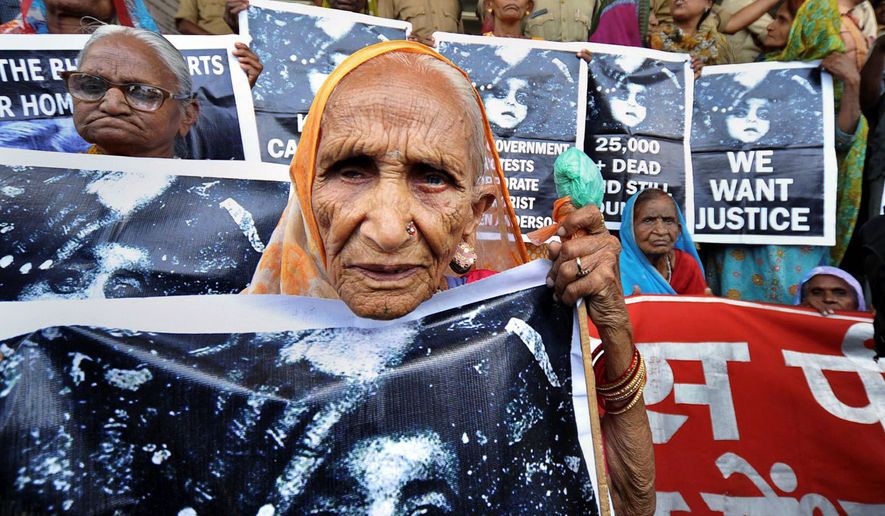

BHOPAL, India | An Indian court on Monday convicted eight former managers of Union Carbide Corp.’s Indian subsidiary of negligent homicide and sentenced them to two years in prison for their part in the 1984 Bhopal gas leak, which eventually killed at least 15,000 people and injured 500,000, more than two decades ago.
Survivors and their relatives howled in outrage over the criminal sentences as being too little, too late in the wake of the world’s worst industrial accident. Some even clamored for death sentences.
The convicted managers, seven of whom were released on bail soon after the verdict, also were fined about $2,175. One convicted manager died during the course of the trial. Union Carbide India Ltd., the subsidiary, was fined about $10,870.
Absent among the defendants was Warren Anderson, former head of Union Carbide, for whom Indian authorities had sought extradition from the United States. Neither Mr. Anderson nor Union Carbide was tried in absentia, sparking more outrage among survivors.
“We will fight for justice till the end. We want to see Anderson, prime accused, brought from USA and punished in India,” Rasheeda Bi, a Bhopal victim and activist, told The Washington Times.
“It proves that the Indian justice system is flawed and weak. It proves that our governments, our prime ministers, no one did anything for the sufferers, and the entire world watched it,” she said.
India’s top investigative agency, the Central Bureau of Investigation (CBI), had long contended that the operators of the pesticide plant had not followed safety regulations before the accident, in which a cloud of toxic gas was accidentally released over Bhopal in December 1984.
The convicted managers, many now in their 70s, are mostly Indian nationals who held key positions in Union Carbide India Ltd. at the time of the devastating gas leak: non-executive chairman Keshub Mahendra, managing director Vijay Gokhle, vice president Kishore Kamdar, works manager J. Mukund, production manager S.P. Choudhary, plant supervisor K.V. Shetty, production assistant S.I. Qureshi, and assistant works manager R.B. Roy Choudhary, who died during the trial.
Meanwhile, Union Carbide Corp. said in a statement that it was not subject to Indian court rulings because it was not involved in the Bhopal plant operated by its subsidiary.
“By requirement of the Government of India, the Bhopal plant was detail designed, owned, operated and managed on a day-to-day basis by Union Carbide India Limited (UCIL) and its employees,” the chemical company said.
“All the appropriate people from UCIL — officers and those who actually ran the plant on a daily basis — have appeared to face charges.”
In addition, Union Carbide noted that it sold UCIL in 1994 to MacLeod Russell Ltd., which renamed the subsidiary Eveready Industries India Ltd. Union Carbide and its officials were not part of this case since the charges were divided long ago into a separate case, the company said.
On the night of Dec. 2, 1984, 40 metric tons of methyl isocyanate — a highly volatile, toxic chemical — stored at UCIL’s pesticide plant in Bhopal was contaminated with water and other impurities. The result: A massive, lethal cloud escaped from the plant and fell onto the town, killing thousands of people and inflicting grievous injuries on hundreds of thousands.
Residents ran for their lives to flee Bhopal any way they could, but many collapsed in their tracks. At least 3,000 bodies were strewn all over Bhopal the next morning, while an estimated 15,000 people eventually died over the years from the harmful effects of the toxic cloud.
Some estimates put the number at 20,000 killed. Hundreds of thousands endured horrendous diseases, and many children born since the catastrophe have suffered deformities and other birth defects from toxic contamination of soil and water in the area.
Mr. Anderson, the former Union Carbide chairman, has been charged with manslaughter and declared an absconder in the case. He lives in New York City.
In 1989, Union Carbide paid the Indian government $470 million as a settlement in the case. The Dow Chemcial Co. took over Union Carbide in 2001 and said the Indian state of Madhya Pradesh, which now owns the factory site, has responsibility for all its liabilities.
The trial dragged on for 23 years as prosecution arguments by the CBI and defense arguments by the eight defendants’ attorneys were heard. A total of 178 prosecution witnesses were examined, and 3,008 documents were exhibited.
The CBI counsel contended that the defective design of the pesticide plant and poor maintenance practices were responsible for the tragedy. But defense attorneys argued that UCIL’s Bhopal plant adhered to the strictest safety norms.
John Coale, an American lawyer who represented victims of the Bhopal disaster, said the sentencing shows the “ridiculousness of the Indian legal system.”
“To take 25 years to convict someone … is absurd,” he said in an interview.
Mr. Coale said that problems with the Indian legal system were major reasons that litigation he handled against Union Carbide was filed in the United States.
“As to these guys, there was a lot of negligence, and I guess they deserve to be punished,” he said. “But it’s a little late.”
The accused were charged and tried under the Indian penal code sections dealing with death by negligence, acts endangering life or personal safety of others, and causing hurt by acts endangering life or personal safety of others.
India’s court system is badly burdened by corruption, incompetence and a lack of resources, making it easy to stall a case for many years, the Associated Press reported. Even top Indian judicial officials acknowledged that the system is in trouble.
“It’s most unfortunate that it has taken that much time to give the verdict,” Law Minister Veerappa Moily told reporters after the ruling. “We need to address that.”
Four organizations of survivors of the Bhopal tragedy said the Indian government is culpable for “criminal negligence” in its weak prosecution of the world’s worst industrial accident. Prime Minister Manmohan Singh, as the minister in charge of the CBI, must accept blame for the prosecuting agency’s “incompetence and mishandling of the case,” they said.
“The judgment proves that the Indian prime minister is for the rich people only,” said Nityanand Jayaraman, an Indian researcher who specializes in investigating and reporting on the environmental and human rights track records of corporations.
Mr. Singh has said the Bhopal tragedy “still gnaws at our collective conscience,” promising to continue decontamination efforts in the area.

Please read our comment policy before commenting.