



MANILA (AP) — Benigno “Noynoy” Aquino III, the son of Philippine democracy icons who promised to eradicate corruption and fight poverty among the country’s many ills, won the May presidential election by a landslide, the congressional count that ended Tuesday showed.
A fellow opposition politician and mayor of Manila’s Makati financial district, Jejomar Binay, won as vice president.
Mr. Aquino garnered more than 15 million votes — about 5.7 million ahead of his closest opponent, ousted leader Joseph Estrada, who pledged to support him. Congress officially will proclaim Mr. Aquino’s victory on Wednesday.
“We have done this … for the Filipino people,” Senate President Juan Ponce Enrile told a jubilant crowd before he and House of Representatives Speaker Prospero Nograles banged the gavel to conclude several days of vote canvassing.
A 50-year-old bachelor and economics graduate, Mr. Aquino officially will become this Southeast Asian nation’s 15th president on June 30. He will replace Gloria Macapagal Arroyo, who ran and won a House seat after a turbulent nine-year rule.
Mr. Aquino’s historic rise to power, via the country’s first automated elections, has been attributed largely to his family name and strong anti-corruption campaign.
His late parents — opposition Sen. Benigno Aquino Jr. and former President Corazon Aquino — are deeply revered figures for their opposition to the late dictator Ferdinand Marcos, who was ousted in a 1986 “people power” revolt.
Mr. Aquino’s victory reflected the public’s longing to fill a moral vacuum in a country plagued by corruption, poverty and violence. For many voters, it’s been nearly a quarter century of disappointment since his mother led the 1986 uprising and restored democracy.
Mr. Aquino’s father was shot to death in 1983 while in military custody at Manila’s airport as he returned from U.S. exile to challenge Marcos.
With little legislative record to speak of, Mr. Aquino has emphasized his clean public image.
His campaign was replete with poignant symbols of the 1986 revolt — yellow ribbons, pro-democracy anthems and raised hands flashing the L-sign for “Laban,” or “fight” in Tagalog, drawing huge crowds everywhere he barnstormed.
Close ally Florencio Abad said that by restoring trust in government and fighting graft, Mr. Aquino likely would avoid the military unrest that hounded past presidents, including his mother, who fought off seven coup attempts, and Mrs. Arroyo, who survived four attempted power grabs.
Mr. Aquino has said he’ll make the prosecution of corrupt officials a priority, in what would be a marked departure from Mrs. Arroyo’s administration, which is widely accused of turning a blind eye to graft to shield her political allies.
Mrs. Arroyo herself has been linked to massive corruption but has denied any wrongdoing. She is ready to face any investigation or criminal charges, according to her aides.
Mr. Aquino also will have to tackle decades-long Marxist and Muslim insurgencies, a restive military, violent crimes and political strife.
“The problems I will be inheriting are still growing to this very day and, perhaps, to the last day,” Mr. Aquino told reporters Monday, adding that his incoming administration has to produce results in the first two years to meet the public’s high expectations.
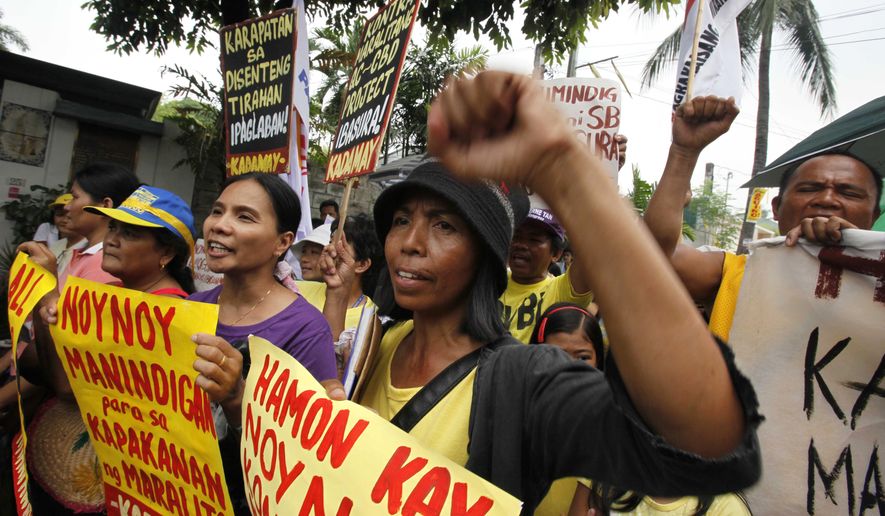
Two groups of peasants and slum dwellers rallied in front of Mr. Aquino’s suburban home Tuesday, demanding he carry out land reform, including redistribution of his family-owned sugar estate, one of the country’s largest.
Mr. Aquino said he has been busy assembling his Cabinet from the ranks of defectors from Mrs. Arroyo’s administration and loyal Aquino supporters. He has pledged to create a commission to investigate corruption allegations against Mrs. Arroyo and her officials — a potential flash point early in his six-year term.
Born to one of the country’s wealthiest political clans, Mr. Aquino in 1998 won a House seat, where he served three terms before being elected to the Senate in 2007.
Associated Press writer Oliver Teves contributed to this report.

Please read our comment policy before commenting.