


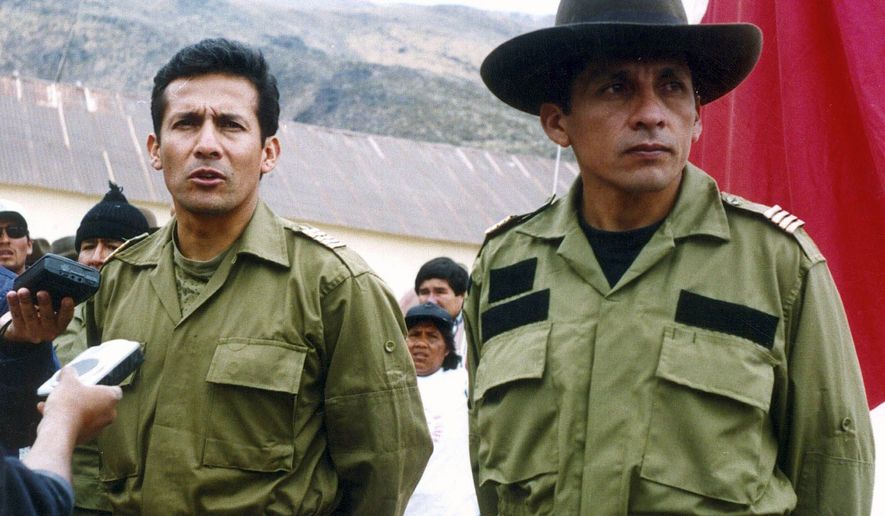

LIMA, Peru | A leftist former army officer who nearly won Peru’s presidency five years ago with fiery anti-capitalist rhetoric and open affinity for Hugo Chavez has risen once again to share the lead in opinion polls just days before the presidential election.
To get there, Ollanta Humala ditched his leftist discourse and radical red T-shirt and has distanced himself from Venezuela’s president, pitching himself as a mellowed moderate.
But is the image makeover merely cosmetic?
Although Mr. Humala frequently dons a suit and tie and does his best to appear as a modest, respectable family man in pictures with his three children, the business community is spooked.
Business leaders fear that if Mr. Humala wins Sunday’s election, he would scuttle an economy that grew nearly 9 percent last year and is the envy of many neighboring countries.
Lima’s main stock market index dove more than 5 percent early last week after two polls showed Mr. Humala reaching a technical tie for the lead with Keiko Fujimori, daughter of disgraced former President Alberto Fujimori.
Dropping to third was Alejandro Toledo, Peru’s president from 2001 to 2006, who had been leading the race since January. One of the polls had Mr. Humala leading with 22.8 points, compared to 22.3 percent for Ms. Fujimori, and 21.6 for Mr. Toledo. The margin of error for the poll was plus or minus 1.96 percentage points.
The latest numbers indicate that no candidate will obtain the simple majority needed to avoid a runoff in June.
Seeking to calm investors, Mr. Humala summoned reporters to a hotel in Lima’s wealthy San Isidro district after last week’s market drop to assure them that his economic policies would “respect our international agreements.”
“Nothing will be done outside democratic, legal means,” he added.
Earlier in the campaign, the former army lieutenant colonel had called for renegotiating Peru’s free-trade agreements.
Mr. Humala also is promising to respect Peru’s constitutional prohibition against immediate re-election, a clear acknowledgment of fears that he might mimic Mr. Chavez and the Venezuelan president’s South American allies, Bolivian President Evo Morales and Ecuadorean President Rafael Correa.
All three won re-election after voters passed referendums allowing their constitutions to be rewritten.
All three also have been accused of using strong-arm tactics to silence opposition-run news media. Mr. Humala says he respects freedom of the press.
But Peru’s dominant, business-friendly daily newspaper, El Comercio, has shown little respect for him.
Last month, the paper suggested Mr. Humala planned to implement the same kind of policies that wrought economic ruin in eastern Europe under Soviet rule.
While short on specifics, Mr. Humala has advocated expanding the state’s role in the economy and extracting higher royalties from mining companies, which account for 60 percent of Peru’s exports.
Mr. Toledo also proposes higher taxes on windfall profits by mining companies. But he and several other candidates also say the private sector should continue to play a dominant role.
In his 192-page campaign platform, Mr. Humala strikes a markedly different tone from the others, contending that Peru has become “the instrument of a few small [business] groups who consider their transnationalization the only road to development.”
Mr. Humala told business leaders in a January speech that he would seek to rewrite the constitution to create “an economic regime that has social justice as its objective.”
That, he said, includes “restoring national sovereignty over … natural resources.”
He insists, for one, that the natural gas needs of Peru’s people take priority over exports, echoing rhetoric that helped Mr. Morales get elected in gas-rich Bolivia.
Playing on class resentments in a nation where 34 percent of the people live on less than $2 a day, Mr. Humala says Peru’s economy still depends too much on the cheap labor of its poor, poorly educated indigenous majority.
That has played well in the largely destitute central and southern highlands, where people whose first language is Quechua or Aymara have benefited little from the decadelong boom produced by higher mineral prices.
Mr. Humala’s climb from fourth place in January, when just 10 percent to 12 percent of voters preferred him, is a reflection of what independent political analyst Julio Cotler calls “the classist vote” in Peru.
“It’s a vote that seeks the redistribution [of wealth],” he said, through such vehicles as state-supported day care, guaranteed pensions and inexpensive natural gas. “They are old causes that I consider to be perfectly valid.”
But diametrically opposed causes are gaining favor in the race as well.
Pedro Pablo Kuczynski, a free-market champion who served as economics minister and Cabinet chief during Mr. Toledo’s presidency, also has surged in the polls since mid-March.
Mr. Kuczynski is now fourth — and ahead of the entire pack in the capital of Lima, whose streets recently have become clogged with shiny new autos from China, Japan and South Korea, all beneficiaries of free-trade agreements with Peru.
Yet polls show that Mr. Humala would defeat Mr. Kuczynski in a runoff, despite lingering questions about Mr. Humala’s radical background. His brother Antauro is serving a 25-year prison sentence for rebellion and murder for leading an attack on a highlands police station in 2005 in which he sought to spur an uprising against Mr. Toledo. Four police officers and two insurgents were killed.
Many analysts say Mr. Humala’s close association with Mr. Chavez — himself the instigator of a failed 1992 coup in Venezuela — kept him from the presidency in 2006. Mr. Humala told reporters in January that he hasn’t been to Venezuela since.
He instead has sought advice from the Worker’s Party of former moderate-leftist Brazilian President Luiz Inacio Lula da Silva, traveling to Brazil four times in the past five months to meet with some of the party’s leaders.
Worker’s Party leader Valter Pomar told the Associated Press that while the party has been in contact with Mr. Humala, “there is nothing special about that,” and that it is not participating in his campaign.
As for Mr. Chavez, he broke a long silence Wednesday during a trip to Uruguay, noting that Mr. Humala had led a revolt against then-President Fujimori, now serving 25 years for authorizing death squad killings.
“I think he was a good soldier,” Mr. Chavez told reporters.

Please read our comment policy before commenting.