


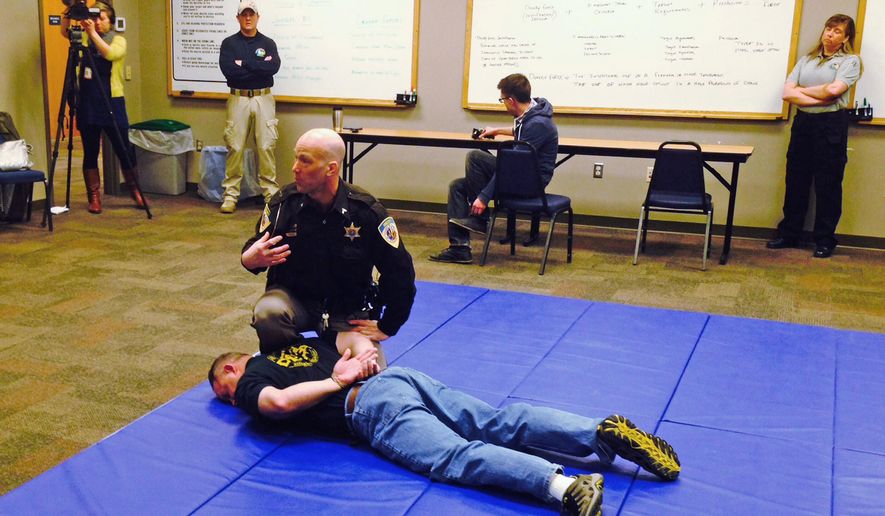

WAUNAKEE, Wis. (AP) - A month after a white Madison police officer shot and killed an unarmed biracial man, the sheriff’s department is trying to build understanding of the training it gives on how to deal with split-second life and death decisions.
Police officers can use deadly force to protect their lives or the lives of others in imminent danger but must be able to justify why they didn’t use a less lethal option in the aftermath, Dane County sheriff’s deputies told reporters this week during a four-hour training session on use-of-force policies.
The session came as District Attorney Ismael Ozanne continues to weigh whether to file criminal charges against city of Madison police officer Matt Kenny, who shot and killed 19-year-old Tony Robinson last month. Kenny was responding to calls that Robinson had assaulted two people and was running in traffic. Police said Robinson attacked Kenny inside an apartment house.
The shooting prompted multiple protests in Madison, with activists calling for Kenny to be charged with murder. Anger over police brutality is simmering in a number of cities across the county where white officers have killed black men in recent months, prompting calls for police to re-examine their use of force polices and accusations of racism.
Several other police associations and departments across the country, including the Dallas Police Association, the Maricopa County, Arizona, sheriff’s department and the San Antonio Police Department have run similar use-of-force sessions for community leaders and activists in recent months.
“The impetus is what’s happening around the country,” said Ron Pinkston, president of the Dallas Police Association. “People don’t understand and aren’t trained like police officers. We will shoot if we can’t see your hands or if we’re in a deadly force situation. It’s not our job to get hurt or get killed.”
Brandi Grayson, a spokeswoman for the Young, Gifted and Black Coalition, the group that has been leading the Robinson protests, said she knew little about the Dane County session or how it was presented. But she said it appeared to be an attempt to generate sympathy for the police.
“They’re trying to move us away from the root conversation, which is a black child who was unarmed was murdered,” she said.
No Dane County deputies were involved in Robinson’s death. But instructors at the department’s training complex in Waunakee, just outside Madison, said they want to educate the public about how police operate and how they must make split-second life-or-death decisions.
“We can’t just run away. We have to return the situation to normal. That’s what we’re hired to do,” said Deputy Dawn Brooks, one of the instructors. “If this is something the public won’t accept anymore, we need to have those conversations.”
Under state training standards, police do not have to wait to be attacked to use deadly force. They can fire their guns if they reasonably believe they or someone else faces an imminent threat of great bodily harm or death. But they must be able to explain why that level of force and not a lesser option was reasonable. Everything depends on each situation’s individual circumstances, Brooks said.
Officers are not taught to empty their magazines at a suspect once they make the decision to fire, the instructors said. Instead they’re taught to shoot until they stop the threat and to fire at the center of a person’s body. People who believe police should shoot to wound have seen too many movies, they said. In a high-stress situation it would be almost impossible to hit someone in an extremity such as an arm or leg, they said. Someone who is wounded can still fight, they added.

Please read our comment policy before commenting.