



HICKORY, N.C. (AP) - Alexis Hilton’s husband, Steve Hilton, had always been healthy.
Healthy enough to work 12-hour days as an account manager at Aaron’s.
Healthy enough to move from a small home in Granite Falls to a bigger one in Hickory.
Healthy enough to think about starting a family.
That’s when the young couple decided to get life insurance. And that’s when, during the medical exam, they found out Steve Hilton’s creatinine - the amount of waste in his blood - was high. Very high.
For Steve Hilton, a creatinine level on the high end would be about 1 mg/dL. Steve Hilton’s creatinine was more than double that.
Alexis Hilton, who works as a physician’s assistant at Hickory Village and several other local retirement communities, knew something was wrong.
“I work in nursing homes, so I said, ’Oh, no.’ I don’t see those levels in my 85-year-old patients,” she said.
Suddenly, things started to make sense: Steve Hilton was tired a lot. He went through most days with what he calls “brain fog.” But he had just chalked it up to his long work hours.
“I didn’t know I felt bad to begin with,” Steve Hilton said. “It felt like a head cold, like I was cloudy all the time.”
That’s because toxins were building up in his body, probably for years, without him knowing it. A kidney biopsy at Catawba Valley Medical Center revealed both of his kidneys were scarred and the amount of protein in his urine was at least 50 times the normal level. The diagnosis: “idiopathic membranous glomerulonephritis,” a long way of saying Steve Hilton had slow progressive disease of the kidneys with no known cause.
“You go in thinking everything’s OK, and you come out needing a kidney transplant,” Alexis Hilton said.
Her husband’s kidneys were going into failure.
Kidney failure doesn’t usually affect people as young as the 39-year-old Steve Hilton.
“When I’m in the waiting room, it’s like I’m with all my grandparents,” he said. “I’m the youngest one there.”
Until he got a kidney transplant, waste would continue to build up in his blood and urine, causing complications like high blood pressure, anemia, swelling and extreme fatigue. Patients with end-stage kidney disease eventually go on dialysis.
Alexis Hilton prayed that wouldn’t happen.
“I’m worried about the physical aspect. I’m worried about the financial aspect,” she said. “Because I know - I have patients that go on dialysis. I see what they go through.”
Dialysis, while life-preserving, is hard on the body and increases the risk for other medical complications.
The only treatment for Steve Hilton would be to get a kidney transplant.
People are born with two kidneys, but they only need one to live a normal life, so kidneys are the most common organ to be donated by a live donor. But they’re also the most needed organ in the U.S. According to the Organ Procurement and Transplantation Network, 101,600 patients are on the waiting list for a kidney transplant as of January. The liver and heart are the next most-needed organs, with 15,401 and 3,974 patients on the transplant list respectively.
Donating a kidney is a personal decision that people with children and health concerns must weigh carefully, said Mary McDaniel, a registered nurse at CVMC who helps facilitate organ procurement at CVMC.
“That’s high risk to you,” McDaniel said. “It may be that you’re not in the condition of donating to your loved one.”
A live donor has to be in perfect medical condition to donate a kidney. Pregnant women cannot donate them at all. Because Alexis and Steve Hilton wanted to start a family, Alexis Hilton’s twin sister volunteered to donate her kidney instead. So did a neighbor of the Hiltons. But both were ruled out after multiple days of medical screening.
“It was the worst day,” Alexis Hilton said. “Because I had just had a baby. I had to wait to tell him until he got off work and that was the worst day, that my sister was out of the running.”
According to Johns Hopkins, the average wait time for a kidney transplant in the U.S. is three to five years. Almost a third of the patients die waiting.
At Carolinas Medical Center in Charlotte, more than 75 percent of patients on the waitlist had not received a transplant after nearly five years.
At this point, Steve Hilton’s creatinine levels had skyrocketed to 6 mg/dL. His skin was becoming ashen. He was napping three times a day.
“It always kind of felt like my eyes were half closed all the time,” he said.
At that point, their daughter had just turned one and Alexis Hilton was getting frantic. Very soon, her husband would have to be on dialysis.
So Alexis Hilton volunteered. She went through the blood test. The physical. The overnight. The urine. Finally, in January, she got the call.
“I called him at work,” Alexis Hilton said. “I couldn’t wait. I said, ’Guess who’s giving you a kidney?’”
On Jan. 13, Steve and Alexis Hilton traveled to their hospital in Charlotte, where surgeons carefully removed Alexis Hilton’s left kidney and transplanted it to her husband.
Upon waking up, the pain was excruciating (“I felt like I did 100 crunches in 10 minutes,” Steve Hilton said). But Alexis Hilton’s donated kidney started working for her husband almost immediately.
In five days, the couple watched his creatinine drop from 6 to 2.1 mg/dL. His blood pressure cleared up. He started feeling awake and energetic. The color came back to his face.
“I have the best wife ever!” he texted his wife from his hospital room.
After three years of worry, it looked like he would be OK.
The Hiltons were lucky. They had supportive family and friends, good health insurance and were able to avoid dialysis. Now, the couple wants to raise awareness to encourage others to become organ donors.
“There’s so many people who need it,” Alexis Hilton said. “If I could, I would do it again.”
CVMC doesn’t perform organ transplants, but does help procure organs for Carolina Donor Services, the federally-designated organ procurement organization for the region.
“We’ve had some donors who have helped up to five, six, seven people, and that’s not counting the tissues,” McDaniel said. “According to the Carolina Donor Services, if you talk about all the tissues that could be retrieved, all the organs that could be retrieved, it could be up to 50 people that could be helped.”
Even organs and tissues that one normally wouldn’t think of are useful. Skin grafts go to burn victims. Bone can be used in reconstructive surgery. Cornea tissue can give the gift of sight to someone who needs it.
“It could make a big impact on someone’s life,” McDaniel said. “It allowed my grandmother to be able to read from a cornea donation late into her life. It makes not only saves their lives but can change the quality of their lives.”
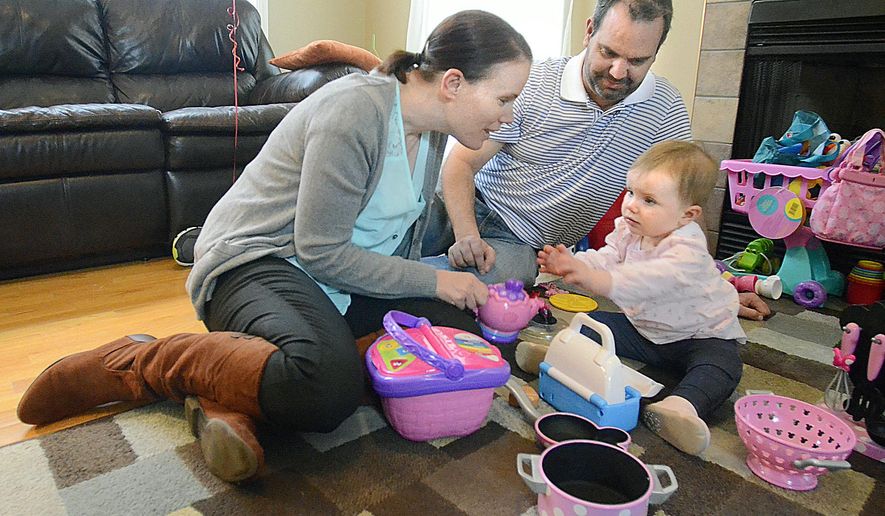
A few weeks after the kidney transplant, the Hilton family celebrated their daughter’s first birthday. Alexis Hilton went back to work at Hickory Village, continuing to care not only for her husband’s health but also that of her patients.
Steve Hilton made her a shirt to celebrate.
“I’m a living donor,” it read. “What’s your superpower?”
___
Information from: The Hickory Daily Record, https://www.hickoryrecord.com

Please read our comment policy before commenting.