


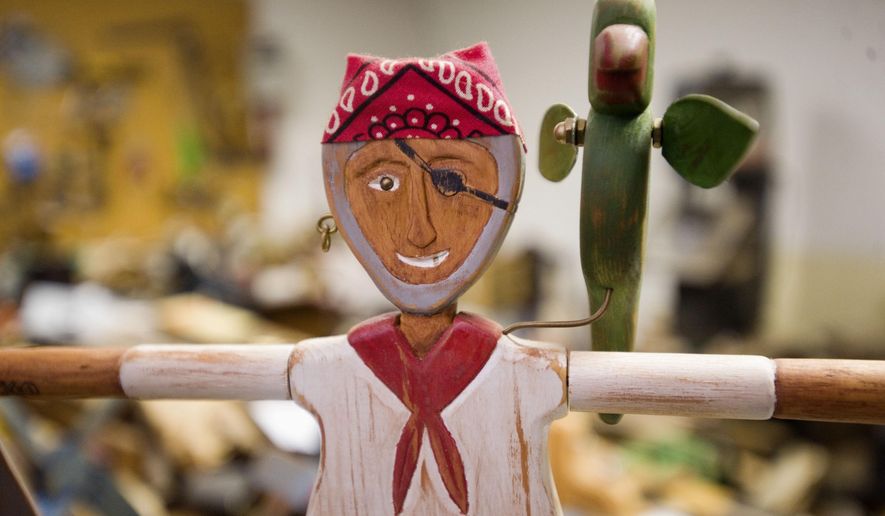

CHARLESTON, Ill. (AP) - Honest Abe chops some wood outside a log cabin. A whale hunter jabs away with a harpoon while on the back of his target.
Wood, wire and wind combine to set them in motion.
They’re called whirligigs and Gary Foster says they’re just for “pure whimsy.” Foster started making them about 30 years ago and now uses his remaining collection to help people learn more about them.
Figures such as Abe Lincoln, a sailor and others are cut from wood, then joined with a propeller and some sort of rudder and attached to a base. Wire and small moving parts work with the propeller so the whirligigs turn in the wind.
Much of the whimsy comes from the design and how the figures are painted, and Foster said he likes how he was able to put different faces on the various sailor figures he’s made.
Foster went from carving things such as spoons and bowls in the 1970s to being introduced to furniture making about 10 years later.
Then, it was a combination of his earlier woodworking, seeing and enjoying others’ whirligigs and an interest from his career in academics that helped lead him to making them himself.
Foster is the former chairman of the anthropology and sociology department at Eastern Illinois University. He said he was working on his master’s degree in folklore at Western Kentucky University when he met a man who had a whirligig on a fence post.
“I started thinking about whirligigs,” he said.
Then, credit goes to friend Dick Hummel, who got Foster involved in furniture making and opened up the workshop at his rural Charleston home for Foster to use.
“I provided the space,” Hummel said.
Foster said his first whirligig was an Uncle Sam figure he made about 30 years ago. He wanted it to be functional and move with the wind, but said it ended up being more of a learn-by-doing experience.
“I got absolutely everything wrong,” he said, explaining that he started thinking about the physics behind the figures, realizing there had to be propeller and a rudder for the whirligig to move.
“I figured it out myself,” Foster said. “There’s not much in the way of whirligig instruction.”
He said he enjoyed using Hummel’s workshop because of “the fine collection of tools,” though he did have his own at one time. What happened to his tools, and several of his whirligigs as well, is one reason he hasn’t made any in several years.
Foster kept his tools and many of his whirligigs in his office at EIU’s Blair Hall. They were there in April 2004 when the building was extensively damaged by a fire and the whirligigs and tools were some of the casualties.
About a half-dozen of the 16 or so whirligigs Foster made are at the home of Hummel and his wife Kathy, including the one depicting Lincoln chopping wood that he made about 15 years ago.
The Hummels bought it after Foster donated it to an auction to raise money for the Sarah Bush Lincoln Health Center hospice program.
“I just wanted to do something that had an Illinois theme,” Foster said.
Otherwise, many of the remaining whirligigs are of sailors or of something related to sailing, which Foster called the “most satisfying.”
“They all seem to have a connection to the water,” he said. “I have a fascination with the sea.”
There’s a series of “Sailor Jack” whirligigs that include a pirate with an eye patch, a gold tooth and a parrot on his shoulder. Foster said “you can add to the whimsy” with features such as a slingshot in one sailor’s back pocket.
One future whirligig in Foster’s plans is another sailor, an African American with which he said he wants to “acknowledge the maritime history, the early history of the United States.”
Foster said he starts by sketching his idea for a whirligig on paper, then thinks about the mechanics needed to make it move in the wind.
He usually uses pine for the figure itself but a variety of items for the base. Each base is related to its whirligig’s subject, such a whale bone for the harpooner, a boat propeller for the sailors and a piece of wood from a Kentucky log cabin for the Lincoln figure.
Painting the whirligig takes some thinking about how it might look if it sat on a fence post for years and years as old-time whirligigs did.
“I try to imagine if this whirligig were outside and left to the elements,” Foster said. “How would it wear? I think that’s part of the art.”
Whirligigs from the 19th Century and older were for entertainment, especially for the people who made them, Foster said. They were meant to be left outside so they were “pretty much neglected” and that’s why not many early ones are still around, he said.
Foster is scheduled to do a presentation on whirligigs from 1-4 p.m. on July 5 during one of the twice-monthly open houses at the Five Mile House site southeast of Charleston.
He said he plans to point out that there’s “no comprehensive history” for whirligigs and while the components to make them have been around since the 14th Century, “I don’t know if they did.”
He said the oldest ones he knows of date to the 1780s and ’90s and are at a maritime museum in Connecticut.
Foster said he talked a couple of times with the late Vollis Simpson, who had a “huge” display of steel whirligigs in North Carolina. There are also some modern ones sold commercially, though Foster described those plastic versions as mostly “very colorful pinwheels.”
He returned to “whimsy” as how to describe whirligigs old and new, something that were, and are, entertaining to make and fun for people to see.
“If they served any purpose, it was minor,” he said.
___
Source: Journal Gazette & Times-Courier, https://bit.ly/1MfLDy4
___
Information from: Jacksonville Journal-Courier, https://www.journal-courier.net

Please read our comment policy before commenting.