


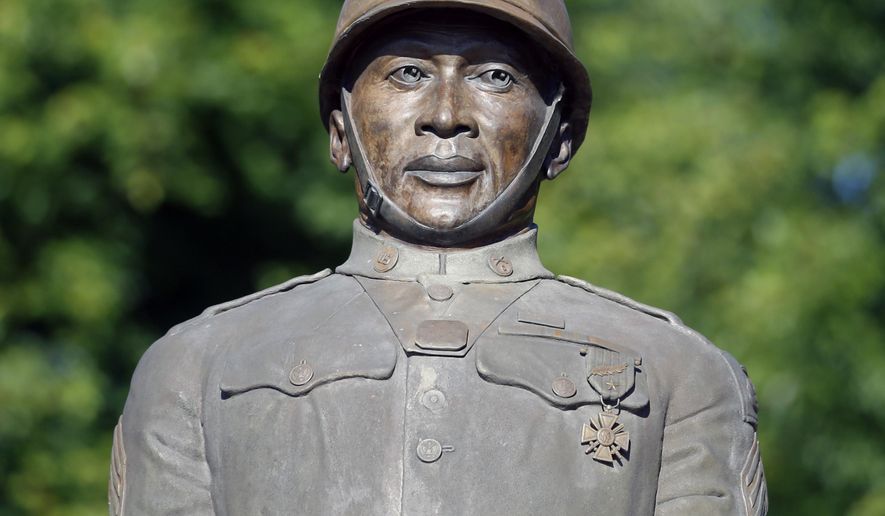

ALBANY, N.Y. (AP) - President Barack Obama will award a posthumous Medal of Honor for a black World War I hero from New York next month.
Sgt. Henry Johnson, who was a train station porter from Albany, will be honored during a June 2 ceremony in Washington D.C., the White House said Thursday. Also honored will be Army Sgt. William Shemin, who was Jewish and from the Bronx.
Medals for the two New Yorkers were approved by Congress after long campaigns to bestow recognition on men who may have been unjustly denied the honor due to discrimination.
In recent years, Sen. Charles Schumer and other New York lawmakers had joined Johnson supporters who had been pushing for the Medal of Honor for decades. They said the recognition was unjustly denied during the Jim Crow era.
“A great day. Henry Johnson was finally given his just recognition,” Schumer said Thursday. “So richly deserved and so long delayed.”
Local efforts for the Medal of Honor began in the 1970s among veterans groups, descendants and others. A breakthrough came in 2011 when Schumer’s staff found a U.S. Army dispatch from May 1918 describing Johnson and Needham Roberts, of Trenton, New Jersey, showing “notable instance of bravery and devotion” when their trench outpost was hit by a night assault by a German raiding party in May of 1918. The report and other supporting documents were submitted to Pentagon officials to bolster Johnson’s cause.
Johnson was born in Virginia, moved to Albany and enlisted in the 369th, a New York National Guard unit based in Manhattan that became known as the “Harlem Hellfighters.” With U.S. armed forces segregated at the time, the 369th was assigned to serve under French command.
Heavily outnumbered and severely wounded during the attack, the 5-foot-4 Johnson used his knife and rifle to kill or wound several enemies who were trying to drag the injured Roberts away. Johnson was credited with repulsing the onslaught and saving Roberts.
Johnson’s actions earned him the French Croix de Guerre, one of France’s highest honors. After he returned to the U.S., Harlem held a parade in his honor, and the governor and mayor met his train when he arrived in Albany. But his heroism was all but ignored by American military officials.
Hobbled by his wartime injuries, Johnson died a destitute alcoholic at age 32 at a veterans hospital in Illinois in 1929. His grave was rediscovered in Arlington National Cemetery in 2002. The next year, Johnson posthumously received the Distinguished Service Cross, the nation’s second-highest military decoration.
Shemin is being honored for racing across a battlefield three times to pull wounded comrades to safety in August 1918.
“Both of these brave souls put the needs of our country before their own, and their example of valor and integrity lives on today,” Gov. Andrew Cuomo said. “I am proud to see them awarded this long overdue and well deserved honor.”
___
Follow George M. Walsh on Twitter at https://www.twitter.com/gmwalshAP

Please read our comment policy before commenting.