



According to April’s U.N.-linked “World Happiness Report,” Switzerland is the globe’s happiest country. The small European nation is known for its Alps, prosperity, chocolates, lakes, peerless public transport, timepieces and industrious people with Calvinist traditions. In 1949’s film noir classic “The Third Man,” Orson Welles quips: “In Switzerland, they had brotherly love 500 years of democracy and peace, and what did that produce? The cuckoo clock.”
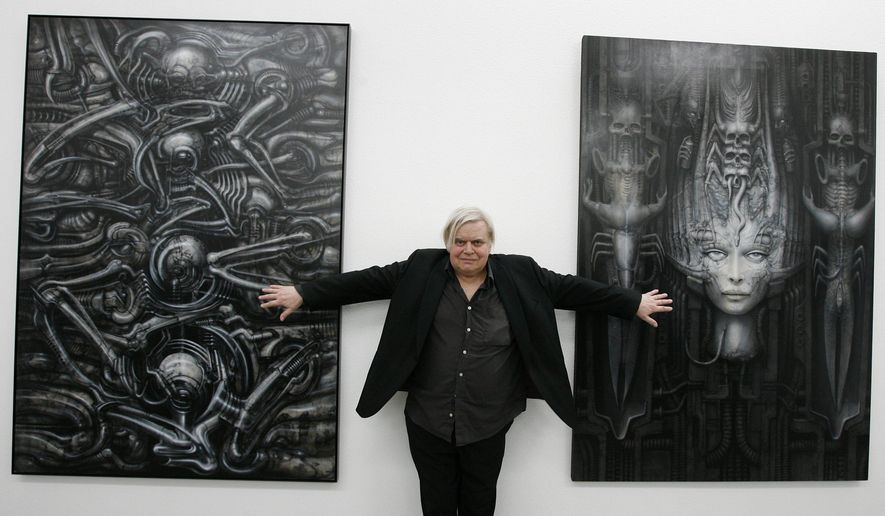
But the alpine country also gave birth to the avant-garde Dadaist movement, LSD and Oscar-winning artist Hans Rudolf Giger, the subject of a new documentary.
“Oh, he’s a very controversial artist in Switzerland,” said Belinda Sallin, director of “Dark Star: H.R. Giger’s World.” “Of course, everybody knows Giger in Switzerland. He’s world-famous and famous in Switzerland, [but] this doesn’t mean he was accepted by the Swiss art institutions or art establishment. Lots of people in Switzerland refused his art, until now.
“It’s no secret Giger wanted to have a large solo exhibition in Zurich,” Ms. Sallin said. “This never happened, except for a small exhibition in 1977 at the Kunsthaus,” Zurich’s top fine arts museum.
As “Dark Star” graphically reveals, Giger’s otherworldly artwork dwelt upon themes of birth, death and eroticism, with often spine-tingling, explicit imagery. Ms. Sallin, interviewed via phone in Zurich, said, “Maybe Giger broke too many taboos and was too provocative for the reserved Swiss. Yeah, he didn’t get the acknowledgment he deserved in Switzerland.”
Giger died in 2014, shortly before her documentary was completed.
Ms. Sallin said her homeland “has two sides.” There are the well-known financial interests, which have given rise to what she calls a “clean country.” This led, she said, to artists like Giger to seek out the Swiss dark side.
“Dark Star” talking head Tom Fischer, a Giger acolyte who became his assistant, Ms. Sallin said, “founded the genre of extreme metal music. He was born near Zurich,” and, like the painter, projects a Goth persona.
Bars, museum and whimsical house of horrors
Swiss and foreign aficionados alike flock to the HR Giger Museum, which opened in 1998 at a chateau Giger acquired in the medieval walled town of Gruyeres in the French-speaking part of Switzerland. The museum receives no government subsidies.
In “Dark Star,” during a packed book signing, fans weep while meeting Giger, who autographs tattooed devotees’ flesh with his pen.
The Giger Bar adjoins the museum, and another Giger-themed saloon opened in 1992 at his Swiss German-speaking hometown of Chur, where Giger was born in 1940.
“Dark Star” reveals Giger’s bizarre home, filled with skulls, statues, books, paintings, gigantic watches and, unostentatiously on a bookshelf, his golden Academy Award statuette. In his garden, amid a fountain, sculptures and trees, is a miniature railroad transporting passengers through a surreal realm created by the late artist, as if they are on a psychedelic amusement park ride.
Psychotherapist Stanislav Grof said Giger’s oeuvre is full of Jungian imagery, with his train ride symbolizing the process of giving birth.
Ms. Sallin said Giger’s whimsical house of horrors still exists at Oerlikon, near Zurich’s airport, where his partner, Carmen Maria Giger, continues to live. She, Giger acolyte and former assistant Tom Fischer and Team Giger work there on books and exhibits, with long-term thoughts of turning this imaginative enclave into a shrine and museum devoted to Giger’s visionary artistry.
Giger goes Hollywood
It was only a matter of time before Giger’s dream world, notably realized in his book “Necronomicon” in 1977, came to the attention of Hollywood’s dream factory.
Dan O’Bannon, who co-wrote the script for “Alien,” and director Ridley Scott were looking for a concept artist who could design the world of “Alien” as well as the monster itself. O’Bannon showed Mr. Scott “Necronomicon,” whose enthusiastic response was: “That’s it! Why look further?”
The pair traveled to Oerlikon and talked with Giger for hours.
“H.R. Giger told me, ’I didn’t understand what they wanted from me, because I didn’t speak English at the time,’” Ms. Sallin said.
But art knows no borders and, as Ms. Sallin stated, “they got along very well together. They wrote film history together,” with Giger and his co-designers winning 1979’s Academy Award for best visual effects.
To work on “Alien,” the Swiss artist went to the Shepperton Studios near London, where “he worked for seven to nine months. It was difficult for Giger because the film crew was not used to working with an artist.”
Ms. Sallin said Giger was “very surprised” upon discovering he was nominated for an Academy Award. “He thought Oscars were for actors or directors. He didn’t know it existed” for designers, she said.
The nomination led to the European painter’s first trip to Hollywood, where, beating out a James Bond picture, Steven Spielberg’s “1941,” “Star Trek: The Motion Picture” and “The Black Hole,” the tuxedo-clad, bow-tied Giger “was really surprised when he won.”
While Giger went on to work on other films, the “Alien” sequels were not among them.
⦁ “Dark Star: H.R. Giger’s World” opens Thursday at the District’s Landmark Theatres E Street Cinema.

Please read our comment policy before commenting.