


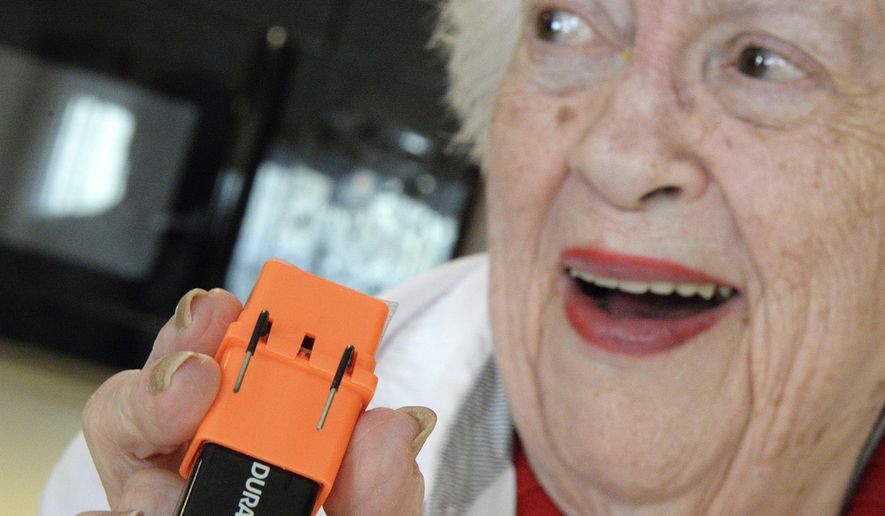

NORMAL, Ill. (AP) - Dolores Hirst set a large-print timer attached by a magnet to her refrigerator door.
“I use it to cook,” she said in her Normal duplex. “I can actually see the numbers.”
Next, she showed Velcro strips that she attached to knobs of her washer, dryer and stove to help her to find settings; walked by a large-print calendar; felt tactile markings on the keypad of her microwave to help her to distinguish numbers; touched her talking watch which told her the time, date and year; and used a liquid level identifier which beeped when the water that she poured into her coffee machine rose to the level of the identifier’s probes to reduce spills.
“I was very much a visual person, so this is a terrible shock,” Hirst, 85, said of becoming legally blind last August.
“But Kim saved my life,” Hirst said.
Hirst was referring to Kim Tarkowski, vision access advocate for Bloomington-based LIFE Center for Independent Living (LIFE CIL). Through LIFE CIL’s low vision program, Tarkowski not only provided Hirst with assistive devices to help her to continue to live independently but trained her to use the devices.
“This is such a blessing,” said Hirst, a retired teacher whose late husband was a minister. “It has meant a difference between being able to live a happy, contended life and being caged.”
But few people know about the program, which is available without charge to people who qualify, Tarkowski said.
“We serve 60 to 110 people a year throughout McLean, Livingston, DeWitt and Ford counties,” she said.
But there are about 4,700 older adults in those counties who are blind and many of them could benefit from the program, said LIFE CIL Executive Director Gail Kear.
“People don’t know these services are available,” Tarkowski said.
“It’s essential that people with low vision seek out these services early so they can benefit from these services and enhance their ability to perform daily living skills independently,” said Tarkowski, who has been blind for 40 years.
The low vision program is for people 55 and older with low vision or blindness. Low vision is defined as any chronic visual deficit that impairs everyday functioning and is not correctable by ordinary eyeglasses, contact lenses or surgery, Tarkowski said.
Leading causes of visual impairment are diseases common in older adults, including age-related macular degeneration, glaucoma, diabetic retinopathy, cataracts and optic nerve atrophy, she said.
Tarkowski does home visits to assess needs of clients, provides them with devices that may help and training to use them, teaches strategies such as how to fold currency to tell the difference between denominations, conducts monthly education meetings in Bloomington and in Clinton, and teaches self-advocacy. The program also may help to pay for low-vision exams and transportation to and from exams, Kear said.
Ferne Ferguson, 93, has been able to remain in her independent living apartment in Westminster Village in Bloomington, thanks in part to devices supplied by the low-vision program.
Among devices used by Ferguson are a lighted magnifying glass that she uses to read, a talking scale, a check writing guide (which lays over a check to help her to stay on the lines), a large-print calendar, a pen that writes like a fine-point marker and a large-print check register.
She also uses an electric magnifier that allows her to read print placed under a magnifier and displays magnified on a computer screen. While she paid for that $2,000 piece of equipment herself, she heard about it from LIFE CIL.
“It’s wonderful,” she said of the program. “It’s helped me to remain independent. Without it, my son would have to take over my checkbook and I’d just stumble through things.”
Hirst had been treated for macular degeneration since 2002. But on Aug. 11, 2015, she lost most of the vision in her left eye. She also has lost most of the vision in her right eye.
“I retained a bit of peripheral vision,” she said. “To me, it always looks like it’s 9 o’clock at night with no lights on.
“I was practically catatonic for a month,” she admitted. “I have moments of panic.”
But Hirst trained herself to use her peripheral vision with assistance from devices provided by LIFE CIL.
Ferguson has been treated for macular degeneration for years and has limited, peripheral vision remaining in both eyes.
“I’ve learned to use my peripheral vision,” Ferguson said. “I don’t look directly at what I want to see. I look at the corner of the TV screen and over peoples’ shoulders.”
The assistive devices help.
Any older adult with vision loss should contact LIFE CIL, Ferguson and Hirst said.
“By all means, get in touch with those people,” Hirst said. “It’s too bad more people don’t know about this.”
___
Source: The (Bloomington) Pantagraph, https://bit.ly/1nVTvhl
___
Information from: The Pantagraph, https://www.pantagraph.com

Please read our comment policy before commenting.