



OPINION:
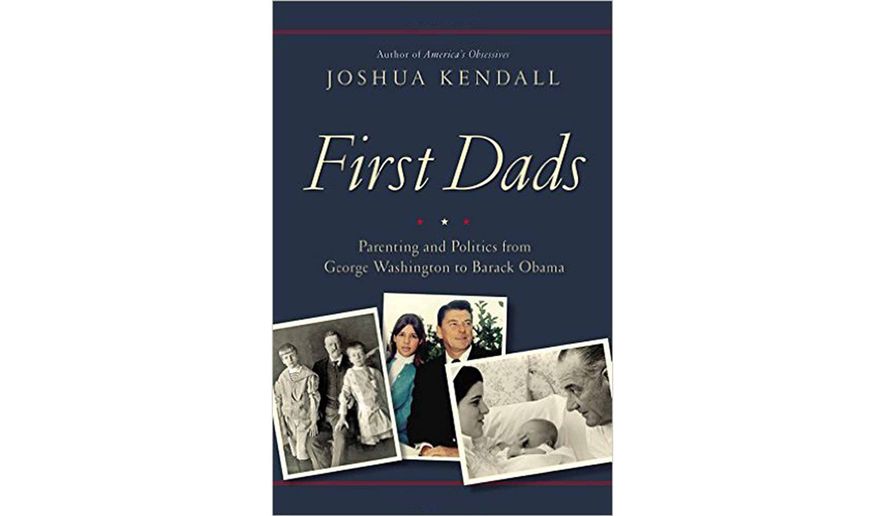
FIRST DADS: PARENTING AND POLITICS FROM GEORGE WASHINGTON TO BARACK OBAMA
By Joshua Kendall
Grand Central Publishing, $27, 391 pages
Which is tougher: being a celebrity parent or being a celebrity’s child? Both roles carry special penalties and rewards and since, as Jay Leno once quipped, “Politics is just show business for ugly people,” the same applies to presidential parents and their children. One of the many virtues of biographer Joshua Kendall’s lively, informed examination of American presidents as fathers is that it looks at each president — and each batch of presidential offspring — as unique individuals interacting in their own particular ways to the boons and burdens of living private lives in the public eye. Tolstoy famously observed that all happy families are the same while each unhappy family is unhappy in its own way. But as some of the examples in Mr. Kendall’s book illustrate, there are at least as many different ways of being happy as there are of being miserable. And in the lives of most families — first families included — joy and sorrow often intermingle.
Readers will find a striking example of this in the opening pages of “First Dads.” It begins on Saturday morning, July 2, 1881. President James Garfield pops into the White House bedroom shared by his two teenage sons, Harry and Jim, and as 17-year-old Harry recorded in his diary, “told us of the responsibilities and cares of his office, and then turn[ed] as quickly as he could from work to recreations.”
Paraphrasing a line of the character Little Buttercup in Gilbert and Sullivan’s recent hit operetta, “HMS Pinafore,” Garfield sang “I mixed these babies up” while hoisting up both youths under his arms and carrying them around the room. A brief, impromptu gymnastic competition followed in which the 49-year-old commander-in-chief, a fit six-footer weighing in at 185 pounds, was more than a match for his offspring. But the family frolic didn’t last very long; the president and his sons had a train to catch. Sadly, they never managed to board it. “Soon after arriving at Washington’s Baltimore and Pennsylvania railroad station, the President was shot by anarchist Charles Guiteau. The wounds were ultimately fatal, and he died eleven weeks later.”
As with the Kennedy administration cut short by a bullet in the next century, “Garfield’s presidency is now associated with a string of ’might have beans.’ The nine-time Ohio Congressman ran on a platform that featured strong stands on both civil rights and civil-service reform. In his inaugural address Garfield called ’the elevating of the Negro race from slavery to full rights of citizenship the most important political change … since the adoption of the Constitution’ and promised to fight those who would deny Negroes freedom of the ballot “
While we can only speculate about what Garfield might have achieved had he survived, Mr. Kendall concludes, “given what we know about how he governed his own children, his loss appears even more tragic. It would take a couple more generations for Americans to elect another President as deeply committed to the full rights of the least powerful among us.”
The author divides presidential pops into six basic categories: “The Preoccupied,” “Playful Pals,” “Double-Dealing Dads,” “Tiger Dads,” “The Grief Stricken” and “The Nurturers.” Presidential greats like Washington (who had no children of his own but did his best for the offspring of his wife Martha’s first marriage as one of the “nurturers”), Lincoln (a fond father who endured the deaths of two of his sons, in the “grief stricken” category) and Franklin Roosevelt (a self-centered but charming “absentee dad”), all receive their just deserts. Some of the most poignant episodes, however, involve less celebrated presidents.
In July 1924, just as Calvin Coolidge began running for a full term of his own after succeeding, as vice president, on the death of Warren Harding, his beloved second son, Calvin Coolidge Jr., died suddenly of blood poisoning, caused by a blister acquired while playing tennis without wearing socks. As it happens, this reviewer’s father, who was about the same age as Calvin Jr., had played tennis on some of the same courts and was a nodding acquaintance, so the story of young Cal’s death was part of my childhood folklore. Of his son’s death, Coolidge himself would write, “When he went, the power and the glory of the presidency went with him.”
In “First Dads” Joshua Kendall opens a window into the inner lives of our presidents in ways that tell us a lot about both their approach to parenting and their approach to the presidency. The view is often moving and always illuminating.
• Aram Bakshian Jr., an aide to Presidents Nixon, Ford and Reagan, writes widely on politics, history, gastronomy and the arts.

Please read our comment policy before commenting.