


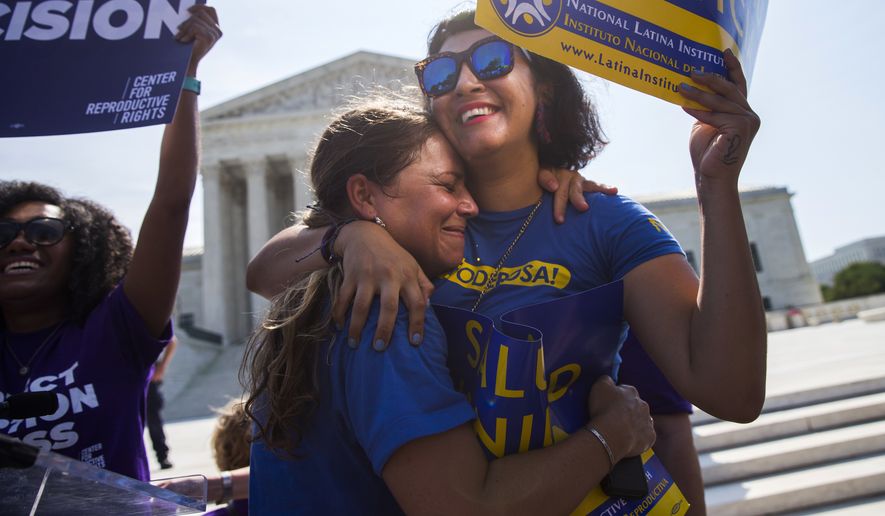

Legal analysts are uncertain about which abortion regulations are constitutional in the wake of the Supreme Court’s decision striking down two Texas abortion regulations, with some calling such uncertainty a feature, not a bug.
The Court on Monday declared that requiring abortionists to have admitting privileges at a nearby hospital and holding clinics to the health and safety standards of ambulatory surgical centers imposed an “undue burden” on women attempting to exercise their right to abortion.
Twenty-six states have similar regulations on the books. In addition to those statutes, the decision in Whole Woman’s Health v. Hellerstedt could threaten other regulations on abortion deemed to impose an “undue burden” on women seeking abortions such as waiting periods, fetal-pain bills and requirements for such procedures as ultrasounds.
“We obviously are going to be reviewing the decision closely for how it affects the many abortion rights cases that are being litigated around the country right now,” Nancy Northup, president of the Center for Reproductive Rights, said in a press call after the decision.
She was not specific about which abortion regulations might next be in the pro-choice movement’s crosshairs in the post-Hellerstedt world. But nearly every abortion regulation gets litigated almost immediately.
Clarke Forsythe, acting president of Americans United for Life, said the Supreme Court “threw up a lot of dust and created a lot of confusion” around abortion policy nationwide. He said there is no way for states and judges to determine what constitutes an “undue burden” on the right to an abortion.
Justice Clarence Thomas made this point forcefully in his dissenting opinion, saying the standard “will surely mystify lower courts for years to come.”
“The majority seriously burdens States, which must guess at how much more compelling their interests must be in order to pass muster and what ’common sense inferences’ of an undue burden this Court will identify next,” Justice Thomas wrote.
Indeed, the Court has had trouble defining “undue burden” since it was introduced in the 1992 Planned Parenthood v. Casey decision. In that case, the phrase was further defined as a “substantial obstacle” placed on the path to obtaining an abortion.
Justice Antonin Scalia, who died in February, warned at the time how the ambiguity of the term could be used as a raw judicial power grab in future cases.
“Defining an ’undue burden’ as an ’undue hindrance’ (or a ’substantial obstacle’) hardly ’clarifies’ the test,” Justice Scalia wrote in his Casey dissent. “Consciously or not, the joint opinion’s verbal shell game will conceal raw judicial policy choices concerning what is ’appropriate’ abortion legislation.”
Nearly 25 years after Casey, Mr. Forsythe said the Court “still doesn’t understand what ’undue burden’ means.”
“And federal judges don’t understand what ’undue burden’ means,” he said. “’Undue burden’ is whatever five justices on the Supreme Court say it is.”
Petitioners argued the Texas regulations shut down as many as 20 abortion clinics, especially in the western half of the vast state, where there are fewer hospitals, often far apart, for doctors to have admitting privileges.
But abortion clinics have been shuttering rapidly across the country, with a dozen closing in abortion-friendly California since 2011.
Such regulations on abortion clinics became popular nationwide in the wake of the Kermit Gosnell trial. The Philadelphia abortionist, according to prosecutors, killed perhaps hundreds of children born alive at his abortion clinic, performing late-term abortions for decades by inducing labor and ripping out the spines of breathing infants.
Gosnell was convicted of first-degree murder in the deaths of three born-alive infants and of manslaughter in the death of a patient, but only after his clinic was raided by law enforcement officers over suspicions about drug dealing.
He was sentenced to life imprisonment.
Officers at the clinic found as many as 45 fetal bodies stored everywhere from milk cartons to orange juice jugs and shoe boxes as well as rows of jars containing severed baby feet. His clinic had not been inspected for 17 years.
The grand jury in that case recommended the adoption of health and safety standards for abortion clinics similar to ambulatory surgical centers in order to prevent similar oversights in the future. Texas was one of many states to take up that recommendation.
Because it gives judges the ability to determine when regulations on abortion clinics create real health and safety benefits, Mr. Forsythe said the Hellerstedt decision gives the pro-life movement a chance to keep such regulations in place by winning the war of ideas.
“[Associate Justice Stephen G.] Breyer’s opinion is virtually an invitation to states and state legislators and pro-life people to assemble more evidence of the risks and dangers of abortion,” Mr. Forsythe said. “And, frankly, we welcome the invitation. Game on.”

Please read our comment policy before commenting.