



QUINCY, Ill. (AP) - When Paula Reeder’s nearly 20-year marriage fell apart last year, so did her health.
Already battling chronic obstructive pulmonary disease, fibromyalgia, coronary heart disease and peripheral artery disease, Reeder found out she needed heart bypass surgery.
“It got to where I couldn’t walk five feet without stopping,” Reeder said.
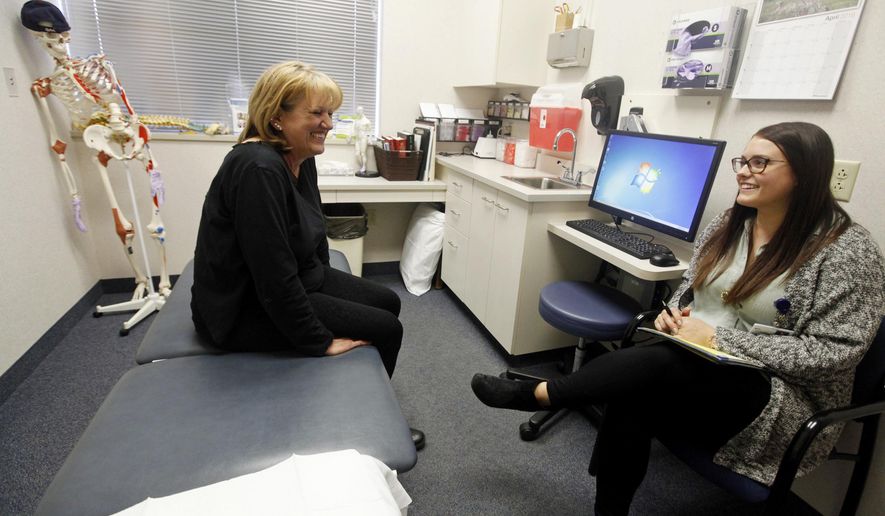
But the Ewing, Mo., woman wasn’t dealing with all the medical issues on her own. She had help from Millie Silver, an interventionist with the nurse care management program provided through Quincy Medical Group.
“She goes to most of my appointments with me. As a matter of fact, she became so involved in my health care she asks questions sometimes I don’t think of or forget to ask,” Reeder said.
Even more important, Silver cares about Reeder’s health and what’s going on in her life.
“Sometimes you just need to know that someone cares,” Reeder said. “It’s one thing for your mama to love you and for your grown children to love you, but when there’s someone else you can turn to, it’s wonderful.”
Before and after the October surgery, which left Reeder feeling better than she had in more than a decade, Silver “went above and beyond” the medical issues to help provide other resources, including food, for Reeder.
“I just feel like I had someone else besides the Lord watching over me,” Reeder said. “When it comes to health care, sometimes the doctors are really busy. They don’t have time to stay involved with what you’re doing. They just know what’s going on in their office. They don’t know about other things you’re having problems with unless you tell them. With Millie, she’s involved in every aspect of my health care. She knows what’s going on with me as well as I do. It is just so nice to know that they’re there for me.”
Each medical provider in Quincy — QMG, Blessing and Southern Illinois University Center for Family Medicine — offers care management at no charge, and an increasing number of referrals and interest has all three programs continuing to expand.
“How it got started is in an effort to keep patients very healthy and at home,” said LeAnn Kassing, care management coordinator with QMG. “We want the best for these patients. When they’re happy, they’re going to be healthy.”
If a patient’s not thriving, doctors seek help from care managers to find out why.
“We’re detectives,” Kassing said. “We have to dig into this to find out what’s going on, what is the missing piece.”
Maybe the patient doesn’t have enough money, so they buy food instead of medicine. “We make sure they get their medication,” Kassing said.
“It could be the smallest thing to a really large thing,” Silver said. “We build a rapport, and if we can get our foot in the door, then we can start finding resources for them.”
Care managers reach out to food pantries, churches, social service organizations, businesses, medical companies and volunteers in the immediate area and beyond to meet needs for patients of all ages.
“We have found foster homes for dogs, adoptive homes for dogs,” Kassing said. “Recently, we found a nursing home that will take a patient and a dog.”
Grace, another QMG patient who uses a walker, was struggling because of issues in her home environment.
Water damage created a hole in the kitchen floor, and another hole was worn through the bedroom floor. The bathroom needs a new toilet and flooring, but Grace, not her real name, didn’t want to leave her home.
So the care management team is pulling together donations from the Crossing, Midwest Paints and Liberty Christian Church along with volunteers to install new flooring and put in a new toilet for Grace.
“I prayed,” said Nancy Frank, a nurse care manager working with Grace. “Our goal is to keep people healthy in their home — or in a place where they can remain as healthy as their body is allowing them to be — and we go to any lengths to do that.”
Care managers serve as a conduit between doctor and patient.
“They made my job a lot easier,” said Dr. Richard Noble at QMG.
“We are really trying to focus on preventative care, being proactive instead of waiting until they’re sick,” said Dena Nokes, nursing care manager for SIU.
Nokes said care management at SIU focuses on managing chronic diseases like diabetes and education along with meeting needs from food to diapers and working around “roadblocks” for patients.
“There are some patients who are perfectly capable on their own and can figure things out. Some just hit roadblocks. They don’t go any further. They don’t get what they absolutely need. They can’t figure it out,” Nokes said.
Even small tasks like routine blood sugar checks can be a roadblock if patients don’t understand the process.
“When they’ve learned, now they have full control of their life again,” she said. “It’s a daily thing when you have made a difference in somebody’s life.”
It’s helping people — and potentially decreasing health care costs because medical issues can be identified and acted on more quickly.
“Besides, they develop a relationship with these people. They look forward to hearing from them, having them come into the house,” Noble said. “We’re still trying to keep it personal. We’re still trying to make sure that you have as many links to the physician and the office as much as possible so patients don’t feel like they’re out there on their own anymore.”
Julie Shepard, Blessing’s director of care coordination, said the goal is providing seamless care for the patient with nurses, social workers and caseworkers.
“We have nurses who work with patients if they’re newly diagnosed with a chronic disease or if their chronic disease is uncontrolled. We can spend time with them, help them address some of their issues that are preventing them from managing their disease,” Shepard said. “A transition team helps people when changing from one setting to another. We try to focus in on the gap between when they leave the hospital and get back into primary care, then making sure people get to their appointments.”
Social workers target behavior health issues, such as depression, that make it hard for people to manage physical health needs while caseworkers focus on basic needs like transportation, medication, housing and food — all done with home visits to put the health care professionals into the day-to-day setting of the patient.
Some patients may go months between contacts with care managers. “Other patients we’re talking to every day,” Kassing said.
“Everything in health care is moving toward managing people, helping them in the community setting,” Shepard said. “This is really the right thing to do, but it’s a lot harder to practice this type of medicine than just treating the one thing they’re coming in for.”
Shepard’s program has about 23 staff members, up from just three 5 years ago, and around 2,000 active patients. The 12 people on QMG’s care management team handle a caseload of nearly 1,000. SIU recently increased its program staff from one nurse to three.
“Really what we want people to do is be able to understand their health, know what they need and be able to have a good, positive relationship with their provider to have their needs met,” Shepard said. “A common misconception is we’re just focused on lower-income population, but anybody with a family member diagnosed with a serious disease knows it’s not easy to navigate through the system, so having someone to do some extra support is very helpful for anybody.”
Staff spend a lot of time connecting people to community resources, and Shepard tells the story of a 30-year-old male diagnosed with high blood pressure who couldn’t afford his medication. A caseworker found an affordable source for the medication, helped with financial assistance at the hospital, referred him to smoking cessation program, arranged transportation to appointments, referred him to counseling for stress management and helped to provide a breathing machine.
“He followed through with everything,” Shepard said. “I love hearing these stories, and I have to twist my staffs’ arms to get them. They do this every day. They don’t understand why I think it’s so amazing.”
The patient’s immediate need may only be one of many struggles.
“When you sit down with the patient, it’s like peeling an onion. More and more things come out, the whole patient picture, which is why we have so many disciplines in the department,” Shepard said. “We’re in a really unique position to really help people.”
___
Source: The Quincy Herald-Whig, https://bit.ly/1SBh2wn
___
Information from: The Quincy Herald-Whig, https://www.whig.com

Please read our comment policy before commenting.