


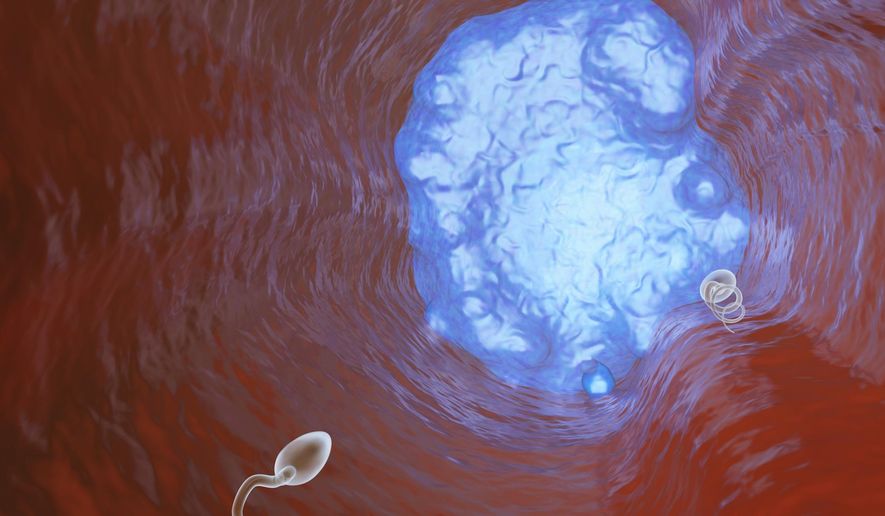

What once required a little snip could soon be accomplished with a pinprick, as researchers explore a nonsurgical and reversible long-term solution for birth control for men.
Researchers have developed a polymer gel called Vasalgel that can be injected into the vas deferens to block the transfer of sperm cells from the testes to the urethra.
A study published Tuesday in the Journal of Basic and Clinical Andrology noted that the researchers have concluded a successful reversal of the procedure in rabbits, restoring their fertility.
“The results of the Vasalgel reversibility study in rabbits indicate the implant could be removed resulting in a quick return of sperm flow,” the study’s lead author, Donald Waller, said in a statement released by the Parsemus Foundation, which funds the study.
To reverse the procedure, researchers injected a baking soda-like solution to flush out the gel.
“We were pleased that the number of sperm and their motility after reversal were no different from baseline measures. More flushing during reversal may be needed to remove traces of the gel from the vas deferens, which appeared to impact other sperm characteristics,” the study notes.
The Parsemus Foundation is a California-based nonprofit that invests in medical research, particularly male contraception. Linda Brent is the foundation’s executive director.
“One thing that people might not think about is that it is a foundation. It’s a nonprofit organization that supports the development of Vasalgel. Our goal isn’t just to make profits, it’s for wide accessibility and affordability,” said Ms. Brent.
For women, a host of products for hormonal and reversible birth control is available. There are dozens of pills, patches, implants, shots and emergency contraception options.
But for men, the only long-term birth control method is the vasectomy, and the short-term solution is the condom.
A Parsemus survey found that 5 percent of couples practice withdrawal before ejaculation, “with a 22 percent failure rate in typical use.” Planned Parenthood recommends practicing withdrawal in conjunction with another birth control method, like the pill or condoms.
Vasectomies are intended to be reversible but are not always successful. Other complications from the procedure include bleeding or infection at the procedure site, sperm leaking from the severed tube or the formation of a small lump of built-up sperm.
Because of the success of the pill for women, pharmaceutical companies sought to replicate that success for men, but with no success.
“The men were having side effects, and there was some pushback,” Ms. Brent said. “Most men are not interested in taking something that could alter their hormonal balance.”
Vasalgel doesn’t contain any hormones. Its gel-like substance is thick enough to block sperm but porous enough to allow “water soluble molecules” to pass through, according to the study.
The gel was first tested on nonhuman primates — 16 adult male rhesus monkeys. They had one week of recovery following the injection before being released to an environment with females present.
“Treated males have had no conceptions since Vasalgel injections,” the study authors wrote in a February study published in Basic and Clinical Andrology.
Minor complications included one monkey with a lump of blocked sperm that wasn’t absorbed into the body, and one incident of incorrect placement of Vasalgel led to a vasectomy. The researchers wrote that such complications were “few and similar to those associated with traditional vasectomy.”
The release of Tuesday’s study is the first publication on reversibility, and the Parsemus Foundation will begin preparing for approval for clinical human trials.
“We’re hoping, if all goes well, we’ll be able to start [the] first small clinical trial in 2018,” Ms. Brent said, adding that they have received a positive public response to the findings. “Thirty-eight thousand people signed up for our newsletter to receive updates on when we’ll begin our trial.”
Contact the author


Please read our comment policy before commenting.