


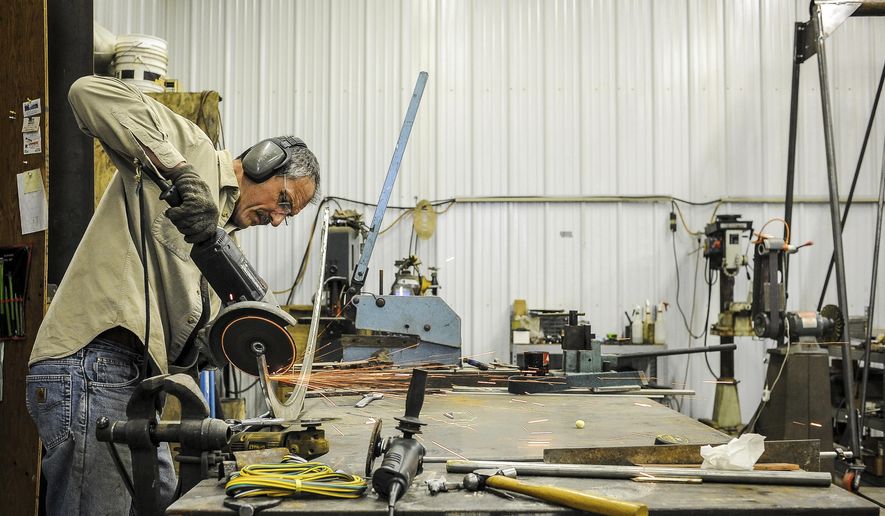

DODGE CENTER, Minn. (AP) - Of all the places he imagined himself, Sebastien Richer never saw himself plying his trade in a pole barn outside of Dodge Center.
Richer’s medium is metal. His artistry is in his ability to mold and shape metal in any way he wants. As a certified master craftsman in the “Compagnon du Devoir,” Richer is a member of a French guild whose roots date back to the 12th century. His finely wrought pieces, made of steel, bronze, brass, aluminum and other malleable metals, grace homes, churches and other buildings on the East Coast and West Coast.
Richer’s resume includes working on the second flame of the Statue of Liberty, a gold-leaf-covered replica of the original flame held by lady liberty that now is displayed in Paris. He had a hand in the restoration of the Palace of Versailles, the seat of power of French kings from the late 17th and 18th centuries.
So the how did he end up in Dodge Center?
It’s easy to imagine how Richer might see it. Given his four decades in metal work, it must feel like living on the edge of the artistic universe, far from his clientele on the coasts that he cultivated, working in a shed on a dead-end street, surrounded by farm fields.
You would be right. But no, it doesn’t bother him, he says. His goal is to find interesting work. And he does. Though it can be more challenging finding commissioned work based in the flatlands of southeastern Minnesota, Richer doesn’t struggle.
“The sad thing is more and more people lack an imagination and are afraid to express themselves in their own house,” Richer told the Post Bulletin in his rumbling, French accented English in reference to Midwestern trends. “They have to conform to architectural digest. They have to conform to what is expected.”
To be acquainted with his work, even superficially, is to realize that there is little in the physical world that Richer can’t re-create using metallic materials. Wrought iron railings, delicately curved brass chandeliers, bronze tables and gates decorated with acorns.
Richer has been living in Rochester for more than a decade, long enough for his work to make its mark in the area. His s-shaped, 10-foot long canoe installed near the Silver Lake fire station as part of the Rochester Art Center’s Art4trails installation is a homage to Native American history. His human-sized safety pin has been ubiquitous, passed from house to house in Rochester.
“My goal is to design something which is going to last by choosing the right material and the right design in a way that works for clients,” Richer said. “The clients give me money to play.”
Even after four decades in metal, Richer doesn’t tire of the work. That’s mainly because nothing Richer does is mass produced. Each job, he said, usually presents him with a new challenge. Whether a staircase or gateway, each has to be molded to fit in a unique environment. Sometimes, his tools have to be custom-made to do the job. No two commissions are the same.
Richer, who was born in Reims, France, describes himself as the “black sheep of the herd” in his fascination with metal. One of his early memories was forging copper and making Celtic jewelry on his mom’s gas stove as a child. When asked what drew him to metal, Richer paused, “Why not? Maybe the fire. Who knows?”
“I was happy as a clam,” he said.
Bored by traditional school, Richer was encouraged by his parents to follow his interests and entered the guild at age 16. He soon was making a living. Richer traveled to England and German as part of his apprenticeship. At the end of his tutelage, Richer was sharing his knowledge and teaching the next generation of metal workers.
Richer’s status and resume in the metal world may be unknown to his neighbors in the U.S., but it opens doors in Europe’s guild system. One time, Richer was exploring the idea of teaching in Strausberg, Germany. Within 30 minutes of telling a friend of his plans, the friend had called back with three job offers.
“In France, with the training I have, it’s not a problem. I have choice,” he said.
Richer met his wife, Evelyn, in what he describes as one of those “crazy” circumstances, thrown together by language. New to the U.S., Richer didn’t speak a lick of English at the time he met her, and Evelyn was the only one person he knew who spoke French.
“We started to spend time together, and we started traveling together. And we never stopped,” Richer said.
And that, in the long run, is how Richer ended up in Rochester. His wife, who graduated from Kenyon High School and is a veterinarian, wanted to return to her roots in southeast Minnesota. Richer felt there was nothing for him in the area. Yet, a year later, after finishing a big project, he had followed her to Minnesota where they have now lived for a decade. The couple has two grown daughters.
Richer said he doesn’t regret the move.
“I’ve moved a lot in my life,” he said. “So basically, it was a positive. If you are going to focus on the bad side, you can focus on the bad.”
Richer played the role of Mr. Mom while his two daughters were growing up. Yet the social opportunities to polish his English, both with fellow artists and stay-at-home moms, were limited by what he describes as his somewhat intimidating presence. Richer is 6-foot-6 and speaks in a powerful baritone. Richer does not blend into the woodwork.
“Most of the ladies were afraid of me,” Richer said. “I was the guy bringing the kids to school. When I work, I work by myself. I have never been able to practice my English fully.”
One gets the impression that Richer’s work doesn’t come cheap. When asked what a Richer-made project costs, Richer declined to get into costs. It is not uncommon for first-time customers to voice concerns about the price of a project. But they soon change their tune.
“In the beginning, they complain because I’m too expensive,” Richer said. “Then they come back and ask me for a second project.”
___
Information from: Post-Bulletin, http://www.postbulletin.com

Please read our comment policy before commenting.