



JACKSON, Wyo. (AP) - The nine can be a little tough to keep on track.
Eight of them are girls, and if they weren’t friends before they joined the Teen Power group, they’re friends now. They have lots to talk and giggle about, especially after school on a Thursday afternoon.
The group of middle-school students is in its baby-sitting unit, one of the club’s more popular offerings and what caught the attention of most of the girls who joined.
“I already had the experience of baby-sitting and I wanted to baby-sit more people,” sixth-grader Liseli Garcia-Torres said.
Among other skills, she has learned “how to not yell at kids when they do something,” she said.
Teton Youth and Family Services Family Advocate and Teen Power coordinator Ben Brettell laughed hearing the feedback.
Teen Power, the ’tween and teen-centric group run by Teton Youth and Family Services, does offer a bit of a soft entry into the job market, teaching its members baby-sitting and pet-sitting skills. It’s partially how the group is marketed to sixth-graders at the beginning of the school year, when Brettell visits classrooms or a group assembly to talk about joining.
“He mentioned making money a lot, so that’s the reason (I joined),” sixth-grader Griffen Anderson said.
While the club does lead kids toward their first informal jobs - typically baby-sitting, pet-sitting or yard work - Brettell sees confidence as the main benefit of the after-school club.
“It’s easy to talk about responsibility, but that’s not how you learn it. You learn by doing,” Brettell said. “Maybe that’s something we sometimes forget about with teenagers. We think about all the negative connotations with teens and ’tweens, and we forget they like to have responsibility. We have to give them some in order for them to know what to do with it.”
It’s a bit of a “rotating cast” of students, but the roster averages about 20 kids a year. The group meets weekly through the school year and a few times in the summer for field trips, visiting places like the Animal Adoption Center to log some volunteer hours and learn about jobs in the animal industry.
It was a program born 15 years ago out of the Teen Center, a place that once found its home at the Center for the Arts. When the Teen Center dissolved, the program lived on, largely thanks to Michelle Rooks, a teacher credited with launching the program and keeping it alive. Four years ago it transferred to Teton Youth and Family Services.
The club starts the year with team-building games, teaching members of the group - some of whom are friends, some of whom walk into the classroom at Jackson Hole Middle School alone - how to work together.
“Some of the activities are maybe even easier doing by themselves, and they get frustrated breaking that down,” Brettell said.
But the games speak to a life skill they’re sure to face: “Most jobs you’re working with people,” he said.
The kids learn leadership skills, build confidence speaking in front of one another and take career assessments, a light entry into thinking about what they may want to be when they grow up. Some of the kids disagree with the findings, which Brettell said is a reasonable conclusion. The point of the activity is less to sort out what the 12-year-olds are going to be when they’re 24 and more to open their minds to the possibilities.
“It’s getting them to think about what different options look like,” he said.
Brettell brings in speakers to talk about jobs, like Jackson Police Department Officer Phil Smith, who spoke to the class alongside K-9 Officer Cigy.
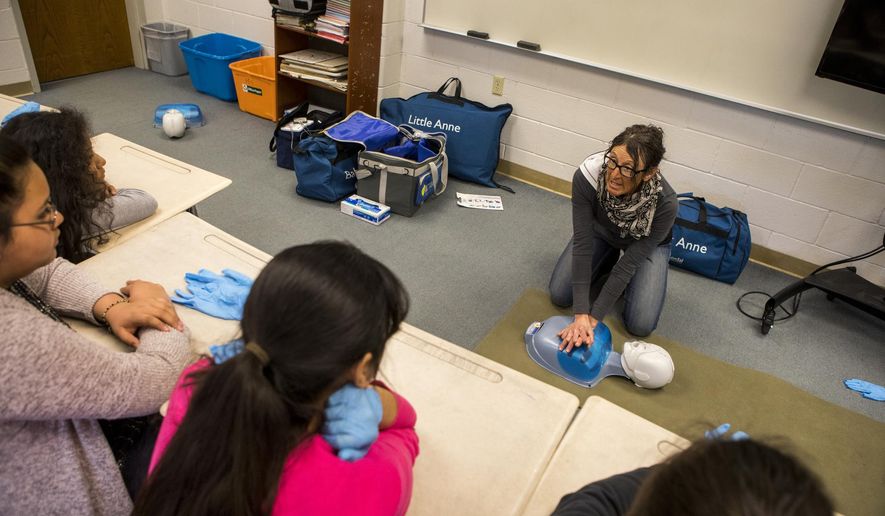
They also hear from experts in the community, like Nancy Bockino, winter programs manager for the Jackson Hole Outdoor Leadership Institute, who lead the group through part one of a two-part series on CPR last week.
-
Many of the girls in the class baby-sit regularly, looking after younger siblings or cousins. Teen Power has helped them round out their skills, teaching them “appropriate punishments” for misbehaving kids and what to do in an emergency.
Bockino arrived one Thursday afternoon with several duffle bags of CPR dummies, medical supplies and simulated AED machines. As the lead instructor for the institute, she has taught a lot of CPR, first-aid and backcountry-safety courses. But the group of 11- and 12-year-olds is probably the youngest she has instructed thus far.
The kids, though a bit distracted through the two-hour course, could already see the benefits before it concluded.
“If somebody gets hurt or something you could help them because you know more than you used to know,” sixth-grader Leslie Perez said.
Bockino started with the basics: how to spot someone in trouble and the first steps to assessing the situation. She reminded the kids to ensure the environment is safe, call 911, tap the person on the shoulder and check to see if she is responsive.
They worked in teams to put together the dummies. One group named its dummy Bob.
“Oh,” Bockino said, looking at Griffen, who was checking on his dummy, “he put a sweater on him.”
Bockino walked around the classroom to check in on the groups, asking the students to showcase the skills she had demonstrated up front: 30 quick heart pumps followed by two breaths of air.
“Let me see you checking for breathing,” Bockino said to Griffen, who put his ear next to the dummy’s mouth. “Perfect, good job.”
When Griffen joined the group he wasn’t really interested in the baby-sitting component, but he said he’s “sorta” interested now.
“It will probably come in handy,” he said. “My mom offered me a job in the summer, a baby-sitting job. So I’ll be prepared for that.”
-
The club caters to kids typically too young to hold an official job in the state - workers must be 14 - but part of the program is hooking up the students, when possible, with small and informal work, Brettell said.
A former club member, for example, was set up with a dog-walking gig.
“It was such a perfect connection,” Brettell said. “They lived a couple blocks away. The dog owner wasn’t able to exercise the dog enough, and the student loved dogs but wasn’t allowed to have one.
“(She) was just so excited because it was true responsibility and she felt trusted,” Brettell said.
Not every student concludes the school year with work for the summer - it just depends on what pairs well with a particular cohort.
Before the end of the school year, the club will ease into building resumes through an activity called “News About Me,” a worksheet that prompts students to think about their strengths and “how do you put yourself on paper.” Brettell has had a few discussions with students about the basics of salary negotiations, suggesting they agree to a price for service before accepting a job. They learn a few interview skills by working in groups, asking one another questions.
But when it comes to finding work, Teen Power offers the connection. The rest of the details of the relationship is left to the student.
“That’s a lot of what I do in general, make the connection,” Brettell said. “Sometimes it’s a one-time deal, and sometimes it turns into a weekly thing for a couple hours. It’s cool when it takes a life of its own, and it speaks to the power of giving them the opportunity.
“I think of the real benefit less as the hard skills of job preparation and more on the soft stuff of confidence, willingness to work with someone you’re not familiar with, to try new things. To feel valued is maybe the biggest one, to be an asset to your community instead of always being the negative side of the teenager that people are quick to think of.”
___
Information from: Jackson Hole (Wyo.) News And Guide, http://www.jhnewsandguide.com

Please read our comment policy before commenting.