


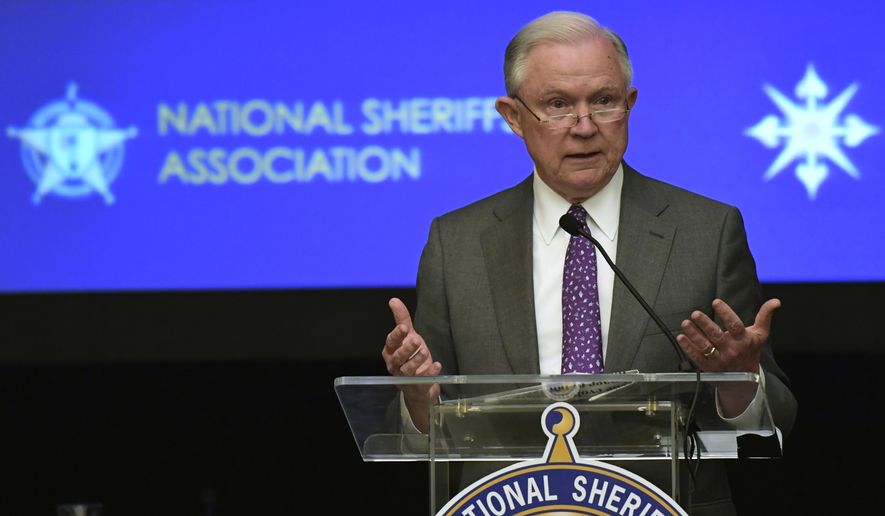

Attorney General Jeff Sessions said Thursday that keeping federal investigators on the job past retirement will bulk up understaffed agencies in the wake of the opioid crisis.
Speaking to the National Sheriffs’ Association’s Opioid Roundtable, Mr. Sessions unveiled a three-prong plan to hang on to experienced narcotics officers.
The plan includes raising the retirement age to 60 instead of 57; bringing back already-retired agents to work part-time and contracting former state narcotics officers to work for federal agencies such as the Drug Enforcement Administration.
People were interested in these podcasts
“Why not see how many people we keep?” Mr. Sessions said. “That is like a new, well-trained, experienced person on the job.”
Mr. Sessions said the length of time it takes for a new agent to get up to speed is too long for a nation facing an epidemic drug crisis.
About 64,000 people died from drug overdoses in 2016 and 42,000 of those deaths were related to opioids, according to Justice Department statistics. By keeping experienced agents on longer, law enforcement can better face the issue.
The attorney general said grant money could be used to pay for retaining former or retiring agents, but did not offer specifics.
He also emphasized that retiring agents might enjoy the opportunity to stay in the game. Those agents would reduce their workload to a maximum of 20 hours a week, according to Mr. Sessions’ plan.
“Wouldn’t that be fun?” he said about remaining on the job in a reduced capacity. “You could go see your grandchildren when you want to.”
Mr. Sessions comments came hours after the Department of Justice announced the indictment of five physicians associated with a Western Pennsylvania treatment center.
The defendants, who worked as contractors at Redirections Treatment Centers, are charged with conspiracy to unlawfully distribute prescriptions for an addiction treatment drug and with fraudulently billing Medicare for it.
Doctors who prescribe such medicines are a target of the administration, Mr. Sessions said. The administration reduced the number of opioid prescriptions by 10 percent last year, shy of President Trump’s goal of lowering the number of such prescriptions by one-third.
The attorney general urged local sheriffs to focus on doctors who are illegally prescribing opioids.
“I hope you are keeping an eye on them,” he said. “We are hearing too many concerns about treatment centers.”
Since the start of the year, Mr. Sessions has announced a number of initiatives to reduce opioid prescriptions. One of his most ambitious efforts, the Prescription Interdiction and Litigation Task Force, will review all civil and criminal penalties available to pursue charges against opioid producers.

Please read our comment policy before commenting.