


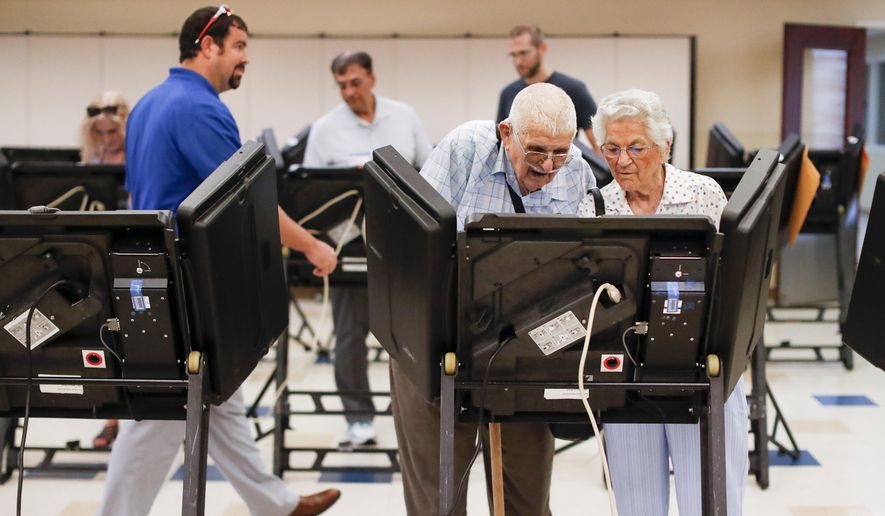

A federal court ruled Friday that Ohio’s legislative district map illegally discriminated against voters based on political party affiliation and must be redrawn ahead of the 2020 election.
The three-judge panel for the Southern District of Ohio said GOP lawmakers in the state pushed through a “remarkably pro-Republican redistricting bill” in 2011, taking advantage of their majority, and were assisted by partisan operatives in Washington, D.C.
The court held the Republican lawmakers discriminated against Democratic voters’ associational rights in all of the 16 districts without justification.
People were interested in these podcasts
“They designed these districts with one overarching goal in mind — the creation of an Ohio congressional map that would reliably elect twelve Republican representatives and four Democratic representatives,” the judges said in the 298-page opinion.
The state has to create a remedial plan by June 14 ahead of the 2020 elections.
Jen Miller, executive director of the League of Women Voters of Ohio, which brought the lawsuit, said the ruling restores voters’ voices.
“Ohio voters have been without fair congressional district maps since 2011, and the panel’s decision today means that they will be fairly represented in future elections,” she said.
The ruling comes after a federal court threw out Michigan’s legislative map last week, also ordering it must be redrawn ahead of the 2020 election because it also disadvantaged Democratic voters.
“This is yet another win for voters when it comes to more equal representation at the ballot box. Along with last week’s ruling in Michigan, the Ohio district court’s order shows that there are fair solutions to gerrymandered maps,” said Virginia Kase, CEO of the League of Women Voters.
Partisan gerrymandering has become a major flashpoint for politicians and the legal community, with voting-rights activists saying that piling voters of one party into some districts to dilute their power while spreading voters of the other party out among districts to increase their power runs afoul of the U.S. Constitution’s guarantees of equal rights.
The Supreme Court, however, has not yet reached that same conclusion.
Although justices have expressed concern over the extent of gerrymandering, they’ve struggled to draw clear lines to identify when a map is too partisan.
The court punted on one partisan gerrymandering case out of Wisconsin the last term, but it has other cases pending this term that put the issue back squarely before the justices. A decision is expected by June.
The National Republican Redistricting Trust urged the justices to weigh in after the Ohio ruling, saying Democrats will continue to bring challenges unless the high court “makes clear once and for all that these cases lack standing in federal court.”
“The truth is that Democrats have failed to run viable elections in Ohio for 10 years. That has nothing to do with the maps and everything to do with how out of touch modern Democrats are with the people of Ohio,” the organization said in a statement.
Contact the author


Please read our comment policy before commenting.