


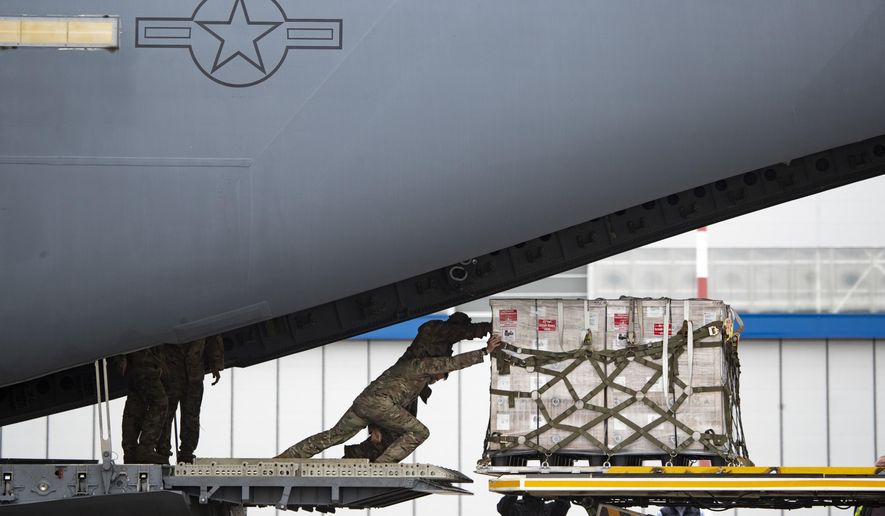

The Department of Defense has completed more than a dozen aeromedical evacuation missions to safely transport patients infected with COVID-19 in forward-deployed locations to hospitals in Europe or the United States.
Undersecretary of Defense Ellen Lord told reporters Monday the 78th department-affiliated coronavirus patient was successfully evacuated last week — the 14th such mission since the pandemic erupted.
“These missions have moved service members, [Department of Defense] contractors, civilians and two dependent children,” Ms. Lord said. “We are fully committed to the safety of our air crew, medical support staff and patients during these missions.”
People were interested in these podcasts
An Air Force system initially designed to transport infected patients during the 2014 Ebola outbreak is being used to evacuate those who have tested positive for COVID-19, the respiratory disease caused by the novel coronavirus. The Transport Isolation System (TIS) is a self-contained infectious disease containment unit designed to isolate up to four patients aboard an aircraft.
At this point, only the C-130 Hercules and the C-17 Globemaster III are able to carry the TIS capsule.
“Being able to help them when they’re needing it most is what we do. That’s why we’re here,” said Air Force Capt. Dan Cotton, a C-17 pilot. “It makes climbing into the C-17 and helping out with the [aeromedical evacuation] missions feel really impactful.”
The TIS was first used in April when three U.S. defense contractors in Afghanistan tested positive for COVID-19. They were placed in the TIS and flown to Ramstein Air Base in Germany to receive medical attention at a U.S. military hospital.
The Transportation Isolation System “has really expanded our capabilities to the point where we’re able to continue the [aeromedical evacuation] mission without any major interruptions by COVID-19,” said Capt. Freddy Roman-Otero, an Air Force flight nurse. “Despite the technology being made for Ebola, we’ve adapted it to suit today’s needs.”
Contact the author

Please read our comment policy before commenting.