


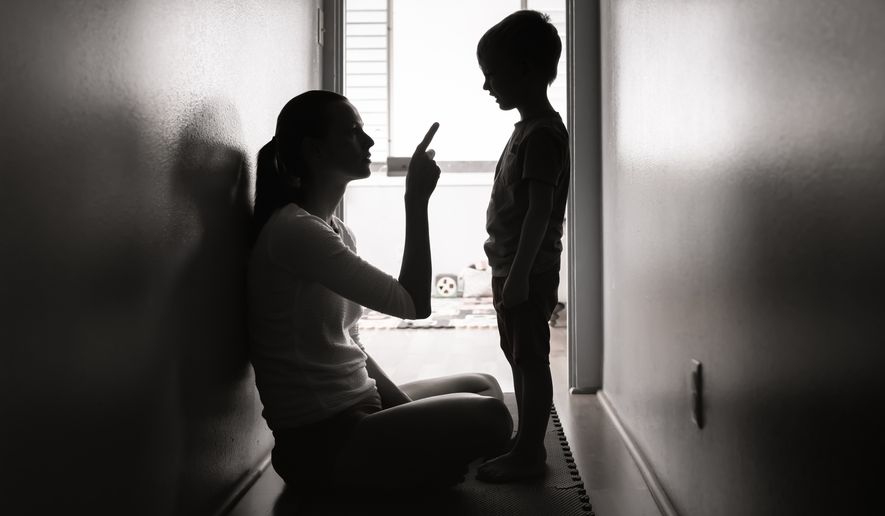

Some conservative and Christian family advocates say millennials shouldn’t feel guilty about spanking their kids this holiday season — as long as it’s a gentle swat on the bottom and not actual physical abuse.
They say parenting experts who oppose spanking don’t appreciate the maternal wisdom that a smack on the bottom is often the best way to stop toddlers from putting their fingers in electrical sockets or pulling down Christmas trees in an effort to help clean up decorations — common situations where reason fails.
“I feel no shame in saying I’ve spanked my kids on the backside on occasion when they did something or were about to do something dangerous,” said Julie Gunlock, director for the Center for Progress and Innovation at the Independent Women’s Forum. “They’re doing just fine.”
People were interested in these podcasts
Ray Guarendi, a clinical psychologist and Catholic media host based in Canton, Ohio, said 70% of the 100 faith-based families he surveyed for his 2013 research book “Back to the Family” said they “were not averse to using a swat in the context of a very loving home.”
“Bad spanking causes problems where it is an emotional reaction, over the top, but a spank here and there by loving parents under certain conditions has no research support to say that it is problematic for a child’s development,” Mr. Guarendi said.
Spanking had been a long-accepted form of punishment before child psychologists and advocates began questioning and criticizing the practice in the late 1960s. Since then, parental spanking has been largely frowned upon and corporal punishment at schools has been banned in many jurisdictions.
However, spanking remains legal for parents in all 50 states and the District of Columbia, as long as the punishment is reasonable and does not cause injury.
And many parents accept the practice: A Reuters/Ipsos poll in October 2014 found that 7 in 10 Americans said spanking a child at home was acceptable and most said corporal punishment was tolerable if it did not use implements.
According to a UNICEF report on violent discipline from August, around 1.1 billion caregivers across the globe still view corporal punishment as necessary to properly raise or educate a child in 2021, and 2 out of 3 children in most countries have experienced it.
But the report discourages spanking, calling it a form of “violent discipline.”
Such discipline need not be violent, according to the evangelical Christian ministry Focus on the Family, based in Colorado. A spokesman provided a link to the ministry’s website with guidelines for the “appropriate use of spanking” on children older than 18 months and younger than 3½ years.
“Give your child a warning before each spankable offense,” the website states. “If he deliberately disobeys, inform him of the upcoming spanking, escort him to the designated room, and mete out the punishment.”
An appropriate spanking is “one or two swats on the buttocks,” states the website, which also provides a counseling hotline for parents who have questions.
Still, there is a consensus against spanking among pediatricians and psychologists, who cite research showing harmful developmental effects.
Aliza Pressman, a developmental psychologist who hosts a podcast on parenting issues, said the American Academy of Pediatrics (AAP) discourages even the gentlest form of spanking as ineffective and subject to abuse.
“Parents who use spanking to gently guide their children are misguided in their approach, but they shouldn’t have their children taken away,” said Ms. Pressman, a clinical professor in the Icahn School of Medicine at Mount Sinai. “They should be given better tools and support to understand that spanking has no place in rearing children.”
Ronald Rohner, a comparative psychologist who directs the Center for the Study of Parental Acceptance and Rejection at the University of Connecticut, said spanking experienced as parental rejection can lead to “a whole range of internalized developmental issues” including aggression, impaired self-esteem, depression, emotional problems, anxiety and insecurity.
But he also said this research doesn’t account for children who experience spanking as a positive.
“The problem with that research, in my opinion, is that it doesn’t control for how the kids perceive the punishment’s fairness and harshness,” Mr. Rohner said. “It doesn’t distinguish a mild slap or swat.”
Ms. Gunlock, whose work on family issues focuses on regulation and public policy, said it would be wiser for young parents to trust their instincts than experts.
“What we need in the parenting space are fewer ‘experts’ who have created an industry making parents feel guilty about their perfectly reasonable and understandable parenting decisions, and more compassion toward parents who are likely doing their best in a panicked situation,” she said.
Contact the author


Please read our comment policy before commenting.