


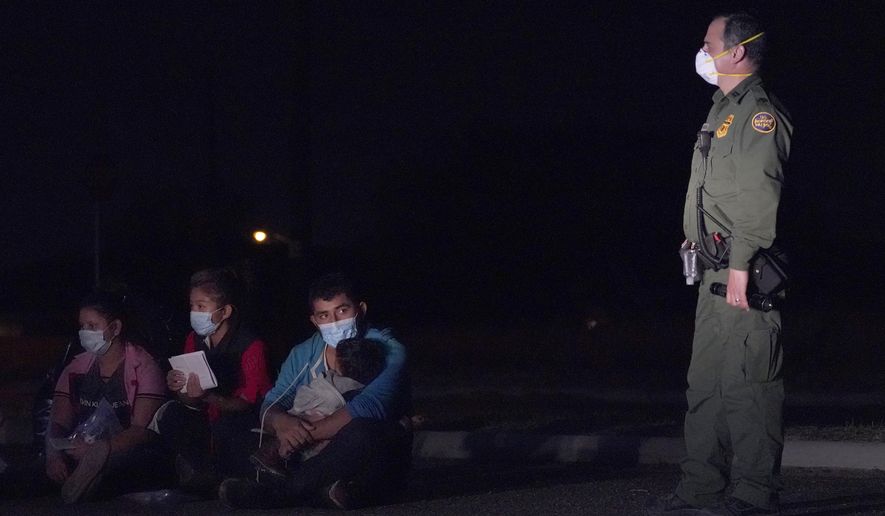

The Biden administration is reframing the migrant crisis at the U.S.-Mexico border, saying the influx results not from any White House actions, but rather from climate change in Central America’s Northern Triangle of El Salvador, Guatemala and Honduras.
Vice President Kamala Harris, who has been tasked with leading the White House’s response to the crisis, made the argument this week during a speech before the Conference of the Americas in Washington.
“The citizens of El Salvador, Guatemala, Honduras are leaving their homes at alarming rates. But there’s a fundamental truth behind that headline,” Ms. Harris said. “They leave only when they feel they must … And so we are focused on addressing both the acute factors and the root causes of migration.”
One of those root causes, according to the vice president, was “the lack of climate adaptation and climate resilience” by countries in the Northern Triangle. Ms. Harris argued that increasing temperatures and rising sea levels, in particular, had devastated the economics of the countries.
“We must focus on … the catastrophes that are causing people to leave right now,” the vice president said, adding that climate change made hurricanes, “drought and extreme food insecurity” in the Northern Triangle worse.
Ms. Harris’ framing of the issue comes as the migrant crisis on the southern border continues unabated. Most of those attempting to enter the U.S. illegally are from the Northern Triangle, according to Customs and Border Patrol officials.
Starting after the 2020 election, the flood of migrants has reached levels unseen in more than a decade.
In March alone, 170,000 individuals were apprehended trying to jump the border. A substantial portion of those were unaccompanied minors, below the age of 14.
One recent study indicates that if the trends continue, the U.S. could see about 1.2 million illegal immigrants traverse the southern border this year.
As part of its effort to stem the migration, the White House is proposing to boost climate change spending and aid to Central America. President Biden has already committed to spending $4 billion to help countries in the Northern Triangle rebuild their economies and weatherize their infrastructure.
“Our administration wants to help,” Ms. Harris said. “In Honduras, in the wake of hurricanes, we must deliver food, shelter, water and sanitation to the people. And in Guatemala, as farmers endure continuous droughts, we must work with them to plant drought-resistant crops.”
Experts say the focus on climate change diverts attention from the real issues contributing to illegal immigration, both domestic and international.
Countries in the Northern Triangle, for instance, rank low for economic mobility, democratic protections and healthcare. Meanwhile, they also tend to rank high in corruption, violence and unemployment.
Most residents in the region live below the poverty line and are employed in low-skill jobs that do not provide benefits, such as health care. The lack of healthcare, in particular, has been underscored during the coronavirus pandemic, as transmission and infection rates in those countries are some of the highest in the globe.
Similarly, the region has been wracked by crime and violence for decades, leading the Northern Triangle to be recognized as one of the most dangerous areas of the world.
Studies show that crime and gang violence are the leading causes for the exodus of migrants toward the U.S., after lack of employment.
“The institutional issues facing countries in Central America cannot be resolved overnight,” said Andrew Arthur, a resident fellow in law and policy at the Center for Immigration Studies.
While it is true that Northern Triangle economies have suffered because of hurricanes and climate-related disasters, the situation is nothing new for the region.
“Storms and droughts have been a factor for decades, especially in Central America,” Mr. Arthur said. “Back in 1998, Hurricane Mitch caused nearly 11,000 fatalities in the region, yet apprehensions remained on average for the time.”
“Historically we’ve seen much larger waves of migrants coming to the U.S. over time,” he added. “Back in the 1980s, there were more than a million coming here, which was before climate change hit the forefront.”
Some also contend that the rhetoric and policies embraced by the White House cannot be discounted as reasons for the uptick in illegal immigration.
Mr. Biden, most notably, has proposed legislation expanding protections for illegal immigrants and the creation of a pathway toward citizenship for the more than 11 million illegal immigrants living in the U.S.
“Let’s end our exhausting war over immigration,” the president said during his joint address to Congress last month. “For more than 30 years, politicians have talked about immigration reform, and we’ve done nothing about it. It’s time to fix it.”
Republican lawmakers point to the reinstitution of “catch and release,” a policy in which illegal immigrants are discharged into U.S. communities after apprehension to await a hearing in immigration court, for fueling the crisis.
“The Border Patrol has told me that the biggest problem we have now is there [are] no consequences associated with entering the country illegally,” said Sen. John Cornyn, Texas Republican.
The White House did not return requests for comment.
Contact the author


Please read our comment policy before commenting.