


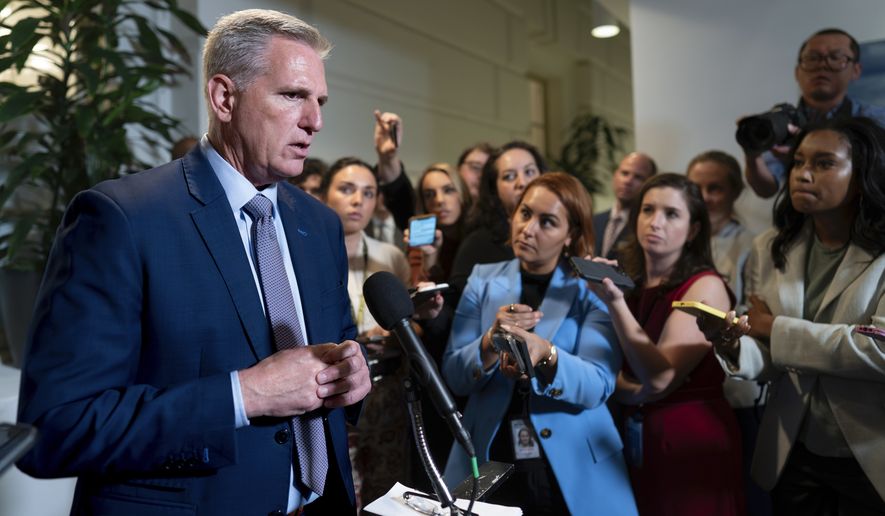

A group of House Republicans scuttled a vote to advance the annual defense spending bill on Tuesday, delivering another setback for Speaker Kevin McCarthy in a sign of difficulty ahead to pass a short-term funding measure to keep the government open.
The House failed to advance the Department of Defense spending bill in a 212-214 vote, with five members of the House Freedom Caucus joining all Democrats in voting against the measure.
The GOP defections blocked what should have been a layup for Republicans and underscored the bitter divide that is pushing Congress toward a partial government shutdown on Sept. 30. Their vote against the defense measure is one that lawmakers are unlikely to forget.
People were interested in these podcasts
“There’s five individual members of the Republican conference that are solely responsible for this happening,” said Rep. Derrick Van Orden, Wisconsin Republican. “There’s five of them, and let’s just remember that.”
The five Freedom Caucus lawmakers who voted against the bill were: Reps. Andy Biggs of Arizona, Dan Bishop of North Carolina, Ken Buck of Colorado, Ralph Norman of South Carolina and Matt Rosendale of Montana.
The conservative caucus has consistently pressed for a guarantee that the topline spending numbers for all the dozen appropriations bills hits their target of $1.471 billion, which is well below the caps agreed to by Mr. McCarthy and President Biden in the debt-ceiling deal earlier this year.
Mr. McCarthy, of California, pulled the same bill from a vote last week over concerns it did not have enough votes to pass. So far, the House has only passed one of the 12 annual spending bills that keep the government running.
This latest setback for the top House Republican comes as he also struggles to get the necessary votes to pass the stopgap spending resolution to keep the government open after Sept. 30 and give lawmakers more time to negotiate a full-year funding bill for fiscal 2024.
Another sign of trouble is that even though members of the Freedom Caucus and the more moderate Republican Main Street Caucus hammered out a short-term continuing resolution, House leadership opted to nix a procedural vote on the measure that was slated for Tuesday afternoon.
Eighteen lawmakers, the majority of whom are members of the Freedom Caucus, have said they will not support the proposal that would keep the government open.
The short term measure includes an 8% cut to non-defense discretionary spending for 30 days, fully funding disaster relief, and includes parts of the Secure the Border Act — a measure that Freedom Caucus lawmakers have said is a priority for their support on a continuing resolution to keep the government open.
Freedom Caucus member Rep. Chip Roy of Texas, one of six lawmakers who brokered the deal, said his colleagues would have a lot of explaining to do if they vote against it.
“Go explain that you’re voting against a 30-day, 8% cut to the federal bureaucracy while having a piece of legislation attached to it that is the strongest border legislation ever passed, and it was passed out of this House Republican conference,” Mr. Roy said.
Main Street Caucus Chair Rep. Dusty Johnson, South Dakota Republican, said he has spoken with lawmakers who were initially skeptical of the measure “largely because of misinformation.”
“On Thursday, I’m going to vote to cut the government and I will vote to secure the border. I would imagine that would be a very hard vote for other Republicans to break with,” Mr. Johnson said.
House Democrats are likely to vote en masse against the measure because of the border bill, and the legislation is all but dead-on-arrival in the Democrat-led Senate.
The border measure includes ending catch-and-release programs, restarting the Trump administration’s “Remain in Mexico” policy and continuing construction of the border wall. It also includes provisions to hire more border agents and increases collection of DNA from migrants.
Notably absent from the stopgap measure is the E-Verify provision, which would have made the E-Verify work authorization platform mandatory for businesses.
That omission has caused some House Republicans, like Rep. Marjorie Taylor Greene of Georgia, to oppose the overall measure.
Also absent from the measure is President Biden’s $24 billion request for more Ukraine funding, which means that if the House is able to advance the bill, it would likely be a nonstarter for both Republicans and Democrats in the Senate.
Freedom Caucus Chair Rep. Scott Perry, of Pennsylvania, said there are two paths for House lawmakers.
“One path is where we offer something and the American people can see what we stand for,” Mr. Perry said. “The other path is quite honestly accepting whatever the Senate sends us, which is likely to be 100% worse than everything and anything that we stand for, that’s the two options that we have.”
Mr. Perry said that he is engaging in conversations with members of his caucus opposed to the measure, and signaled that he would be open to making changes to it.
“My message is ’what is it that you’re interested in doing that you’re not seeing here and can we accommodate that?’,” Mr. Perry said. “And by accommodating that do we lose other votes to accommodate you, if we can accommodate you and keep the votes, let’s accommodate you.”

Please read our comment policy before commenting.