



Arrests in shootings, carjackings and robberies are up in the District this year thanks to the city’s beefed-up surveillance camera system and crime-weary residents’ willingness to talk to police.
Metropolitan Police Chief Pamela Smith said in an interview with The Washington Times that the cameras have helped but her officers have worked hard to establish better relations with the people they serve.
“The arrest rate is really about the officers doing great work in our communities, but also the communities really helping us with the crime that’s happening,” Chief Smith said. “What I mean by that is that giving us good tips, giving us good information.”
Another factor could be a more manageable workload for investigators. The upswing in case closures overlaps with the sizable drop in violent crime through the first five months of 2024.
Local lawmakers suggested in 2023 that the Metropolitan Police Department’s struggles to bring justice compounded the most violent year this century.
Chief Smith, who will mark one year in the post next month, has implemented promising policing changes.
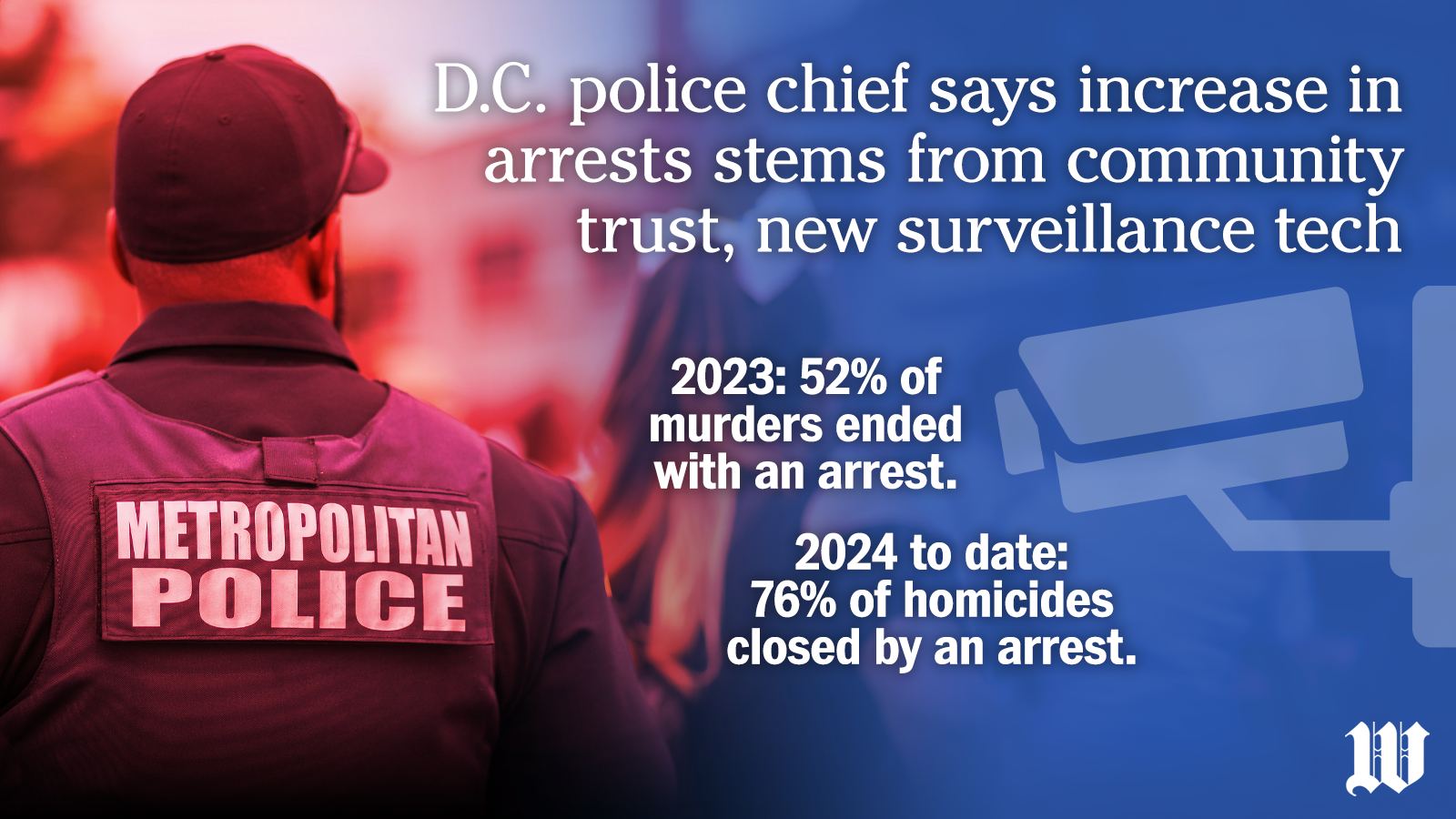
Crime statistics from the first three months of the year show arrests in 76% of homicides, 68% of weapons assaults, 44% of robberies and 34% of nonfatal shootings.
Last year, police made arrests in 52% of homicides, 51% of armed assaults, 27% of muggings and 26% of shootings that didn’t result in fatalities.
D.C. Council Chairman Phil Mendelson pointed last year to the low arrest rates to suggest people could “get away with murder in this city.”
The crime wave resulted in a 26-year high in homicides, record-high carjackings and frequent ambush-style robberies of pedestrians.
All three of those crimes have shown major year-over-year drops. D.C. police reported a 26% reduction in violent crime through Monday.
Chief Smith said the Real Time Crime Center, a massive surveillance hub that taps into CCTV feeds and business and residential cameras throughout the city, helps gather live video evidence and blast it out to the public and police teams simultaneously.
Chief Smith said the key factor has been officers mingling with people in neighborhoods. The initiative has engendered more trust and persuaded onlookers to cooperate with officers when violence erupts.
Research indicates that witnesses remain crucial to building investigations, even as technology gives police more eyes on crime scenes.
A 2021 Manhattan Institute study found that “most successful investigations had as one key source of evidence the information provided by a cooperating eyewitness.”
The study, which looked at Boston’s arrest rate for deadly and non-deadly shootings from 2010 through 2014, said a bystander’s recollection was the key to solving 28% of all homicide cases and 14% of all injurious shootings in that period.
A pivotal witness who observed a deadly Northeast shooting on Memorial Day helped police make an arrest and provided physical evidence to MPD detectives.
Court documents said officers found Chidozie Njoku, 23, shot dead around 2:45 p.m. on May 27 in an apartment parking lot on the 4000 block of Minnesota Avenue Northeast.
Minutes later, someone phoned 911 with a precise description of the shooter: a light-skinned Black male with a purple gun who was walking on the pedestrian bridge by the Minnesota Avenue Metro Station.
The gunman was only a block away from the parking lot where Njoku was shot, the filing said. Officers arrested 20-year-old Shannon Updike after a brief foot chase.
The caller even shared photos with investigators at the scene and gave them a play-by-play account of what led up to the slaying, including Mr. Updike saying, “I don’t care if I catch another body today,” according to court documents.
Crime victims are even delaying medical treatment to assist police investigations.
An arrest affidavit said a man wounded in a March shooting immediately went to a police substation in Southeast instead of a hospital.
The filing said the description of the gunman, combined with surveillance footage from the area of the shooting, allowed police to create a lookout.
An officer came forward with an identification, court documents said, and detectives got in touch with a parole officer who told investigators the alleged gunman was his client.
Police executed a search warrant at the home of Calvon Brown, 30, about a month later and booked him on charges of assault with a dangerous weapon.
Chief Smith said the District’s success in closing robbery cases is likely a result of better patrol routes.
Robberies have one of the lowest clearance rates of all violent crimes nationwide. FBI data from 2022 showed law enforcement agencies made arrests only 23% of the time.
The chief said she frequently reviews crime trends to determine where to send officers.
“It’s making sure that we have officers in the right place,” the chief said, referring to the department’s Robbery Suppression Initiative launched last summer. “Looking at our data and looking at the evidence on how we are utilizing [the] hot spot policing concept.”
A police sergeant passing through the Edgewood neighborhood in Northeast on May 20 was flagged down by a person reporting the robbery of a phone in an ambush, court records show.
A short canvas of the area ended when authorities arrested 34-year-old Malik Martin-El a few blocks away and charged him with violent theft.
Outside of violent crimes, Chief Smith said, the department’s Operation ATLAS (Action Teams Leaving Areas Safer) is a roving patrol unit that moves around the city and addresses smaller infractions such as the use of fake license plates and disobedience of traffic laws.
The chief said the ATLAS units are tamping down some of the everyday lawlessness residents see around the District.

Please read our comment policy before commenting.