


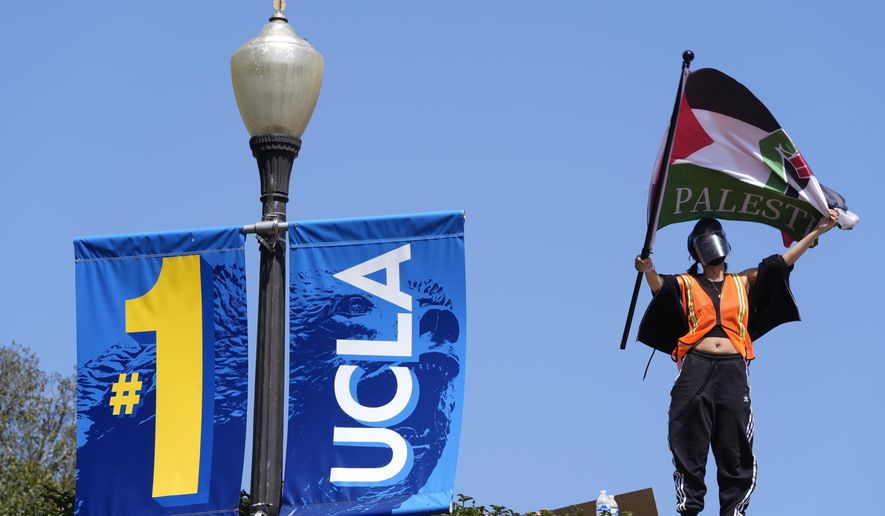

Pro-Palestinian and pro-Israel demonstrators agree on one thing: Universities are violating their First Amendment rights.
Activist lawsuits citing the First Amendment are squeezing schools nationwide as administrators seek to maintain safety and decorum on their campuses.
“Universities are in a difficult position,” said Will Creeley, legal director for the Foundation for Individual Rights and Expression. “It’s a minefield, and what we are worried about … is that schools are going to err on the side of censorship first, ask questions later.”
People were interested in these podcasts
Public and private universities have been hit with lawsuits over campus responses to demonstrations since Hamas’ Oct. 7 deadly assault on southern Israel and the Jewish state’s retaliation against the Palestinian terrorist group in the Gaza Strip.
• The Brandeis Center for Human Rights Under Law filed a federal complaint this week accusing Harvard University of tolerating “cruel anti-Semitic bullying, harassment, and discrimination” before and after Hamas’ massacre of Israeli civilians.
“Through its public actions and failures to act, Harvard has made its position clear: Jews are fair game,” reads the lawsuit filed in U.S. District Court for Massachusetts. “Students and faculty can harass and discriminate against Jews, and they can do so openly and with impunity. Harvard will go out of its way to protect antisemitic protesters and conspiracy theorists.”
The Brandeis lawsuit cites examples of harassment and hostility, including the experience of one Israeli student at Harvard Business School who was accosted, pushed and harangued by protesters as he walked through and took footage of a November “die-in.”
• Last month, a Jewish student sued officials of Columbia University in New York because of harassment by pro-Palestinian demonstrators.
In one incident, more than 100 protesters locked arms and marched toward a female Jewish student wearing a Star of David necklace and forced her to leave the area.
“The segregation of Jewish students is a dangerous development that can quickly escalate into more severe acts of violence and discrimination, underscoring the critical importance of addressing and combating such behavior at its early stages,” the lawsuit reads. “Plaintiff C.S. brings this lawsuit to hold Columbia accountable for failing to provide a safe educational environment for its students.”
Jeff Swartz, a professor at Cooley Law School, said the Jewish student has a “legitimate cause of action” against Columbia because the student isn’t asking for damages but a security fix.
“That is an easy fix,” he said. “As far as any restraint on the university regarding First Amendment rights, I think that as long as they say we provide the ability of students to demonstrate but don’t allow them to camp, I think they will be OK.”
• University of Virginia officials are facing a lawsuit filed last week by a Jewish student who alleged harassment and discrimination against Jews because of their faith. The student said he had to leave his dorm because school leadership failed to address his safety concerns.
• University of California, Davis, officials face a lawsuit filed this month by a disabled veteran who says a 200-person encampment blocked a public sidewalk, making it difficult for him to move about.
School officials told reporters that the university is committed to a “safe and peaceful campus environment.”
“When the university receives a complaint of denial of reasonable accommodation, antisemitism or other offensive behavior, it immediately reaches out to the affected parties to provide support and resources, and reviews the allegations under the university’s anti-discrimination policy,” the statement reads.
• The American Civil Liberties Union filed a lawsuit against University of Florida officials and others in November over a chancellor’s order stating that Students for Justice in Palestine chapters violated a state law against providing material support for terrorism. The group hosted boycott, divestment and sanctions teachings; vigils for Palestinians killed in war; and social events highlighting Palestinian culture.
The lawsuit alleged that the chancellor’s order violated the students’ and the group’s First Amendment rights.
“Independent political advocacy — no matter its viewpoint — is fully protected by the First Amendment,” the lawsuit read.
The lawsuit named as defendants Raymond Rodrigues, chancellor of the State University System of Florida; Gov. Ron DeSantis, a former Republican presidential candidate; and University of Florida President Ben Sasse, among others.
A judge ruled in January that Mr. Rodrigues does not plan to disband the student chapters, two of which are in Florida schools. Students for Justice in Palestine has 200 chapters nationwide.
“Florida officials are now on notice that if they attempt to enforce the deactivation order, we will be back in court to uphold our client’s First Amendment rights,” said Brian Hauss, a senior staff attorney with the ACLU. “The Chancellor should formally acknowledge that the deactivation order will not be enforced by removing it from his official website.”
• Valerie Richardson contributed to this report.
Contact the author


Please read our comment policy before commenting.