


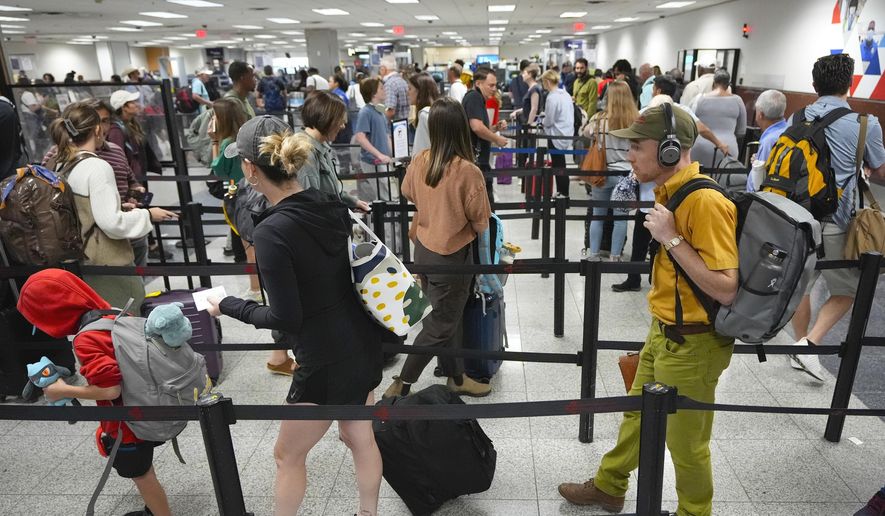

The Justice Department is trying to prosecute a left-wing activist because he used a duress passcode to erase his phone’s data while being detained at the Atlanta airport.
But lawyers for Samuel Tunick argue the federal government violated their client’s constitutional rights when customs agents held him under allegedly false pretenses of looking for child pornography to search his mobile device.
Mr. Tunick now faces charges of felony destruction of evidence, although the defense team said authorities lied about wanting to search for child pornography and instead sought information about his activist ties.
People were interested in these podcasts
The case stems from Mr. Tunick’s arrival at Hartsfield-Jackson Atlanta International Airport in January 2025 following his vacation in the Dominican Republic.
Court documents filed last month by the defense team said Mr. Tunick was flagged for a secondary inspection while going through customs back in the U.S. and questioned by Customs and Border Protection’s terrorism investigators.
The filing said Mr. Tunick, who is an American citizen, was patted down and had his luggage searched before agents asked for the passcode to his phone.
“Despite Mr. Tunick’s request to speak with his lawyer and not engage in further questioning, the officers insisted that they could question Mr. Tunick and search his phone to determine whether he had child porn,” the defense team’s court papers said. “Evidently, this was a pretext for a fishing expedition into Mr. Tunick’s connections with the Defend the Atlanta Forest movement.”
The Defend the Atlanta Forest movement was also known as Stop Cop City, a group of left-wing activists who camped out in a wooded area that local politicians approved to be the site of a training facility for the Atlanta Police Department.
The activist encampment made national news after a January 2023 law enforcement raid saw Manuel Esteban Paez Teran shot and killed by Georgia State Patrol troopers.
Officials said the troopers ordered Paez Teran, who went by the name Tortuguita, to get out of his tent and leave the scene.
When Tortuguita refused, authorities said they fired pepper spray into the tent. The suspect responded by pulling out a pistol and firing on the troopers.
The troopers returned fire and killed Tortuguita. One trooper was seriously wounded in the shooting.
Other members of the Stop Cop City protesters were criminally charged for their role in the protest, but Mr. Tunick’s defense team said he was not one of them.
July’s filing said customs agents pressed Mr. Tunick for his phone’s passcode again, with the document quoting agents’ body-worn cameras saying they had broader search authority because “when it comes to immigration and customs, it’s a whole different ballgame. … We don’t need a warrant.”
After Mr. Tunick gave agents the duress passcode, the device’s “screen went blank, flashed several times and the phone appeared to restart,” the filing said.
The duress passcode comes from GrapheneOS, an operating system that can be used for some Android phones.
The defense attorneys said agents violated Mr. Tunick’s Fifth and Sixth Amendment rights by not reading him his Miranda Rights and disregarding his multiple requests to speak with his attorney.
The following attempts to search his phone, the attorneys said, violated his Fourth Amendment rights against unlawful search and seizure.
The defense team said the pretext of looking for child pornography on Mr. Tunick’s phone was never mentioned again by investigators or prosecutors, suggesting that it was intended to criminally nail him to the left-wing group.
Legal experts said Mr. Tunick’s case presents uncharted territory for the rights of border authorities.
Missy Owen, president of the National Association of Criminal Defense Lawyers, said the Supreme Court has not ruled on whether the border agents’ greater latitude to conduct searches applies to cellphones.
But she said that modern phones are not analogous to other travel items that often don’t require a warrant to access.
“Phones are not like luggage. This understanding of a phone being like carrying a tote bag — those two things are not the same,” Ms. Owen said. “The Supreme Court has recognized that a phone holds personal details for a person’s entire life, so that search deserves real constitutional protection, including at the border.”
A federal judge has until the end of October to deliver a ruling on the defense team’s motion to suppress the government’s evidence against Mr. Tunick.
If the case proceeds and Mr. Tunick is convicted, he could be sentenced to up to five years in prison for wiping evidence.

Please read our comment policy before commenting.