



The federal government has topped $40 trillion in total debt for the first time in history, setting a record for red ink.
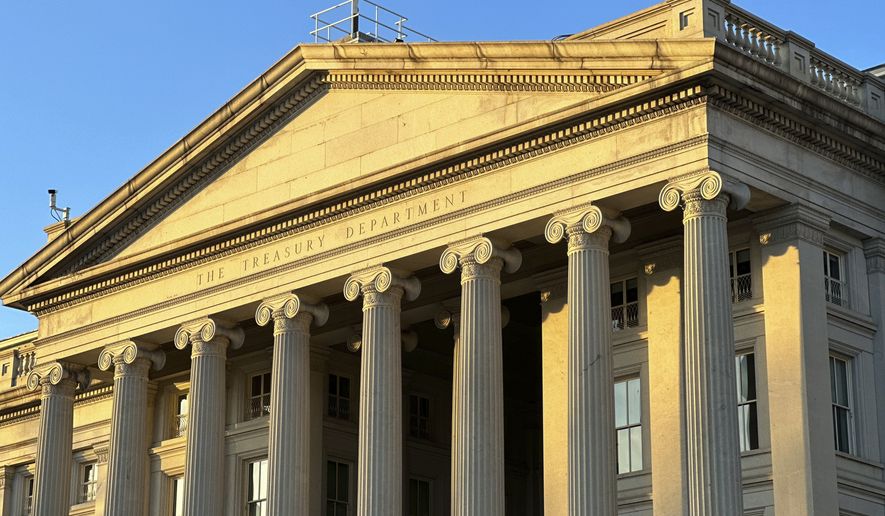
The Treasury Department announced the ignominious milestone Wednesday, though the mark was crossed a day earlier.
Watchdog groups called the figure a flashing warning sign, and urged a wake-up call for Washington.
People were interested in these podcasts
“The more we borrow, the more we exacerbate inflation, squeeze out other priorities in the budget, and leave ourselves vulnerable to emergencies at home and turmoil abroad,” said Maya MacGuineas, president of the Committee for a Responsible Federal Budget.
The U.S. crossed the $30 trillion mark just four years ago, under President Biden, and the $20 trillion mark in 2017, during President Trump’s first term.
“It’s shocking that we’ve doubled the federal debt in less than 10 years, and we must change course,” said Michael A. Peterson, CEO of the Peterson Foundation, which tracks spending and debt.
The exact debt figure as of Tuesday was $40,047,425,768,420.22.
The debt held by the public, which most analysts consider a more important yardstick of fiscal health because it doesn’t include transfers inside the government such as Social Security Trust Fund IOUs, stood at about $32.3 trillion.
That’s nearly the size of America’s total annual gross domestic product, which stood at about $34 trillion.
Crossing the 100% mark has been seen as a red flag moment, with countries that reach that level of debt facing tougher fiscal challenges.
Higher debt generally means a trickier time borrowing and paying higher interest rates.
It can also mean higher interest rates for Americans, and it crowds out private investment, which is usually seen as more efficient and productive than government spending. So the economy is relatively weaker with higher debt.
Still, some experts argue that the U.S., with its dollar serving as the chief reserve currency for the world, can withstand debt levels that would be debilitating to other nations.
Only once before has the country been at this level of debt, and that was in the wake of World War II — when the borrowed money was used to rescue Europe and eastern Asia from fascism.
Once the war ended, much of the debt quickly vanished. By the mid-1950s, it was below 70%, and it would dip to the low 30s in the 1970s.
It has grown steadily since then, though instead of defeating fascism it has gone to fund wars in Iraq and Afghanistan, and recovery efforts from the 2008 Wall Street collapse, the coronavirus pandemic and America’s social safety net programs such as Medicare and Social Security.
And unlike after World War II, there’s no sign that the debt will begin to drop.
Instead, the Congressional Budget Office projects that the federal government will add nearly $2 trillion a year in new deficits for the rest of this decade.
On Capitol Hill, the Republican chairman of the House Budget Committee called for a balanced-budget amendment to the Constitution. He urged the amendment be drawn by an Article V convention, which would be prompted by state legislatures rather than Congress.
“Our national debt continues to pose an existential threat to the future of our nation. We are mortgaging our kids’ entire future to pay for today’s spending — promises we’ve made, which we are unwilling to pay for ourselves,” said Rep. Jodey Arrington, the chairman.
His call to go outside of Congress was a recognition that neither party on Capitol Hill has been willing to offer serious proposals to tackle the rising debt.
Mr. Trump has suggested spending can be tamed by rooting out fraud and waste — a claim most budget analysts dismiss as fanciful.
Democrats, meanwhile, say the answer lies in tax increases on the wealthy to keep funding the expanding bureaucracy.
Budget watchdogs said the answers to the debt aren’t a mystery.
They include hiking taxes and reining in the benefits paid by the big spending programs of Social Security, Medicare and Medicaid.
Social Security and Medicare costs will continue to rise as a percentage of the federal budget because of the aging population, while Medicare and Medicaid grow because of rising medical costs.
Congress, rather than helping, has made things worse by expanding benefits and reducing money flowing in.
That includes the Social Security Fairness Act, approved by a GOP Congress and signed by Mr. Biden last year. It allowed public employees to receive full Social Security payouts in addition to their full pensions.
That increased Social Security’s spending by $200 billion over a decade.
Contact the author


Please read our comment policy before commenting.