


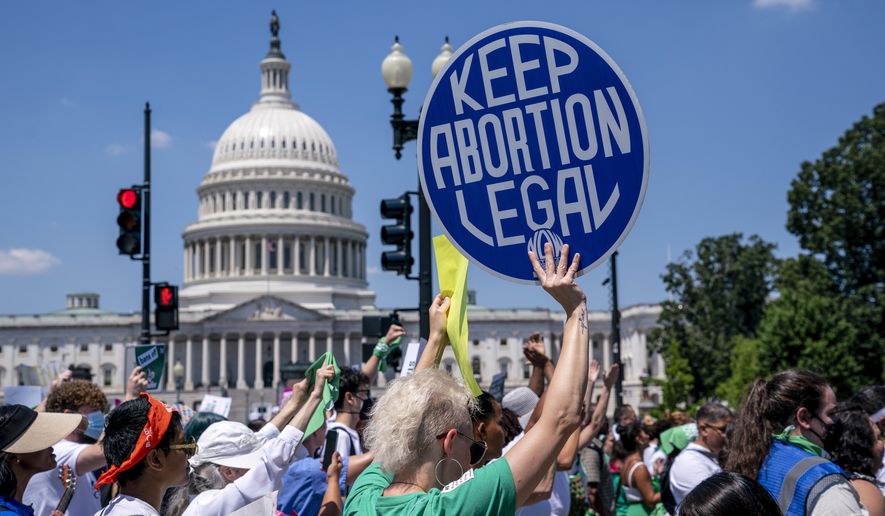

Researchers are warning that risky abortions after the 24th week of pregnancy could surge in 10 states that have abolished all gestational limits.
Most pro-life analysts say data predicts the spike, as lawmakers in states such as Colorado and Massachusetts have acted on the Supreme Court’s 2022 Dobbs ruling, which returned jurisdiction over abortion to the states and allowed them to erase longtime restrictions tied to fetal viability.
“Abortion until birth is a product of ideological extremism,” said Gavin Oxley, media relations manager for Americans United for Life. “Removing gestational limits falsely signals to women a cultural assent to its morality and safety, and states should be liable for the harm abortion deregulation poses to their citizens.”
People were interested in these podcasts
Pro-choice proponents counter that the demand for second- and third-trimester abortions is rare. They predict that few doctors will accept the legal, medical and political risks of learning to perform the procedures in non-emergencies.
“It’s hard to imagine that one state lifting its gestational limits will measurably increase the number of abortions after 24 weeks,” said Jessie Hill, a reproductive rights legal scholar at Case Western Reserve University in Cleveland. “Even hospitals often do not provide abortions that late in a pregnancy unless there is a medical indication for it.”
Massachusetts became the latest state to abolish all gestational limits. Gov. Maura Healey, a Democrat, signed a bill on Aug. 10, leaving decisions about abortion timing up to “the professional judgment of the physician.”
The state’s Department of Public Health data counted 99 abortions at 24 weeks or later in 2024, up from 84 in 2023. All occurred in cases in which the health or life of the mother or baby was at stake, under previous state laws.
Pro-lifers have nevertheless challenged the narrative that most abortions occur at this stage because of life-threatening issues.
Herb Geraghty, chief communications officer for Secular Pro-Life in Philadelphia, noted that a 2020 study found most later-term abortions occurred because of financial issues and the mother’s delayed awareness of pregnancy.
He also pointed to Arizona Department of Health Services data showing that 80% of the state’s abortions after 21 weeks from 2012 through 2017 were not performed for maternal or fetal health reasons.
“Removing a legal barrier on elective abortion late in pregnancy will necessarily increase the number of abortions being done on healthy women with healthy babies old enough to survive outside the womb,” Mr. Geraghty said.
The American Association of Pro-Life Obstetricians and Gynecologists has highlighted a study of federal data that found the rate of maternal death for abortions after 21 weeks “was almost tenfold the rate of death of all abortions.”
There is no national count of abortions after the 20th week of pregnancy. The pro-choice Guttmacher Institute pins the number at less than 1% of all procedures.
The Centers for Disease Control and Prevention, which relies on voluntary reporting from states, estimates that abortions dropped 5% between 2013 and 2022, to 613,383, the most recent year of available data. The number performed after 21 weeks of pregnancy fell from 9,108 in 2000 to an average of 4,081 from 2020 through 2022.
However, key jurisdictions such as California, the nation’s largest abortion-providing state, do not report their numbers to the federal agency.
Guttmacher, which surveys abortion providers directly, says abortions have surged since Dobbs, but it does not provide a gestational breakdown.
Guttmacher estimates that abortions were largely unchanged from 2024 to last year, at 1,124,000 and 1,126,000, respectively, even as the availability of telehealth and mail-order abortion pills expanded nationwide.
“Several of the states allowing abortion up to birth consistently do not report any abortion numbers year after year,” said Dr. Karysse Hutson, national medical director at Save the Storks, a Plano, Texas-based pro-life nonprofit.
She said this refusal to report could hide an upcoming jump in “women seeking or being forced into having an abortion after week 24” as access becomes easier.
Pro-lifers say that this is problematic because the surgical process of extracting sharp fetal parts after this stage poses higher risks of puncturing a woman’s uterus and nearby organs as the baby bump grows.
Surgeries comprise the entirety of abortions after the first trimester because pills are not approved by the Food and Drug Administration for use beyond the 10th week of pregnancy.
The pro-life Charlotte Lozier Institute notes that the CDC’s 2022 report counted more than 60,000 surgical abortions after 15 weeks of pregnancy, when the infant can feel pain and surgeries become riskier.
Michael New, a senior associate scholar at the Charlotte Lozier Institute and an assistant professor of social research at the Busch School of Business at the Catholic University of America, said state laws abolishing gestational limits could still be “largely performative,” given the risk of provoking more than a marginal bump in later procedures.
“Many Democratic elected officials want to show voters, donors, and supporters that they are strong supporters of legal abortion,” Mr. New said in an email. “I do not think that this will have much of an impact on either the number of abortions that take place or their safety.”
Gestating limits
States first eased gestational limits ahead of the Supreme Court’s Roe v. Wade decision, which legalized abortion nationwide in 1973.
A 1992 Supreme Court ruling, Planned Parenthood v. Casey, defined the point at which a baby could survive outside the womb as a limit on the procedure.
Most states interpreted this fetal viability point as occurring between the 23rd and 24th weeks of pregnancy.
Alaska, citing broad privacy protection in its state constitution, never implemented a gestational ban.
Testing the high court’s leeway, Vermont formally abolished gestational limits in 2019 and enacted a 2022 constitutional amendment reinforcing the change.
New Mexico did the same in 2021 legislation and a 2023 follow-up bill, both of which banned local governments from interfering.
In 2022, the Supreme Court’s ruling in Dobbs v. Jackson Women’s Health Organization returned jurisdiction over abortion to the states. Roughly half of the states moved to restrict abortion, while the rest moved to loosen limits.
The other states that have ended all gestational limits since Dobbs are Colorado, Oregon, Maryland, New Jersey, Minnesota and Michigan, along with California, which enacted a 2022 constitutional amendment protecting abortion access despite leaving older statutory viability language on the books.
Public opinion remains divided. A Gallup poll conducted in May 2023 found that 55% of adults opposed legalizing abortion in the second trimester, and 70% opposed it in the third.
“Americans’ moral opposition to abortion increases later in a pregnancy, bolstering support for gestational limits on the procedure,” said Tricia Bruce, a Catholic sociologist who studies abortion attitudes.
Ms. Bruce said most Americans follow a “compartmentalized approach” of “not wanting abortion, but not wanting to force undue medical risks that may result from undiscriminating bans.”
Democrat shifts
Most analysts on both sides agree that Dobbs has done little to change the attitude of most Americans that abortion should be legal but rare, despite the recent flurry of state laws.
“I don’t think Dobbs had the profound political impact that people thought it might,” said James Carville, a Democratic Party strategist. “You don’t even hear candidates talk much about abortion anymore.”
“Abortion on demand until birth is not a new phenomenon in the U.S.,” said Lauren Enriquez of the pro-life Human Coalition. “This has been the reality in numerous states since long before Dobbs.”
Mary Ziegler, a leading historian of the abortion debate and a law professor at the University of California, Davis, said Democrats and Republicans have abandoned their traditional moderation on the issue, frustrating many voters.
“There’s definitely been a shift away from ’safe, legal and rare’ among Democrats,” Ms. Ziegler said. “Democrats are still reluctant to say increasing abortions is good, but they’ve become more unapologetic about opposing bans.”
Contact the author


Please read our comment policy before commenting.