


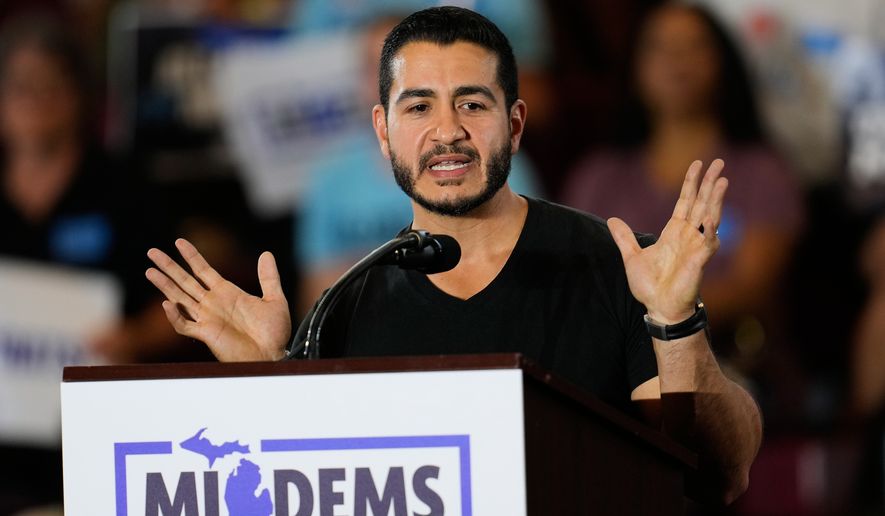

Michigan Democratic Senate nominee Abdul El-Sayed drew a wave of criticism from conservative commentators Monday night after comparing Islamic Sharia law to Catholic canon law during a contentious interview with Fox News’ Jesse Watters.
Mr. Watters pressed Mr. El-Sayed on comments he made in a 2022 speech to the Oklahoma chapter of the Council on American-Islamic Relations, or CAIR-Oklahoma, in which he likened efforts to ban Sharia law to the historical forces behind the Trail of Tears, the Tulsa race massacre and the Oklahoma City bombing.
“Getting rid of Sharia law is White supremacy? Can you explain that one?” Mr. Watters asked.
People were interested in these podcasts
Mr. El-Sayed responded by drawing a parallel to Catholicism.
“Nobody is trying to push Sharia law on anyone else, just like I hope nobody is trying to push canon law on anybody else,” he said, adding that Americans should have “the freedom of your religion.”
The comparison quickly drew pushback online. Andrew Kolvet, executive producer of “The Charlie Kirk Show,” argued on social media that canon law is confined to church affairs and carries no civil force, while Sharia, in his telling, is far more comprehensive and has historically shaped state governance in Muslim-majority countries. Conservative commentator Pamela Geller made a similar distinction, writing that canon law applies only to Catholics and carries no compulsion, unlike Sharia. Commentators Michael Knowles, Dana Loesch and GOP communications strategist Matt Whitlock also weighed in, with Whitlock calling it a “strange prepared defense” that opened Mr. El-Sayed up to further scrutiny rather than deflecting it.
The exchange follows renewed attention to a 2009 interview Mr. El-Sayed gave to The New York Times, in which he discussed seeking a Sharia-compliant mortgage as a 24-year-old medical student buying a condominium in Ann Arbor. He told the Times he felt religiously “obligated” to follow Sharia-compliant practices, saying he didn’t want to have “done it the easy way instead of the Shariah-compliant way” — “not because of fear but because of obligation.” Campaign spokeswoman Roxie Richner has said “Abdul believes in the separation of church and state,” and that while he personally lives by his faith, he opposes any effort by any religious community to write its laws into U.S. law.
Mr. El-Sayed’s Sharia comments come as former Michigan gubernatorial candidate Tudor Dixon has separately argued that his record on the issue, paired with his continued appearances alongside streamer Hasan Piker, marks him as “someone who wants to go into government to permanently change America,” a characterization she tied to what she called his fundamental disagreement with the Constitution and the country’s founding. Mr. El-Sayed is facing Republican Mike Rogers in the general election for the Senate seat being vacated by retiring Democratic Sen. Gary Peters.
This article was constructed with the assistance of artificial intelligence and published by a member of The Washington Times' AI News Desk team. The contents of this report are based solely on The Washington Times' original reporting, wire services, and/or other sources cited within the report. For more information, please read our AI policy or contact Steve Fink, Director of Artificial Intelligence, at sfink@washingtontimes.com
The Washington Times AI Ethics Newsroom Committee can be reached at aispotlight@washingtontimes.com.

Please read our comment policy before commenting.