


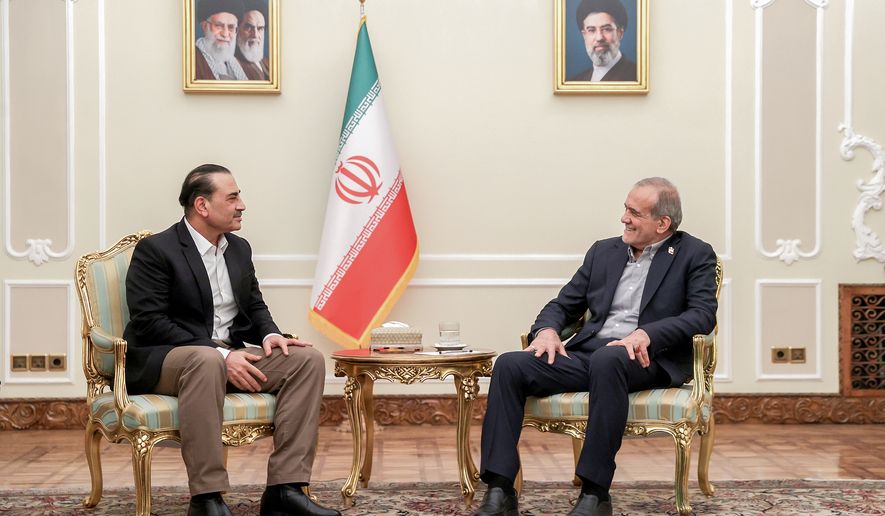

Pakistani officials met with key Iranian officials on Tuesday in an attempt to broker a peace agreement between Tehran and Washington, even as the Trump administration ramps up its economic pressure campaign against the Islamic republic.
Field Marshal Asim Munir and Interior Minister Mohsin Naqvi traveled to Tehran on Monday for a whirlwind visit that included meetings with Iranian President Masoud Pezeshkian, Speaker of Parliament Mohammad Bagher Ghalibaf and Foreign Minister Abbas Araghchi.
Notably, Mr. Munir also met with Mohsen Rezaei, a member of the Supreme National Security Council and a top advisor to Supreme Leader Mojtaba Khamenei, and delivered a U.S. peace proposal. The scheme would end the U.S. naval blockade and remove sanctions in exchange for reopening the Strait of Hormuz and ending Iranian proxy attacks in the region.
People were interested in these podcasts
Mr. Munir also reportedly urged a total return to the Islamabad Memorandum of Understanding, the peace agreement brokered by Pakistan and signed by the U.S. and Iran in June. The agreement, which proposed sanctions relief, reopened the strait and instituted a regional ceasefire, has been effectively dead since July, when the two nations restarted hostilities.
Esmaeil Baghaei, spokesperson for Iran’s foreign ministry, said on Tuesday that the meetings were focused on bilateral relations and had reached “one of their strongest stages.”
Iran has not issued a formal response to the reported U.S. proposal, and it remains unclear if Mr. Munir plans to deliver a response to Washington.
The trip by the Pakistani delegation is the second of its kind this month after Mr. Munir previously traveled to Tehran in early August to revive peace talks and push for a return to the Islamabad Memorandum of Understanding.
Mr. Munir and Mr. Araghchi also held at least two phone calls in the lead-up to this week’s meetings.
Still, despite the diplomatic overtures from each side, it’s unclear whether the meeting will move the needle on U.S.-Iran relations as Washington pushes to isolate Tehran economically and the Islamic republic vows retaliation.
Treasury Secretary Scott Bessent announced an expansion of secondary sanctions on Monday, warning countries that trade with Iran will be cut off and face serious consequences.
“Our objective is to sever every economic lifeline that sustains this tyrannical regime until Tehran stands alone,” he said. “Iran now faces a very clear choice with only two paths before them: complete global isolation and a subsistence economy, or a path back to normalcy with an opportunity to rejoin the global economy.”
However, Mr. Bessent’s announcement offered few details on exactly what the U.S. would do to countries maintaining economic relations with Iran, likely intending to warn potential violators. He confirmed that President Trump was calling world leaders to warn them of the consequences if they did not comply with the directive, but did not clarify which ones.
When asked why the U.S. wouldn’t just impose sanctions on countries trading with Iran immediately, Mr. Bessent implied that such a move would “blow up the global financial system.”
Indeed, sanctions experts say that unless the U.S. targets large financial institutions in China and elsewhere, the effects of the new round of sanctions are likely to be heavily muted.
“Bessent spoke as if he just discovered things that have been known for decades now and that he’s authorized actions in turn that have also been done for decades,” Richard M. Nephew, senior research scholar at the Columbia School of International and Public Affairs, told The Washington Times.
“To demonstrate that this is at all meaningful, they need to do actual things, like targeting banks in China, Turkey, etc. that may have connections with Iran. More threats, and vague ones at that, aren’t meaningful in the slightest.”
China remains one of Iran’s closest trading partners, purchasing the vast majority of its oil exports and providing Tehran with one of its few links to the world economy through its state-run banking system.
The Treasury Department designated more than 60 entities and ordered Bank Melli Iran to shut down, but Chinese state banks were largely spared.
If U.S. sanctions hit Chinese banks hard and cut them off from the U.S. dollar system, it could undermine the dollar’s centrality in global trade and, in turn, the power of Western sanctions.
Emily Kilcrease, senior director of the Energy, Economics and Security Program at the Center for a New American Security, said removing Chinese banks from the U.S. dollar system is the “nuclear option.”
“They are the largest banks in the world, and they facilitate China’s trade with the world,” Ms. Kilcrease told the Times. “And so you have to keep in mind that if you sanction one of those Chinese banks, you’re going to have a damaging effect on overall global financial stability by taking out one of the major institutions in a very disruptive, abrupt way.”
U.S. economic pressure has only ramped up during Mr. Trump’s second term, but has reached a fever pitch during the war with the naval blockade. Iran’s gross domestic product has contracted by nearly 3% this year, annual inflation has inched above 57.7% and the rial fell to a record low of roughly 1.9 million per U.S. dollar by late April.
Still, Iranian officials remain adamant that the mounting economic issues facing their country will not result in economic collapse and that the U.S. will face more intense consequences if it continues its campaign.
Iranian parliament speaker Mohammad Bagher Ghalibaf insisted on Tuesday that the economic pressure campaign will fail, just like “America was defeated by Iran in the military and political war.”
Contact the author


Please read our comment policy before commenting.