


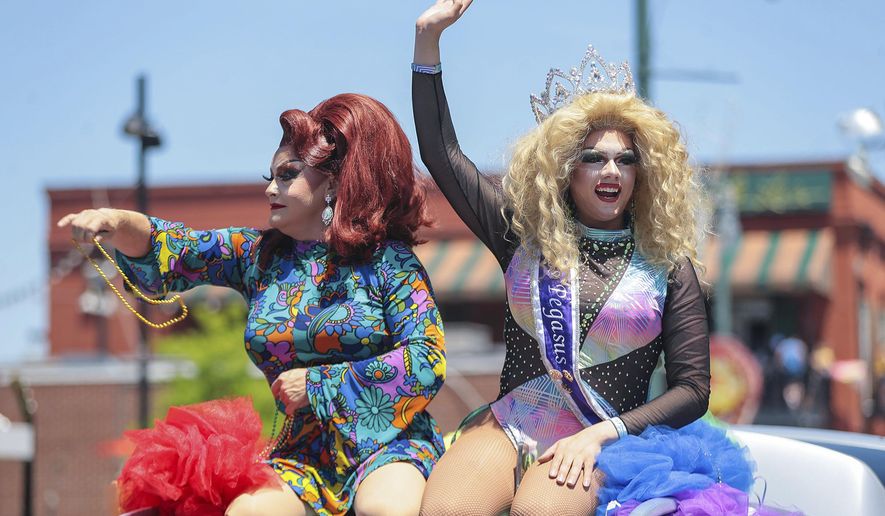

A divided federal appeals court has ruled that Florida can enforce a law barring minors from attending sexually explicit live performances the state considers obscene for children, handing Gov. Ron DeSantis and Attorney General James Uthmeier a win after three years of litigation — though Florida had already been enforcing the law against most venues since December.
The full U.S. Court of Appeals for the 11th Circuit ruled 8-5 on Tuesday that Orlando restaurant Hamburger Mary’s had not shown it was likely to succeed on its First and 14th Amendment challenge to Florida’s Protection of Children Act, according to Courthouse News Service. The court vacated what remained of a preliminary injunction — by that point narrowed to cover only Hamburger Mary’s itself — and sent the case, HM Florida-ORL, LLC v. Secretary of the Florida Department of Business and Professional Regulation, back to the U.S. District Court for the Middle District of Florida.
“We will not second-guess the Florida Legislature’s decision to regulate obscenity,” U.S. Circuit Judge Andrew Brasher wrote on behalf of the majority. “Preventing children from attending adult live performances obscene for them is rationally related to Florida’s interest in safeguarding the well-being of minors.” Brasher was appointed to the appellate bench by President Trump.
The 2023 law makes it a first-degree misdemeanor to knowingly admit a child to an “adult live performance,” punishable by up to a year in jail and, under Florida’s general misdemeanor fine cap, up to $1,000. Separately, the state can fine licensed restaurants, lodging establishments and alcohol licensees $5,000 for a first violation and $10,000 for repeat violations, and can suspend or revoke their licenses. To qualify as an “adult live performance” under the court’s opinion, a show depicting nudity, sexual conduct or lewd conduct must also predominantly appeal to a “prurient, shameful, or morbid interest,” be patently offensive under statewide adult community standards for the age of the child present, and lack serious literary, artistic, political or scientific value for that child’s age. The majority noted that nothing in the law singles out performances for featuring drag.
Mr. Uthmeier hailed the ruling in a statement posted on X.
“Huge victory for our team at the 11th Circuit! After 3 years of litigation, the full court affirmed the constitutionality of Florida’s ban on children attending sexualized drag shows,” he wrote, crediting Solicitor General Dave Dewhirst, who argued the case for the state.
Mr. DeSantis, who signed the measure into law, said the ruling should not have been necessary. “This shouldn’t even be controversial, yet our law protecting kids required us to fend off lawsuits and win a case before a divided appellate court,” the governor said in a statement reported by News4Jax.
The case traces back to 2023, when Hamburger Mary’s, an Orlando eatery known for hosting “family friendly” drag brunches, sued after canceling those shows to challenge the law. Bill Clinton-appointed Senior U.S. District Judge Gregory Presnell blocked the act statewide, and a divided three-judge 11th Circuit panel affirmed that injunction in May 2025. The full court then vacated the panel’s decision and agreed to rehear the case en banc — and, in a Dec. 15, 2025 order citing the U.S. Supreme Court’s 2025 ruling in Trump v. CASA limiting “universal” injunctions, narrowed the injunction so it applied only to Hamburger Mary’s, allowing the state to begin enforcing the law against other venues months before Tuesday’s ruling.
Five judges dissented. In the lead dissent, U.S. Circuit Judge Robin Rosenbaum, an Obama appointee, wrote a dissent accusing the majority of embracing “mess-around-and-find-out” First Amendment jurisprudence, warning the statute “wields a Titanic-sized iceberg of chilling power against protected speech.” She was joined by four other judges, including Judge Nancy Abudu, who filed a separate dissent arguing the majority improperly discounted the law’s legislative history. Rosenbaum noted that Mr. DeSantis had described the law as being about “adult performances … like those drag shows,” and that the bill’s House sponsor, state Rep. Randy Fine, said it would “protect our children by ending the gateway propaganda to this evil — ’Drag Queen Story Time.’”
The majority also split internally on the injunction question: while Brasher wrote that the district court lacked authority to issue a universal injunction, citing Trump v. CASA, Judges Kevin Newsom and Britt Grant declined to join that portion of the opinion, with Grant writing separately that the point was unnecessary to decide once the court found the law constitutional.
On the merits, the majority rejected arguments that the law’s use of “lewd” and its age-variable standard render it unconstitutionally vague, pointing to Florida Supreme Court precedent defining “lewd” as “gross indecency with respect to sexual relations.”
Liberty Counsel, a religious liberty legal group that filed an amicus brief backing the state, celebrated the outcome. Founder Mat Staver said the decision “reinforces the longstanding principles that children should be protected from obscenity,” according to a Liberty Counsel statement.
This article was constructed with the assistance of artificial intelligence and published by a member of The Washington Times' AI News Desk team. The contents of this report are based solely on The Washington Times' original reporting, wire services, and/or other sources cited within the report. For more information, please read our AI policy or contact Steve Fink, Director of Artificial Intelligence, at sfink@washingtontimes.com
The Washington Times AI Ethics Newsroom Committee can be reached at aispotlight@washingtontimes.com.

Please read our comment policy before commenting.