


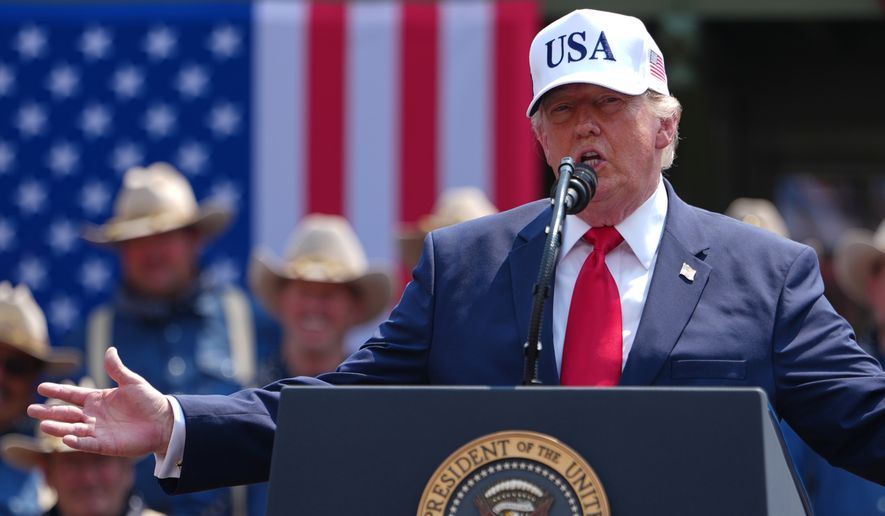

As the nation celebrates its 250th birthday, some historians say President Trump’s emphasis on states’ rights, national self-sufficiency, “America First” foreign policy and a revival of manufacturing harks back to the vision of America’s Founding Fathers.
The comparison can be hotly debated because the United States has evolved dramatically since 1776, and the Founders themselves were not unified on a specific agenda. In fact, they fought bitterly over some of the issues that divide Americans today.
Still, historians see much of the Founding Fathers in Mr. Trump’s agenda, including Alexander Hamilton’s economic nationalism, John Jay’s fear of overreliance on foreign economies, Benjamin Franklin’s anti-immigration stance, and Thomas Jefferson’s fear that a too-powerful federal government would trample states’ independence.
People were interested in these podcasts
“Everything Trump is doing is consistent with the Founding Fathers’ view of the Constitution,” said historian Craig Shirley. “His agenda on immigration, boosting manufacturing, states’ rights is a callback to the Founding Fathers’ legacy of sovereignty, self-sufficiency and not having the federal government exceed its authority.”
Not everyone shares that view.
In a recent op-ed in the Los Angeles Times, journalist Jonah Goldberg argued that the Founding Fathers would have “gotten rid of” Mr. Trump. He argued that Mr. Trump has placed himself above the law and that actions such as his proposed $1.8 billion anti-weaponization fund and pardons would have alarmed the Founding Fathers, who would have been frustrated with the lack of accountability.
“I struggle to think of hypothetical scenarios that would be more likely to arouse in Madison and his contemporaries the — now misplaced — reassurance that impeachment was an available remedy,” he wrote.
Since returning to the White House, Mr. Trump has sought to dismantle the Education Department to give states more control over schools, roll back federal energy regulations so states can dictate their own oil and gas policies, and argued that states have a right to draw their own congressional districts without interference from the federal government.
During his first term, Mr. Trump appointed the conservative justices who eventually overturned Roe v. Wade, returning the abortion issue to the states.
Though the Founders differed on the appropriate balance between state and federal authority, many, led by Jefferson, believed that preserving state sovereignty was an important safeguard against excessive national centralization and that local governments were better equipped to serve their communities than a distant national government.
Mr. Trump has coupled that vision with an effort to reduce the size of the federal government, reducing its workforce to its lowest level since 1966. After the Trump administration cut nearly 12% of government workers, only 1.6% of U.S. workers are employed by the federal government, according to data from The Heritage Foundation.
“The Founders would be astonished at the size, scale and scope of the federal government and be aghast at that,” said Michael Maibach, director of the Center for the Electoral College, who speaks about the Founders’ constitutional design.
However, some argue that Mr. Trump has been inconsistent on the issue of states’ rights. The president dispatched the National Guard to cities such as Chicago and Los Angeles over governors’ objections. He ultimately removed the Guard members after the Supreme Court blocked the federalization of the Guard in Illinois.
Mr. Trump is also trying to federalize election laws, which are traditionally handled by the states, through the SAVE America Act, which would require proof of citizenship to register to vote and a photo ID at the polls.
“Presidents generally support state autonomy when this suits their policy goals, but they embrace federal authority when doing so aligns with their policy goals,” said John Dinan, who teaches federalism at Wake Forest University.
Long before “America First” became a campaign slogan, the Founding Fathers debated whether the young republic should be economically self-reliant or become deeply entangled with foreign trade.
Hamilton argued that the United States could not be independent if it remained dependent on European-manufactured goods, pushing for tariffs and subsidies to build America’s manufacturing base. Jefferson echoed that argument, envisioning a nation of independent farmers who would be economically self-reliant.
Mr. Trump’s tariff policy and his push to reshore manufacturing have been presented by his supporters as a 21st-century update of the same argument. Manufacturing has now reached its highest level in four years, according to the Institute for Supply Management, which tracks factory activity across the country.
“Trump is doing lots of important things to reestablish supply lines and the supplies themselves that are very important to us,” Mr. Maibach said. “Hamilton would be pleased that we are the world’s most productive manufacturer and economy.”
This extends to energy policy and Mr. Trump’s push to maximize domestic oil, gas and mineral production. The White House has cast the effort as a means to insulate the country from supply shocks and price spikes that result from relying on foreign producers, drawing parallels to the Founders’ wariness of entangling the country with powers whose interests did not align with America’s.
“The Founding Fathers weren’t organizing an English protectorate; they were organizing a unique American government run by American citizens. That’s what Trump is trying to do. He wants a government that looks out for the interests of Americans and is not dictated to by illegals or foreign governments,” Mr. Shirley said.
Perhaps the clearest thread tying Mr. Trump to the Founding Fathers is his approach to foreign policy. George Washington warned in his Farewell Address against permanent foreign entanglements.
Mr. Trump’s “America First” policy draws on this tradition by pressing NATO allies to shoulder more of their own defense costs and questioning the value of open-ended military commitments, though he has somewhat undermined that policy with military operations in Venezuela and Iran.
Washington argued in his remarks that America’s geographic separation from Europe allowed it to disengage from world affairs.

Please read our comment policy before commenting.