


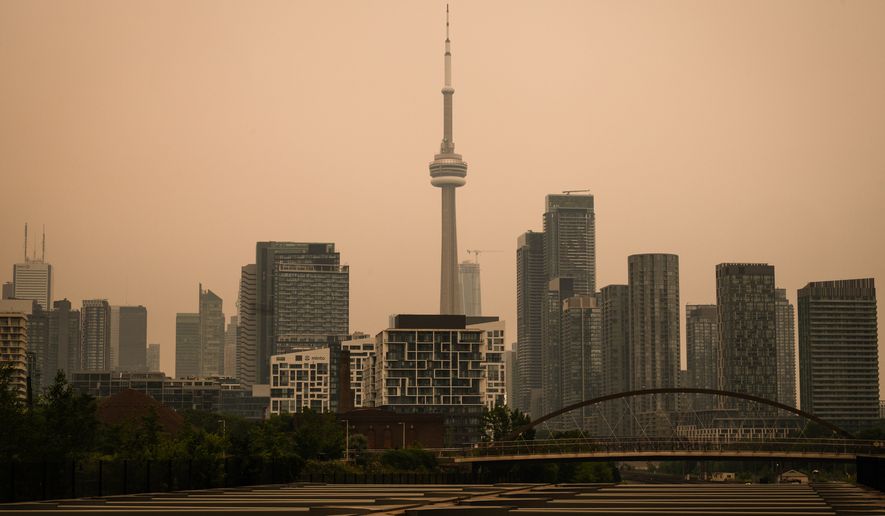

Smoke from wildfires in Ontario, Canada, and Minnesota is drifting east across the United States, causing poor air quality that can be harmful to residents.
The National Weather Service office in New York City posted a time-lapse graphic of where the smoke is expected to drift this week.
By Friday afternoon, the smoke will have passed over all or parts of Connecticut, Delaware, Illinois, Indiana, Maine, Maryland, Massachusetts, Michigan, Minnesota, New Hampshire, New Jersey, New York, Ohio, Pennsylvania, Rhode Island, Vermont, Virginia and Wisconsin.
People were interested in these podcasts
Some wildfires affect Ontario and Minnesota. Superior National Forest in northern Minnesota next to the Canadian border is experiencing 17 distinct wildfires, the U.S. Forest Service said Tuesday, affecting 33,000 acres. That smoke is drifting east across the continent.
“Northern Michigan, maybe Western New York, those types of spots at this point seem most favorable to experience at least a time of poor air quality. And then places farther east, like Boston, some of the major cities in the Northeast,” Dan DePodwin, AccuWeather’s vice president of forecasting, told the Daily Mail.
The smoke and poor air quality are dangerous to people living in those areas, especially when combined with extreme heat.
National Weather Service meteorologist Tyler Hasenstein told The Associated Press that people should stay inside if possible because “those two things coinciding with each other is not good from a health perspective.”
“Tiny particles carried within the smoke can get into people’s lungs, and contribute to health problems including aggravated asthma, decreased lung function, increased respiratory symptoms like irritation of the airways, coughing or difficulty breathing, irregular heartbeat, nonfatal heart attacks, and premature death in people with heart or lung disease,” the Environmental Protection Agency says on its website.
The worst air quality will occur in places where smoke gets closer to the ground. The Fox Weather Forecast Center predicts “there is a growing signal that we could see a 6- to 8-hour window with smoke settling closer to the ground.”

Please read our comment policy before commenting.