



The U.S. unleashed massive airstrikes against Iran on Sunday after an Iranian attack on a base in Jordan killed at least two American troops.
The two sides are now barreling toward all-out war, if they have not reached that point already, after the collapse earlier this month of a brief ceasefire.
The conflict is accelerating and spreading across the region. A “specific and credible threat” led Jordanian authorities to evacuate the international airport and seaport in Aqaba on Sunday, the U.S. Embassy in Jordan reported.
People were interested in these podcasts
Despite initial official denials of a specific threat, Jordan later announced it had intercepted several Iranian missiles en route to Aqaba. Kuwait and Bahrain also reported activating air defenses to shoot down incoming Iranian fire. The Israeli military said it shot down missile debris that crossed into Israel from Jordan.
The Saudi news outlet Al-Hadath, citing an Israeli source, reported that Iranian Supreme Leader Mojtaba Khamenei was no longer in Iran. If true, that could signal that the Iranian government believes Israel or the U.S. could target him. His father, Ayatollah Ali Khamenei, was killed in a joint U.S.-Israeli airstrike on Feb. 28.
U.S. Central Command said the latest round of American strikes, which began late Saturday and continued Sunday morning, targeted the Islamic Revolutionary Guard Corps troops thought to be responsible for the assault that killed American service members in Jordan on Friday.
SEE ALSO: Trump calls for Iran to be added to Russia sanctions bill
“During the eighth consecutive night of U.S. strikes, CENTCOM forces successfully hit Iranian military coastal surveillance and air defense facilities, maritime capabilities and missile and drone storage sites to continue degrading Iranian military capabilities,” CENTCOM said in a statement. “American military assets also targeted Islamic Revolutionary Guard Corps forces that launched attacks against U.S. service members in Jordan on July 17.”
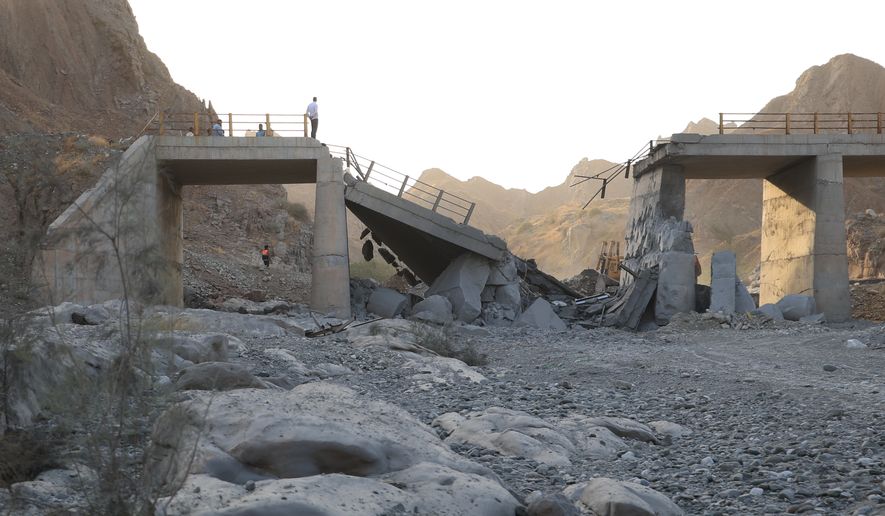
Footage released by the U.S. military appeared to show strikes carried out by fighter jets and by Tomahawk cruise missiles launched from the sea. Footage indicates that at least one strike targeted a mountainous valley — a terrain characteristic frequently used by the IRGC to conceal ballistic missile infrastructure. Iran said the strikes also hit the Darkhovin nuclear power plant construction site, which contains no nuclear material, though those reports were not independently confirmed.
That the IRGC, Iran’s elite paramilitary force, is still capable of launching deadly attacks underscores the difficulty the U.S. confronts in fully eliminating Iran’s ballistic missile and drone capabilities with an air campaign alone.
So far, the Trump administration has resisted putting U.S. ground troops in Iran. The idea is deeply unpopular in Congress and among the American public.
In Washington, key Republicans suggested that the Trump administration’s attempts to negotiate with the Iranian regime were not working.
“Now we’re going to move forward with Plan A again,” Rep. Michael McCaul, Texas Republican and chairman emeritus of the House Foreign Affairs Committee, told “Fox News Sunday.”
SEE ALSO: Gas prices rise above $4, on average, for the first time since mid-June
“The military is going to move in, take out their launchpads, take out their ability to send Shahed drones, to hit tankers, the missiles,” Mr. McCaul said.
American lives lost
The IRGC attack Friday left two U.S. service members dead and another missing after Muwaffaq Salti Air Base in Jordan came under fire from missiles and drones, military officials said.
On Sunday, CENTCOM said “unidentified remains” were found at the site of the Jordan attack. An examination process to verify the remains was continuing, military officials said, but the discovery could mean that the death toll from the Iranian strike will rise to three.
The United States announced that another service member was killed in Iraq on Saturday during the “controlled detonation” of a downed Iranian drone.
The weekend casualties were the first U.S. combat deaths in the Iran war since March. At least 17 Americans have been killed in combat since the war began on Feb. 28, according to Pentagon data. More than 400 have been wounded.
Officials did not specify the exact location of the attack Friday, but media reports and video circulating on social media indicate an Iranian attack on Jordan’s Muwaffaq Salti Air Base, which houses U.S. forces.
Four other American service members were wounded but have since been discharged from Jordanian hospitals, Pentagon officials said.
Mr. Trump said late Saturday that the troops died in service to their nation.
“It’s a very sad thing,” Mr. Trump told NewsNation. “We hate to see it happen. It’s in service to our country.”
What happens next?
The deaths of American troops at the hands of the Iranian military could change the calculus for Mr. Trump, who has warned Tehran that the U.S. is prepared to significantly escalate its attacks if Iran does not make a deal with Washington.
The U.S.-Iran conflict is now centered largely on control of the Strait of Hormuz, a critical waterway for oil exports from the Middle East.
Leading Democrats say there is no clear plan to ensure that commercial ship traffic can move through the strait.
“I see no path in the short term how the strait is going to be settled. This war of choice has been a disaster. It has been a disaster militarily. It has been a disaster in terms of how we’re viewed around the world,” Sen. Mark R. Warner, Virginia Democrat and vice chairman of the Senate Select Committee on Intelligence, told CBS’s “Face the Nation” on Sunday.
Iran says the memorandum of understanding it signed with the U.S. in June gives Tehran the power to manage traffic in the strait, but the Trump administration insists that Iran must keep the strait free to commercial traffic, including oil tankers.
Mr. Trump reimposed a naval blockade of Iranian ports and maritime shipping and has been using the U.S. military to help non-Iranian ships transit the strait. Amid the renewed fighting, the White House insisted last week that Iran and the U.S. were still communicating about a possible peace deal.
“Iran very much continues to talk to the United States of America and has expressed that they want to make a deal with us because they are suffering devastating blows,” White House press secretary Karoline Leavitt told reporters Thursday.
It is unclear whether the deaths of American troops will affect the administration’s willingness to talk.
• This article is based in part on wire service reports.
Contact the author


Please read our comment policy before commenting.