



OPINION:
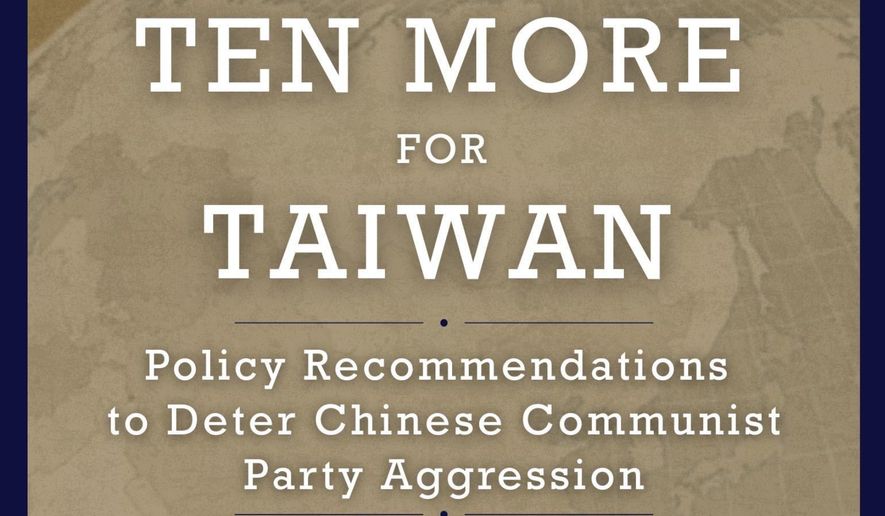
The following is an abridged excerpt from the committee’s December 2025 “Ten More for Taiwan” report.
The growing threat of a CCP attack on Taiwan presents a particularly acute threat to America’s prosperity. Losing access to Taiwan’s semiconductors alone would push the United States into an “immediate Great Depression.” Such an attack would also devastate the world economy, with a second study estimating that a conflict would cause global gross domestic product to plummet by $10 trillion, or ten percent in one single year — far worse than the economic devastation wrought by the Great Recession or COVID-19 pandemic. In short, a military conflict over Taiwan would have disastrous consequences for Taiwan, the United States, and the entire world.
A military attack by the People’s Republic of China (PRC) would also directly threaten U.S. national security and undermine international laws and norms. Congress recognized this threat when it passed the Taiwan Relations Act (P.L. 96-8; 22 U.S.C. 3301 et seq.) in 1979, which provides that it is U.S. policy to consider “any effort to determine the future of Taiwan by other than peaceful means, including by boycotts or embargoes, a threat to the peace and security of the Western Pacific area and of grave concern to the United States.” The Taiwan Relations Act further declared that “peace and stability in the [Western Pacific] area… are matters of international concern.”
People were interested in these podcasts
A CCP conquest of Taiwan would position an aggressive and expansionist PRC at a key position within the First Island Chain, posing an immediate threat to America’s mutual defense treaty allies such as Japan, the Philippines, and Australia. Furthermore, it would degrade the U.S. military’s ability to defend and operate throughout the Western Pacific and American territory — including Guam and Hawaii — would become increasingly vulnerable to attack. As one U.S. Naval War College expert writes, a PRC military takeover of Taiwan would give Beijing “newfound strategic leverage” by “turn[ing] the southern flanks of Japan and South Korea” and increase its threat to the Philippines by “command[ing] the northern rim of the South China Sea.” 1 Unsurprisingly, the CCP is aware of the immense geopolitical springboard it would gain from occupying Taiwan. As the Select Committee noted in Ten for Taiwan, one People’s Liberation Army (PLA) handbook boasts that controlling Taiwan would make “Japan’s maritime lines of communication fall completely within the striking ranges of China’s fighters and bombers.” 2 Japanese Prime Minister Sanae Takaichi echoed this sentiment in November 2025, when she stated her assessment that, for Japan, “any action involving the use of force [against Taiwan], such as China deploying naval ships, can only be described as a survival-threatening situation.”
Finally, failing to deter a PRC military attack on Taiwan would run contrary to some of America’s most deeply held values. Taiwan is one of the world’s most successful and vibrant democracies with a robust media, strong protection of civil liberties, and regular peaceful transfers of power. In contrast, the CCP commands an increasingly repressive one-party dictatorship that allows zero political dissent, denies fundamental individual freedoms, and is carrying out a genocide against the Uyghurs and other ethnic minorities in the Xinjiang Uyghur Autonomous Region. The CCP is also attempting to erase the culture of the Tibetan and Mongolian populations under its rule while destroying civil liberties and the rule of law in Hong Kong, in violation of its pledge to respect Hong Kong’s autonomy. The Taiwan Relations Act states that the “preservation and enhancement of the human rights of all the people on Taiwan are hereby reaffirmed as objectives of the United States.” As the Select Committee wrote in Ten for Taiwan, in the event of an armed CCP attack on Taiwan, “the Taiwanese people would pay a terrible price and their democracy would hang in the balance.”
Many have described the late 2020s and 2030s as a “danger zone” when it comes to the rising CCP threat against Taiwan, frequently citing 2021 congressional testimony from then- commander of U.S. Indo-Pacific Command, Adm. Philip Davidson, who warned that the PRC may be prepared to take military action against Taiwan by 2027. Yet 2027’s significance to the debate over Beijing’s threat to Taiwan stems not from retired Admiral Philip Davidson, but from General Secretary Xi Jinping himself and several key CCP milestones. First, in 2027, Xi is expected to secure an unprecedented fourth five-year term as leader of the CCP, its military, and the PRC government at the CCP’s 21 st National Congress. Second, in August 2027, the PLA will celebrate the centennial of its founding. Third, the year will conclude as Taiwan enters the final weeks of its 2028 presidential election, slated for January 2028. Finally, and perhaps most consequentially, 2027 marks the deadline set by Xi for the PLA to attain the capabilities needed to invade Taiwan while countering the U.S. military in the Indo-Pacific.
According to the Pentagon, the PLA’s 2027 milestone is specifically aimed at attaining the capabilities needed to counter the U.S. military in the Indo-Pacific and force Taiwan’s leadership to capitulate to the CCP’s terms. 3 While there is no guarantee that Xi will attempt an invasion in 2027 or beyond, it is incumbent upon policymakers in the United States and Taiwan alike to deter such a conflict by acting as if this threat will become manifest. As Chairman Moolenaar noted at the Select Committee’s May 2025 hearing, the PRC represents a “very real, near-term threat […] and the 119 th Congress may be the last full legislative session with a chance to alter [CCP General Secretary Xi Jinping’s] calculus. We cannot delay.”
In 2026, the United States will celebrate the 250 th anniversary of the birth of its democracy, while Taiwan will likewise mark the 30 th anniversary of its first democratic presidential election. Unfortunately, today democratic governance is under greater external threat in Taiwan and across the Indo-Pacific than at any time since the most perilous days of the Cold War. It remains imperative that, alongside our likeminded allies and partners, the United States continues to stand by the people of Taiwan, who are defending their democracy and freedoms in the face of the CCP’s growing military and economic threats.
The Select Committee has identified ten bipartisan findings and recommendations to strengthen deterrence against CCP aggression towards Taiwan. These are a near-term roadmap for how the United States can comprehensively strengthen ties with Taiwan, deepen economic engagement, and expand the U.S.-Taiwan defense partnership:
1. Clear political signaling from the United States is essential for communicating American resolve to deter CCP aggression.
2. Deepening U.S. economic ties with Taiwan strengthens deterrence, bolsters Taiwan’s resilience, diversifies critical supply chains, and benefits the U.S. economy.
3. The United States must expand all efforts and pathways to ensure Taiwan has the capabilities it needs to defend itself in a conflict and against daily gray-zone threats.
4. The United States must rebuild the American defense industrial base to deliver the capabilities needed by the United States and our partners to deter and defeat aggression.
5. The Pentagon must fill critical capabilities gaps for Indo-Pacific deterrence while enhancing its logistics enterprise to sustain a protracted conflict in a contested environment.
6. The U.S. must strengthen joint military and economic planning with allies and partners, while accelerating U.S. military access and posture initiatives in the Indo-Pacific.
7. It is essential to enhance Taiwan’s domestic resilience across a variety of scenarios, including a protracted conflict, a blockade, and cyber-enabled coercion.
8. The United States must support Taiwan in advancing its whole-of-society defense readiness from active and reserve forces to civilian preparedness.
9. Defending Taiwan’s international space and economic ties worldwide enhances Taiwan’s strategic resilience.
10. Leaders in the Indo-Pacific believe the PRC is closely monitoring the outcome of Russia’s invasion of Ukraine, of which Beijing is the chief enabler through its “no-limits” partnership with Moscow, and factoring lessons from its outcome into its cost calculation relative to a Taiwan invasion.
• The complete “Ten More for Taiwan” report can be found on the House Select Committee on the Chinese Communist Party’s website at chinaselectcommittee.house.gov.

Please read our comment policy before commenting.