



A version of this story appeared in the daily Threat Status newsletter from The Washington Times. Click here to receive Threat Status delivered directly to your inbox each weekday.
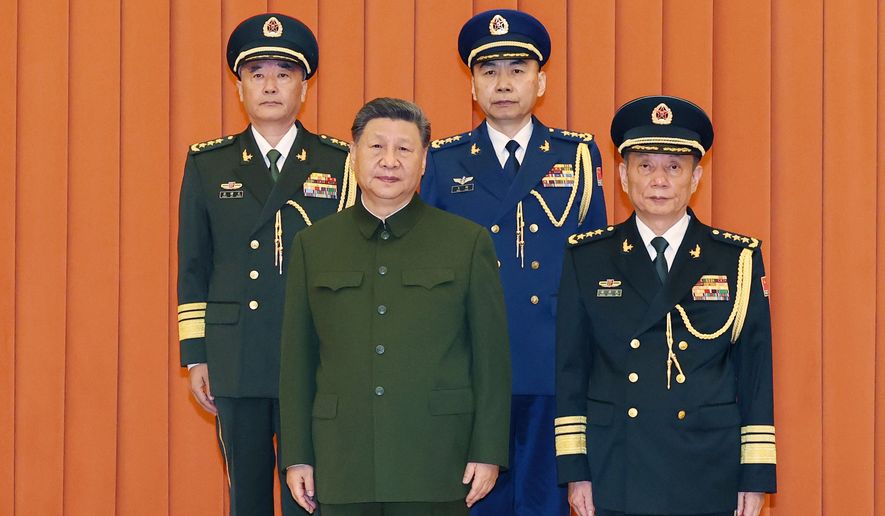
China’s all-powerful civilian and military leader, Xi Jinping, has purged more than 100 senior military leaders since 2022 — far more than the People’s Liberation Army has officially acknowledged, according to an Air Force think tank report.
The ongoing firings within the Chinese military are creating immediate readiness shortfalls and long-term benefits for the Chinese Communist Party’s military wing, says a new report by the China Aerospace Studies Institute.
Overall, the sweeping military dismissals have reduced the members of the Central Military Commission, the party organization that controls the 2 million troops of the world’s largest military, from seven to two: Mr. Xi and a political commissar, Gen. Zhang Shengmin.
A specific reason for the mass military dismissals is not clear. It could be corruption or a lack of loyalty to Mr. Xi, who holds three top posts: CCP general secretary, Central Military Commission chairman and Chinese president.
“Regardless of the motivations, the significant loss of PLA flag officers and the resulting sudden leadership transitions at the top of nearly every PLA theater command and service will have short- and long-term effects on PLA readiness,” states the report, titled “Corruption in the People’s Liberation Army.”
Mr. Xi said in a recent speech broadcast to all military commands that the PLA must deepen “political rectification” and maintain the “glory” of a people’s armed force.
“Our party and our military have continuously grown stronger through struggles against various erroneous ideologies and conduct,” he said in April.
The Chinese leader told a group of assembled leaders that the PLA must be guided by ideals and convictions and have “firm faith in Marxism and be loyal to the party.”
The think tank report says some analysts regard the anti-corruption campaign as a tool of Mr. Xi to consolidate power and ensure military loyalty.
Additionally, the removal of senior generals suggests that the PLA is not on track to achieve the modernization goals set for 2027, the think tank report says.
Mr. Xi has directed the military to be ready by 2027 to use force against Taiwan, such as a cross-strait assault or blockade, in a bid to annex the self-ruled island.
“These goals … call for accelerated military modernization — to include reform of the informatized and intelligentized warfare capabilities — as well as increased anti-corruption efforts,” the report says. “However, it is difficult to determine if the aspect of the plan not being achieved is related to corruption, military modernization, or elements of both.”
Purge perils and benefits
In the near term, corruption investigations could undermine PLA readiness and hamper modernization progress.
Weapons and equipment procurement efforts will likely slow as a result of “fake combat capabilities” — a reference to corruption in procurement — being identified, the report says.
Potential readiness shortfalls are expected because of a lack of leadership continuity and organizational turbulence after the firings.
Still, corruption investigations could help identify and resolve PLA vulnerabilities.
“This could lead to further advancements and drive long-term improvements to the force,” the think tank report says.
Officers who survive the mass firings could be compelled to provide politically correct answers and to carry out orders without question to avoid being purged, the report says.
Also, recent purges removed the last senior officers with combat experience from the 1979 border war with Vietnam. That could leave remaining officers with limited to “textbook” military knowledge, the report says.
However, adding relatively younger officers as leaders could “propel PLA readiness in the future,” the report states.
“While corruption investigations during the past few years significantly altered the ranks of PLA senior leadership and may bring about some short-term negative side effects, the long-term benefits of removing officers with misaligned priorities could prove beneficial for the PLA,” the report says.
Purges could also identify problems and highlight opportunities to improve military readiness and, ultimately, produce a more lethal PLA.
The extensive purges for corruption and political offenses have been a centerpiece of Mr. Xi’s rule since 2012, when he became the top CCP leader.
The program has broadly targeted what the Chinese leader calls a strategy that seeks to “swat the flies” of low-level officers and “catch the tigers” — senior officials such as the two military officers taken down in January.
Scores of military leaders purged
Christopher K. Johnson, a former CIA analyst and president of the China Strategies Group, called the ouster of the two generals unprecedented in Chinese military history, describing it as a “total annihilation of the high command.”
The report provides additional details on the subject contained in the Pentagon’s most recent annual report on the Chinese military. It states that anti-corruption purges “very likely” unsettled the nuclear forces, raised questions among leaders about force readiness, and led to long-term improvements within the PLA.
The annual report of the congressional U.S.-China Economic and Security Review Commission also states that Mr. Xi’s anti-corruption drive seeks to improve combat capabilities and build a force that is politically loyal and ready for a future invasion of Taiwan.
The commission report says the ongoing purges and corruption investigations are likely to hinder weapons modernization, create instability within command structures, and erode troop morale. These effects could undermine combat effectiveness in the short term.
“While the anticorruption drive continues to reshape military leadership, it is unlikely to be the decisive factor in determining when Xi might pursue military action against Taiwan,” the congressional report says.
The removals in January of Gen. Zhang Youxia, first vice chairman of the CCP Central Military Commission, and Gen. Liu Zhenli, chief of the CMC Joint Staff Department, were among the most significant firings.
The ouster of Gens. Zhang and Liu highlights the removal, expulsion or disappearance of more than 100 two-star and three-star flag officers from the PLA for corruption since 2022, the think tank report says.
By contrast, the secretive PLA officially announced just 38 cases of high-level military corruption, including the publicly acknowledged dismissal of 22 PLA three-star flag officers, within a military that relies on about 30 to 35 serving three-star generals and admirals at any given time. That represents 44% to 94% of these officers, the report says.
Another 25 three-star officers are estimated to have disappeared, raising the total since 2022 to 47 three-stars.
Since 2012, at least 160 senior PLA officers have been purged, the report says.
More firings of military leaders could be expected, the report says, based on the number of senior PLA officials who have disappeared from public view, or been dismissed or replaced without reassignment.
Focus on Rocket Force
Some of the disappeared military leaders have reappeared in state media reports, however.
Military corruption has been widespread in the PLA since the 1980s and includes bribery and graft, as well as the buying and selling of promotions, positions and enrollment in PLA-affiliated schools.
Candidates for officer commissions were charged up to $16,000 to pass a PLA entrance exam.
Corruption within the PLA procurement system has also been rampant, the report says.
Every PLA regional command has been targeted in the anti-corruption campaign, and the PLA Rocket Force is a central focus of the purge.
Rocket Force generals accounted for half of all senior leaders’ firings, including four commanders, leaving 17 generals missing, under investigation, or dismissed since 2022, the report says.
“The 2023 dismissal of at least five PLA [Rocket Force] senior officers, speculated in media reports to possibly coincide with allegations of Chinese missiles filled with water rather than fuel and malfunctioning missile silo lids, was among the first wave of recent PLA senior officer removals,” the report states.
Contact the author

Please read our comment policy before commenting.