


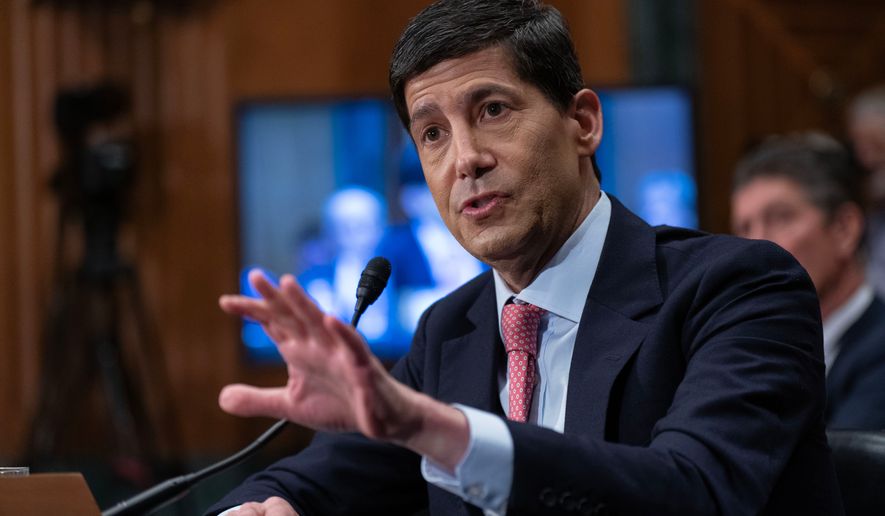

The Federal Reserve decided to keep interest rates unchanged on Wednesday, though Chairman Kevin Warsh faced pressure from fellow central bankers to curb inflation by increasing rates even as President Trump demands cuts.
The Federal Open Market Committee kept its benchmark rate at 3.5% to 3.75%.
“Economic activity is expanding at a solid pace despite elevated uncertainty that owes, in part, to the conflict in the Middle East,” the committee said in its statement. “Productivity growth and capital investment are strong. Job gains have kept pace with the workforce, and the unemployment rate has changed little.”
Three members of the committee — regional presidents Beth M. Hammack, Neel Kashkari and Lorie K. Logan — wanted to raise the target range for the federal funds rate by 0.25%, posing a notable level of dissent for Mr. Warsh to navigate.
Mr. Trump appointed Mr. Warsh to replace the last chair, Jerome H. Powell, with an eye toward lower rates.
So far, the new chairman has presided over two rate meetings, and both of them left the status quo in place despite Mr. Trump’s preference for cuts.
Mr. Warsh, speaking in a press conference, expressed confidence that central bankers could strike the right balance.
“The economy is showing impressive resilience,” Mr. Warsh said. “The committee remains resolute — you’ve heard this before, but we will deliver price stability.”
Despite the split 9-3 vote, Mr. Warsh said the committee’s discussions were “collegial and constructive.”
“I asked for a good family fight, and I got one,” Mr. Warsh said. “That’s the purpose, that’s the design feature.”
The Fed is facing outside political pressure, however.
House Ways and Means Committee Chairman Jason Smith, in a statement on Wednesday’s decision, called on the Fed to lower rates.
“One factor holding back further growth is persistently high interest rates,” said Mr. Smith, Missouri Republican. “As working families, small businesses, farmers, and manufacturers continue to benefit from Republicans’ pro-growth policies, the Fed should lower borrowing costs.”
Mr. Trump did not fault Mr. Warsh after the Fed kept rates steady, dubbing the chairman “fantastic” and constrained by other members.
“He’s got a board, and it’s a political board, and they want to keep rates up,” Mr. Trump said. “But we fight through rates.”
The president pointed to recent investments in U.S. manufacturing, including big-dollar spending by cutting-edge semiconductor companies.
Central bankers are reluctant to cut rates — or want to raise them — because they are confronting stubborn inflation exacerbated by the war in Iran.
The most recent Consumer Price Index report was relatively positive. The annual inflation rate fell to 3.5% from 4.2% in May.
Yet the progress might have been fleeting. Inflation eased alongside a lull in the Middle East conflict, and the violence erupted again in recent weeks.
Also, Mr. Trump imposed 10% to 12.5% tariffs on dozens of trading partners, a move that will fuel inflation fears, since some U.S. importers pass along the cost of the levies to consumers.
The Fed has a dual mandate to maintain maximum employment and keep prices stable.
Earlier this year, it left interest rates unchanged after implementing three small cuts in late 2025 to help a sluggish labor market.
The president hectored Mr. Powell to cut rates, saying it would spur economic growth.
Mr. Powell gave way to Mr. Warsh in May, but central bankers remain skittish about inflation from Mr. Trump’s tariffs. The war in Iran exacerbated price concerns due to oil shocks from Tehran’s clampdown on the Strait of Hormuz.
“Inflation remains elevated relative to the Committee’s 2% goal, in part reflecting supply shocks that have driven price increases in certain sectors, including energy. The Committee will deliver price stability,” the committee said Wednesday.
Oil prices rose on Wednesday after violence flared up overnight in the Middle East, and U.S. stocks took a nosedive as investors weighed recent airstrikes and potential economic consequences.
The average U.S. price of gas stood at $4.09, a one-cent drop from the prior day but a 37% increase from when the war started on Feb. 28, according to the AAA motor club.
Contact the author


Please read our comment policy before commenting.