


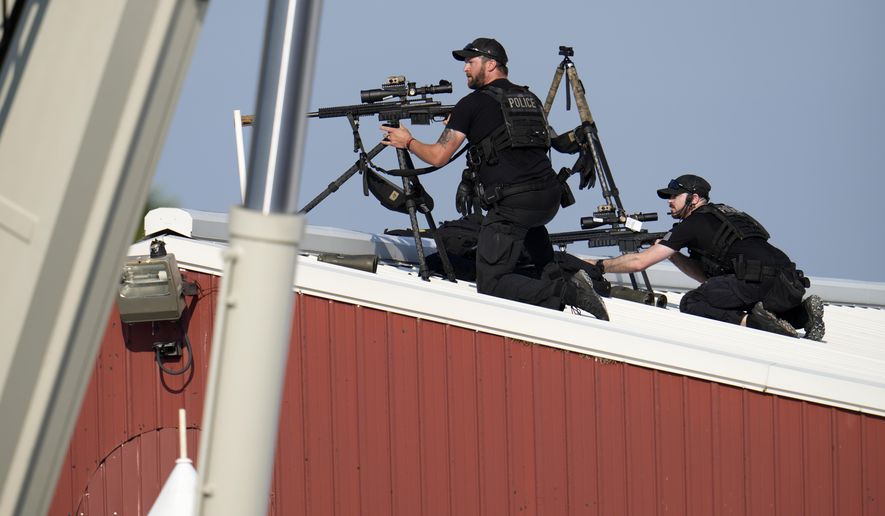

Local law enforcement made 102 radio transmissions about the man who would attempt to assassinate then-candidate Donald Trump at a July 2024 rally in Butler, Pennsylvania, but the U.S. Secret Service never received any of them because it had not established a joint communications room to monitor that traffic, according to a Department of Homeland Security inspector general report made public Thursday.
The 64-page report, dated Tuesday and released by the DHS Office of Inspector General, found the Secret Service’s communications room received only five phone calls and three text messages about Thomas Crooks in the hour before he opened fire. Investigators concluded the gap left Mr. Trump’s protective detail without warning that officers were tracking a suspicious person near the rally site, according to a report by the Department of Homeland Security’s inspector general. WHBL
Local officers’ radio traffic escalated over roughly half an hour: an early transmission around 5:42 p.m. described a young man loitering near the American Glass Research International complex with a rangefinder, while later calls beginning around 6:08 p.m. reported he had been spotted on the roof and was armed. As officers grew increasingly alarmed, the Secret Service’s own communications supervisor and counter-drone operator did not press for the building’s location, the Reuters news service reported, citing the watchdog’s findings. When word finally reached the command post that Crooks had climbed onto the roof, the counter-drone operator searched online for its location rather than asking officers on scene, and was still searching when Crooks fired his first shots, the report found.
People were interested in these podcasts
The rooftop sat just 155 yards from the stage, according to the New York Post, which reviewed the report. Crooks fired eight rounds at 6:11 p.m., grazing Mr. Trump’s ear, killing rallygoer Corey Comperatore and wounding two other spectators before a Secret Service counter-sniper shot and killed him.
The inspector general also faulted the agency for failing to detect a nearly nine-minute drone flight Crooks conducted over the rally site hours earlier, which gave him aerial views of both the stage and the rooftop he later used. The inspector general found the Secret Service’s own counter-drone system was inoperable at the time because the lone technician assigned to it was, in the report’s characterization, “under-trained” and had not tested the equipment beforehand, according to Fox News Digital.
Investigators additionally found the Secret Service failed to share intelligence about a long-range threat with its Pittsburgh field office, did not secure the area outside the security perimeter despite a Pennsylvania State Police plan flagging it as unsecured, and did not use available equipment to block sightlines to the stage even after identifying the AGR complex as a concern. The report noted a Secret Service site agent had proposed positioning trucks to block the sightline, but Trump campaign staff rejected the idea over concerns it would interfere with press photography; a backup plan to relocate the trucks elsewhere was never verified as carried out.
In a statement, the Secret Service said it concurred with the inspector general’s recommendations, noting that many had already been identified and implemented as part of ongoing reforms.
The report is one of several government reviews examining the security breakdowns that nearly killed Mr. Trump, following an earlier bipartisan independent panel report and ongoing congressional inquiries into the shooting.
This article was constructed with the assistance of artificial intelligence and published by a member of The Washington Times' AI News Desk team. The contents of this report are based solely on The Washington Times' original reporting, wire services, and/or other sources cited within the report. For more information, please read our AI policy or contact Steve Fink, Director of Artificial Intelligence, at sfink@washingtontimes.com
The Washington Times AI Ethics Newsroom Committee can be reached at aispotlight@washingtontimes.com.

Please read our comment policy before commenting.