



Don’t miss the full story from our staff writers, whose reportage is the basis of this article.
President Trump’s One Big Beautiful Bill Act marked its first anniversary on Saturday, with Republicans mounting an aggressive campaign to sell the legislation’s tax benefits to voters ahead of a difficult midterm election.
Mr. Trump has emphasized provisions eliminating taxes on tips and overtime pay as wins for working-class Americans, while Senate Republicans have held more than 100 events nationwide since January promoting the law. House Speaker Mike Johnson said American paychecks are bigger and taxes permanently lower because of the bill, arguing that Democrats would have pushed through a $5 trillion tax increase had they prevailed.
People were interested in these podcasts
House Democratic Caucus Chairman Pete Aguilar countered that the law enriches the wealthy while making life harder for working people, accusing Republicans of trying to rebrand what he called a “toxic law” as the “Working Families Tax Cut.”
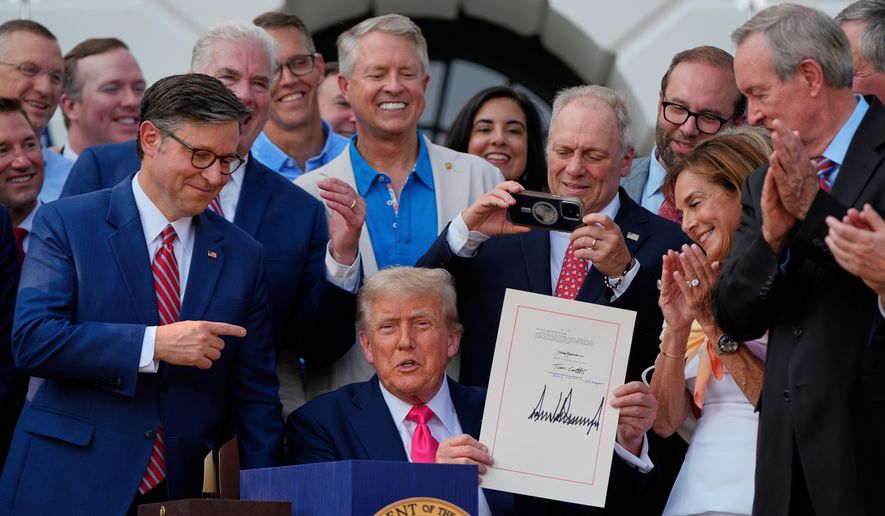
Mr. Trump signed the bill on July 4, 2025, following a contentious legislative fight. The law extended 2017 tax cuts, permanently raised the standard deduction, created tax breaks on tips and overtime, and expanded state and local tax deductions. Tax-advantaged “Trump Accounts” for children launched Saturday, allowing contributions up to $5,000 annually per child, with $1,000 in seed money for children born in 2025. Mr. Trump touted a $250 million investment in the accounts from Micron on social media.
Public opinion has remained skeptical, with Gallup finding in March that 59% of Americans believe their tax burden is too high, and a Fox News poll from April showing 70% feel similarly. Darrell West of the Brookings Institution said the law hasn’t produced clear political gains for the GOP, noting that Iran and affordability concerns are dominating public discourse instead. Still, a Bipartisan Policy Center survey found 56% of filers had some awareness of the law’s tax relief, and a Senate GOP fact sheet cited tens of millions of taxpayers benefiting from various provisions.
Democrats have focused their criticism on Medicaid, pointing to new work requirements and financing changes, though Health and Human Services Secretary Robert F. Kennedy Jr. disputed that the program faces cuts, citing Congressional Budget Office projections showing spending increases through 2036. Separately, KFF data shows Affordable Care Act enrollment fell from 22.1 million in 2025 to 19.2 million in February after the law ended enhanced subsidies, a trend Rep. Frank Pallone cited in criticizing rising premiums and deductibles.
Read more: One year of the One Big Beautiful Bill: Big GOP sales pitch, big Dem resistance
This article was constructed with the assistance of artificial intelligence and published by a member of The Washington Times' AI News Desk team. The contents of this report are based solely on The Washington Times' original reporting, wire services, and/or other sources cited within the report. For more information, please read our AI policy or contact Steve Fink, Director of Artificial Intelligence, at sfink@washingtontimes.com
The Washington Times AI Ethics Newsroom Committee can be reached at aispotlight@washingtontimes.com.

Please read our comment policy before commenting.