


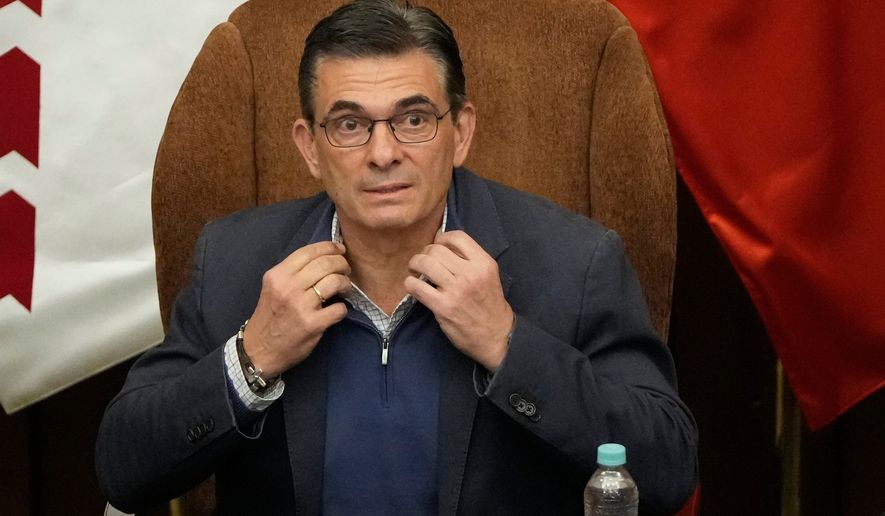

The presidential election of center-right conservative Rodrigo Paz in Bolivia in October ended two decades of political dominance in the South American country by the leftist Movement for Socialism party and its leader, former President Evo Morales.
But after only eight months in office, President Paz’s administration faced mass protests and blockades that ground Bolivia to a halt, forcing him to declare a temporary state of emergency.
Foreign Minister Fernando Aramayo said Bolivia wants to improve relations with the West, particularly the U.S., as it grapples with the demonstrations’ effects.
People were interested in these podcasts
“We are very happy with the process that we are having at present, strengthening our relationship with the United States government,” Mr. Aramayo said Tuesday during a discussion hosted by the Atlantic Council think tank. “We received an immediate response [from the United States] supporting the situation that we’re facing.”
In a June 4 post on X, Defense Secretary Pete Hegseth said the U.S. rejected any attempts to overthrow Bolivia’s current government.
“The United States is watching. Bolivia must not allow itself to fall prey to the old status quo of narco-terrorist dominance in the region,” Mr. Hegseth wrote. “We will continue to support our … partners like Bolivia to ensure that narco-terrorists are deterred from profiting on death and destruction in our hemisphere.”
Some of the protests that rocked Bolivia over the past 50 days were based on problems such as lack of infrastructure, water, public health and education opportunities, Mr. Aramayo said.
“They need responses from public policy, of course, because over the last 20 years, there have been a lot of [concerns] that have not been attended to,” he said.
Bolivia is one of the world’s largest producers of coca leaf and cocaine, behind Colombia and Peru.
Organized crime groups became heavily involved in Bolivia’s domestic politics under previous administrations. When Mr. Paz took office, the South American country’s strikes and blockades had been orchestrated by narco-terrorist elements to protect their illicit and lucrative networks, Mr. Aramayo said.
“They are against democracy and against the rule of law in Bolivia,” Mr. Aramayo said. “The government of President Rodrigo Paz is trying to fight democratically against all these forces that are trying to take us out of the government.”
Mr. Morales expelled U.S. Ambassador Philip Goldberg in September 2008 after the president accused Washington of trying to orchestrate a coup against his socialist government. The George W. Bush administration denied the allegations and responded by expelling Gustavo Guzman, Bolivia’s ambassador to the U.S.
As a sign of improving relations, Mr. Aramayo said Bolivia’s next ambassador to the U.S. will report to Washington by the end of 2026, and he expects Washington to respond in kind.
He said Mr. Paz wants to enhance strategic collaboration with Washington over subjects like agriculture and critical mining technology, along with security concerns.
“I’m talking about Latin America and how we can establish a common agenda to bring security for democracies in the [Western] Hemisphere,” Mr. Aramayo said.
Mr. Paz wants to transform Bolivia from an economically stagnant socialist backwater aligned with narcotics traffickers to a modern, pro-Western nation where business entrepreneurs can flourish, the foreign minister said.
“We are working strongly to recover confidence from the private sector but also from countries and from financial organizations around the world,” Mr. Aramayo said. “We will deliver Bolivia to the world, and we will bring the world to Bolivia.”
Contact the author

Please read our comment policy before commenting.