


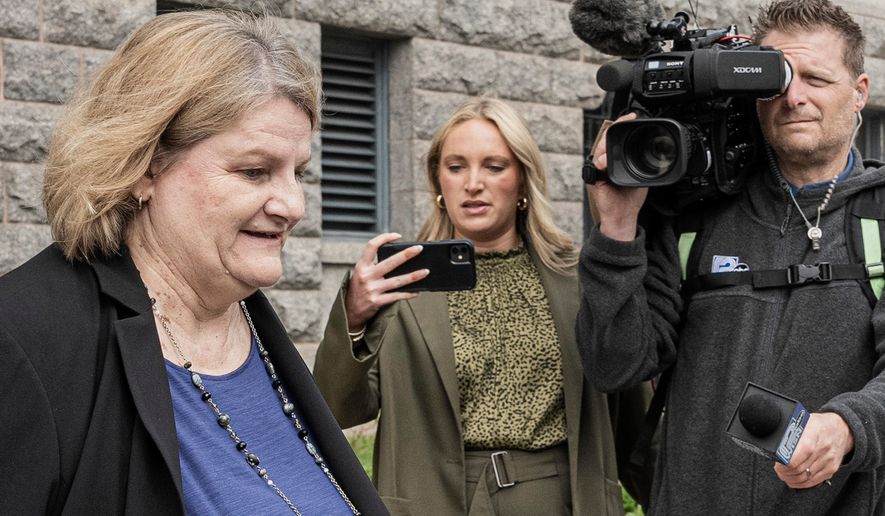

Hannah Dugan, the former Wisconsin judge who tried to help an illegal immigrant evade a U.S. Immigration and Customs Enforcement arrest in her courtroom, was sentenced Wednesday to a $5,000 fine and one year of probation, avoiding any prison time.
U.S. District Judge Lynn Adelman, a Clinton appointee overseeing the case, said she deserved leniency.
“I think this is a situation where an otherwise good person, upset by immigration policies in this country, made a bad decision in the moment,” the judge said.
People were interested in these podcasts
Dugan became a face of resistance to President Trump’s mass deportation crackdown last year after she was accused of trying to distract an immigration arrest team and then cutting short her proceedings against the illegal immigrant and ushering him out a nonpublic door to evade the officers.
The April 18, 2025, incident was an early flash point in the immigration debate. Dugan said she was protecting the integrity of her Milwaukee courtroom and had a duty to assist the illegal immigrant.
A federal jury convicted her on a felony count of obstructing a government proceeding. She was acquitted of a misdemeanor charge of attempting to conceal someone from arrest.
Prosecutors had asked for Dugan to serve time behind bars as a signal to others that interfering with ICE was unacceptable behavior, particularly when it involved a judge charged with upholding the law.
Dugan, 67, argued otherwise. She resigned her county judge’s post and said the government put her through the ignominy of being photographed and “intentionally shamed” during her arrest.
She said she had faced threats and had become “a recluse” as a result.
Dugan remained defiant throughout her case, insisting she was defending her court’s proceedings.
“I have been cast as both a scofflaw and a hero. I am neither. I am a public servant who’s just trying to do my job,” she told the courtroom Wednesday, according to The Associated Press.
Brad Schimel, acting U.S. attorney in eastern Wisconsin, called Dugan’s behavior “reckless” and said there “needed to be serious consequences.”
Dugan was overseeing her courtroom when Eduardo Flores-Ruiz, an illegal immigrant, showed up for a hearing on domestic violence charges. He had been accused of getting violent with housemates who objected to him playing music too loudly.
Several of the victims were in Dugan’s courtroom and said they were waiting for the hearing when she cut proceedings short and ushered him out a nonpublic door.
A federal agent had to chase Mr. Flores-Ruiz through the rain and in and out of moving traffic on the streets outside the courthouse.
Administration officials said the chase needlessly endangered the migrant, federal agents and bystanders.
The Department of Homeland Security said Mr. Flores-Ruiz had a lengthy criminal record, including charges of strangulation, suffocation and battery. He had been deported before and sneaked back into the country.
He pleaded guilty in September to illegal reentry and was sentenced in November to time served. He was then deported.
Dugan is the second judge to face accusations of interfering with ICE.
In 2018, a twice-deported illegal immigrant evaded an ICE arrest after he was allowed to duck back into a Massachusetts courthouse lockup rather than be detained by ICE officers. He then escaped out a back door.
Judge Shelley Richmond Joseph was accused of facilitating the illegal immigrant’s evasion. The Justice Department, under the Trump administration at the time, charged her.
In 2022, with President Biden in office, the Justice Department agreed to dismiss the case if Judge Joseph referred herself to state judicial disciplinary proceedings.
Among those who accused Judge Joseph were an interpreter and a lawyer who were present in the courtroom and said the judge was involved.
The state investigator in the misconduct proceeding discounted those two witnesses as not credible and instead accepted Judge Joseph’s claim that she was unaware of the escape plan.
The underlying issue in both cases is ICE’s ability to make immigration arrests at courthouses.
The Biden administration imposed restrictions on the practice.
The new Trump administration has lifted those limits, sparking fierce pushback from immigration activists and liberal figures in the legal world, including judges such as Dugan who say ICE’s presence interferes with their own cases.
In New York, a federal judge upheld that state’s law barring civil immigration arrests at state courthouses.
Contact the author


Please read our comment policy before commenting.