



OPINION:
After 40 years of covering American politics, I’ve seen presidents spin, deflect and dodge with remarkable skill. But what unfolded during President Trump’s “Meet the Press” interview with Kristen Welker on Sunday wasn’t spin.
It was something far more troubling: a president who seems genuinely convinced that reality bends to whatever he says it is.
The exchange began simply enough. Ms. Welker pressed Mr. Trump on one of the most consistent promises of his political career: that he would keep America out of new wars.
“So, you’re saying you didn’t break your promise, and yet, Mr. President, in your first term, you held to that promise, and it was so fundamental to who you were as a candidate, to a first-term president. What changed? Because you insisted, ’No new wars’?” Ms. Welker asked.
Mr. Trump’s response, delivered with a completely straight face, was surreal.
“Look, look. First of all, I didn’t guarantee no war. Why would I have built the strongest military in the world? I built our military. I inherited a terrible military. We had no equipment. We had nothing. I built a tremendous military. When you say I promised, I didn’t promise anything.”
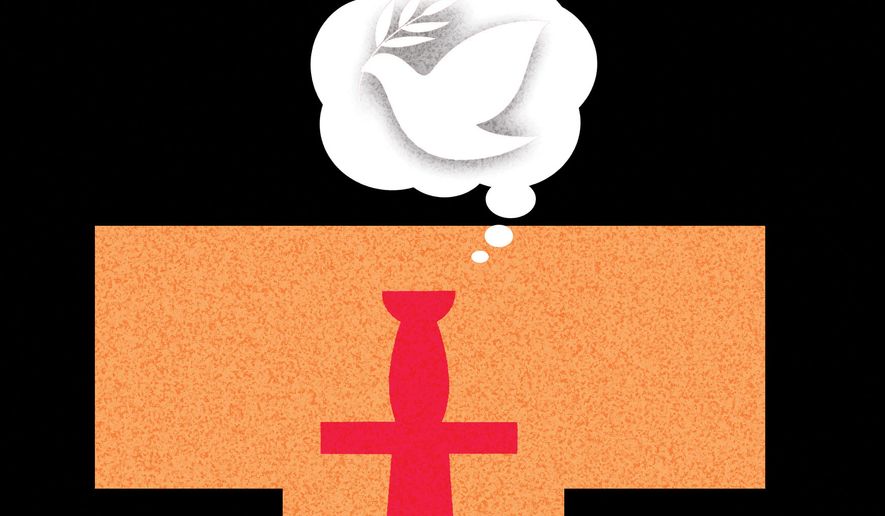
For those of us with long institutional memories, the brazenness of that claim is staggering. Because Mr. Trump didn’t just hint at peace — he built his entire political identity around it, likely winning millions of votes from Americans sick of endless war in faraway lands.
Across three campaigns, he returned to the theme again and again, with the kind of repetition that suggests genuine conviction.
Consider the record. These are all direct quotes:
- “I am the candidate of peace. I am peace.”
- “You know, we’ll stay around the country for 15 years, just bomb the hell out of everybody, make everybody miserable. Nobody knows why we’re there, you know. The wars that never end.”
- “These endless wars that we’ve been in, I’ve gotten us out of so many.”
- “We don’t want to get into wars.”
- “We’re tired of fighting. I’m the only president in the last 84 years that didn’t start a war.”
- “Under Trump, we will have no more wars.”
- “Remember, I’m the president of peace. They said, ’He will start a war.’ I’m not going to start war. I’m going to stop wars.”
- “We will measure our success not only by the battles we win, but also by the wars that we end and perhaps most importantly, the wars we never get into.”
That is not the record of a man who made no promises. That is the record of a man who made peace the cornerstone of his political brand.
When Ms. Welker pressed him further on the current military engagement, Mr. Trump reached for a semantic escape hatch. “They put up a blockade, and so we blockaded them. And we have the ultimate blockade. I don’t consider that a war, but if you want to define it as such, I guess you can,” he said.
“Well, how do you define it?” Ms. Welker asked.
“I don’t define it at all. I don’t think about it. I just do what I have to do,” Mr. Trump said.
And there it is. When the facts become inconvenient, simply refuse to categorize them. If you don’t name it, it isn’t real.
This pattern extends well beyond foreign policy. When Mr. Trump attended Game 3 of the NBA Finals, he was, in the words of Washington Times White House reporter Jeff Mordock’s pool report, “thunderously booed when he was shown on the jumbotron during the national anthem. It was loud and long.”
Mr. Trump’s own account? “I thought it was great. I mean, I thought it was amazing, actually. … It was, I think, mostly cheers.”
Boos become cheers. Wars become blockades. Promises become things that were never said.
George Orwell saw this all coming. In “1984,” he wrote: “The Ministry of Peace concerns itself with war, the Ministry of Truth with lies, the Ministry of Love with torture and the Ministry of Plenty with starvation. These contradictions are not accidental, nor do they result from ordinary hypocrisy; they are deliberate exercises in doublethink.”
Doublethink — the capacity to hold two contradictory beliefs simultaneously and accept both as true — is no longer a fictional concept confined to dystopian literature. It has found a home in the Oval Office.
The real danger isn’t that Mr. Trump is lying. Politicians lie. The danger is that he may not know the difference anymore.
• Joseph Curl covered the White House and politics for a decade for The Washington Times. He can be reached at josephcurl@gmail.com and on X @josephcurl.
Follow the author


Please read our comment policy before commenting.