



OPINION:
In December, San Antonio Spurs big man Victor Wembanyama explained to reporters that the Spurs played a style of “pure and ethical” basketball.
“In modern basketball, we see a lot of brands of basketball that don’t offer much variety in dangers they propose to the opponents,” he said. “Lots of isolation ball and, sometimes, kind of forced basketball. We try to propose a brand of basketball that can be described as more old school sometimes; the Spurs way as well. So it’s tactically more correct basketball, in my opinion.”
Well, I’m not sure even Bernie Madoff would have tried to describe what the Spurs did in the second half as “ethical” in their historic 107-106 collapse Wednesday night at the hands of the New York Knicks in Game 4 of the NBA Finals at Madison Square Garden.
Dishonorable, unprincipled, reprehensible, maybe. But taking 17 three-point shots and sinking only three of them when you already have a 29-point lead? Not ethical basketball, no.
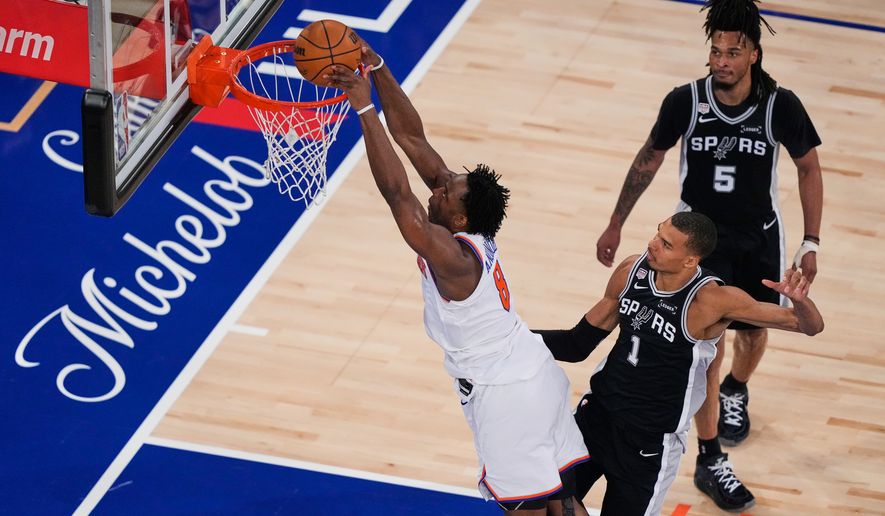
In fact, it was everything that Wembanyama held his nose about in that December lecture. And the winning shot for New York — a tip-in by O.G. Anunoby of a missed Jalen Brunson shot with 1.2 seconds left to give the Knicks the one-point win — was all that Wembanyama praised.
In today’s NBA, there are few things that are more old school than crashing the boards for an offensive put back. It’s something Dave DeBusschere would have done during the Knicks championship glory days of the early 1970s.
It could barely be called a shot — more like a fingertip. But the talk is now it may be the greatest shot in the history of the franchise.
“I don’t know if there was a play bigger than any other play in the history of Knicks basketball,” New York coach Mike Brown said, still caught up in the moment that rocked the Garden a few minutes earlier. “That has to be the most iconic shot in the history of New York basketball.”
We shall see. The Knicks will take a 3-1 lead in the best-of-seven series to San Antonio for Game 5. If they go on to win, then yes, finally there will be something worthy this team will have accomplished to take its place among the accomplishments of DeBusschere, Willis Reed, Walt Frazier and others from the 1970 and 1973 championship squads.
If the Spurs come back and win the series? It will take its place with Steve McNair’s one-yard short final drive for the Tennessee Titans in the 2000 Super Bowl and other heroics that wound up footnotes in defeat.
A third franchise championship, and the first since 1973, might be enough to make the “tip-in” the greatest shot in Knicks history.
As great as those glory years were, the only defining shot came at the start of Game 7 in the 1970s finals, when Reed, playing on one leg with a torn thigh muscle, hit the first shot of the game against the Los Angeles Lakers. Then he hit the second, and that was all he would score in limited play. New York would go on to win the game 113-99, led by Frazier’s all-time Game 7 performance of 36 points and 19 assists.
But that was such a singular iconic moment — Reed’s most important shot may have been the first one he sank in warmups after limping out of the locker room while the Lakers all stopped and watched him — there is nothing comparable to that.
Which would leave Anunoby’s tip-in with a place all of its own — celebrated like Mookie Wilson’s ground-ball dribbler for the Mets in Game 6 of the World Series or David Tyree’s helmet catch for the Giants in Super Bowl XLII.
For right now, I think it’s a soul-crushing play for the Spurs.
“What’s going through my mind right now? I think it’s going to go one of two ways. … A bad one and a good one,” Wembanyama said. “The bad one would be giving up. The good one would be getting stronger through this, getting more together. I know this is what we’re going to do.”
I don’t think the Spurs have it in them.
Anunoby’s tip-in was about San Antonio’s second-half self-destruction more than New York’s defensive pressure.
Yes, the Knicks capitalized on it, but I saw an immature team cave under the pressure of too much success — a record 14 three-pointers in the first half — not one capable of getting stronger from their self-induced failure.
• Catch Thom Loverro on “The Kevin Sheehan Show” podcast.
Follow the author

Please read our comment policy before commenting.