


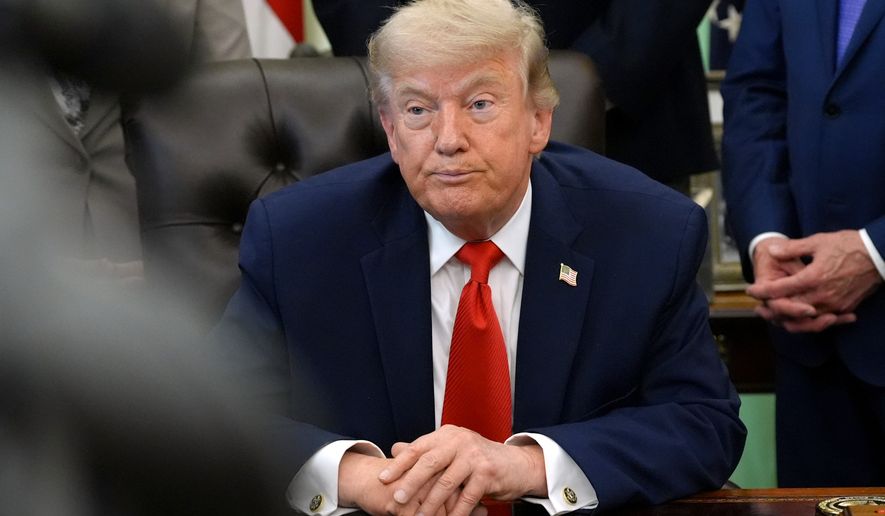

President Trump is throwing his weight behind a House Republican-led push to enact a third filibuster-proof bill of GOP priorities ahead of the midterm elections this fall.
There is just one problem: Senate Republicans are far from interested in repeating the agonizing budget reconciliation process without a unifying legislative goal that is guaranteed to earn enough GOP votes to pass both chambers.
“At the moment, I’m not sure what that is,” said Senate Majority Leader John Thune, South Dakota Republican.
People were interested in these podcasts
Mr. Thune’s comments came after the president’s Wednesday social media post pressing for a third budget reconciliation package focused on “a generational investment” in the military and his long-stalled election integrity bill, the SAVE America Act.
“I am hereby calling on Republicans in Congress to IMMEDIATELY advance and pass the forthcoming $350 Billion Reconciliation Bill (Recon 3.0) — which, at the request of our Great Department of War — will include THE SAVE AMERICA ACT as well,” Mr. Trump posted on social media. “No games, no delays, and no weak compromises! Do this ASAP.”
House Republicans have been working on the reconciliation 3.0 effort even as the second one made its way through Congress.
The reconciliation 2.0 bill, which Mr. Trump signed into law on Wednesday before his late-night pitch on a third party-line package, provides $70 billion to fund immigration enforcement agencies through the remainder of his presidency.
GOP leaders designed that bill to be “narrow” and easy to pass, but it was held up for weeks over political issues of Mr. Trump’s own making.
Republicans pushed back against his administration’s request for Secret Service funding to help secure the new White House ballroom and teamed up with Democrats in an effort to kill the $1.8 billion Anti-Weaponization Fund he announced as part of an IRS lawsuit settlement with the Justice Department.
Sen. John Kennedy, Louisiana Republican, said he advocated for his party to pass more of its priorities through reconciliation earlier in the year.
While he’s still willing to give it a shot, he acknowledged a fundamental reality of Congress: “The closer you get to the midterms, the harder it is to get anything around here done.”
The midterms are also a reconciliation selling point for Republicans who want to enact policies to counter Democrats’ messaging that the Trump-led Congress has done nothing to help Americans afford rising costs.
Republicans are campaigning on their first reconciliation bill, rebranding the One Big Beautiful Bill Act as “the working families tax cut” package to emphasize policies like no tax on tips and overtime.
House Republicans have batted around numerous policy ideas for inclusion in reconciliation 3.0, including measures to make health care and housing more affordable.
Speaker Mike Johnson has homed in on tackling fraud, waste and abuse in government as a key theme of the 3.0 effort. The Louisiana Republican points to a Government Accountability Office estimate that the federal government loses as much as $500 billion to fraud every year.
“That’s $4,000 per American household every year totally wasted. We could use that money so much better,” Mr. Johnson said, calling fraud an “invisible tax.”
Mr. Trump did not mention the anti-fraud effort in his social media post pushing for a third reconciliation bill, but the speaker has said the White House is 100% behind the effort.
The president’s pitch on reconciliation 3.0 is that it is the “only path” to realizing his goal of a $1.5 trillion military budget.
“We will defend the Homeland with the Golden Dome, launch the unstoppable Golden Fleet, dominate the skies with the F-47 and B-21, supercharge our ammunition stockpiles, and achieve total Space Force and Drone Dominance!” he said.
The White House has presented its defense budget request as a two-part effort, asking Congress to approve $1.15 trillion in discretionary appropriations and the remaining $350 billion in mandatory appropriations through the filibuster-proof reconciliation process.
Senate GOP appropriators have warned administration officials against that strategy.
Sen. Mitch McConnell, Kentucky Republican who chairs the defense appropriations subcommittee, said during a hearing with Air Force leaders that it is “especially mystifying” that the administration would request one-off reconciliation spending to fund multiyear procurement contracts for critical munitions, half of the F-35 program, the Golden Dome and drone dominance initiatives.
“The need to budget for them annually is right there in the name,” he said. “But it’s more than just a contradiction in terms. It’s also a recipe for major disruptions in the very possible event that party-line reconciliation fails.”
Mr. McConnell is one of the Republicans opposed to the other priority Mr. Trump is pushing for in the third reconciliation package: the SAVE America Act.
The election bill, as it passed the House, requires proof of citizenship to register to vote and photo ID to cast a ballot, plus forces states to clean up their voter rolls using a federal citizenship database.
Mr. McConnell and Sen. Lisa Murkowski, Alaska Republican, oppose the bill because they view it as a move toward federalizing elections that should remain under control of the states.
Republican Sens. Susan Collins of Maine and Thom Tillis of North Carolina have opposed the more expansive version Mr. Trump is pushing that would also ban states from automatically sending out mail-in ballots to all registered voters, limiting absentee voting to active duty military and people with disabilities, illness or conflicting travel.
Mr. Trump also includes provisions to ban biological men from playing in women’s sports and “transgender mutilation” procedures on children in his preferred version of the SAVE America Act.
Several proponents of the SAVE America Act have argued that rewriting the measure to comply with the budget reconciliation rules would take away any real teeth from the requirements it’s trying to impose.
Mr. Thune pointed to that and the few GOP senators opposed to the bill as reasons to be skeptical of the ability to pass the SAVE America Act through reconciliation.
“It all is contingent on the votes,” he said.
Contact the author


Please read our comment policy before commenting.